
Folding method and kiri-origami design
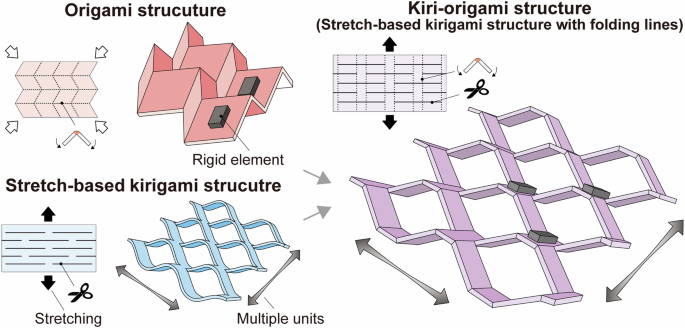
Kiri-origami or origami structures can describe the folding process from a flat state, assuming the geometric constraint that the panels do not deform and the hinges rotate frictionlessly. This model is generally called the “rigid origami” model32,37, In the case of a system that can hold the geometric constraint, such as a system assembled with rigid plates and pin joint hinges, the limited deformation by the geometric constraint occurs regardless of the method of the application of tensile force. However, when using a kiri-origami or origami structure as a stretchable electronic substrate, the panels cannot be regarded as rigid bodies, and the hinges have elastic repulsive forces against folding and other deformations. In this paper, we call the model “elastic origami” model in contrast to the rigid origami model for convenience. In the case of the elastic origami model, various factors, such as warping of the panel, torsion of the hinges, and stretching deformation of the material itself, cannot be ignored. It is unclear whether the same deformation as in the rigid origami model occurs in kiri-origami structures using the conventional simple stretching method where the edges are directly clamped and stretched uniaxially. In contrast, devices using kiri-origami/kirigami/origami structures use folded shapes. Therefore, folding up the structures as designed within the fabrication process is crucial for realizing such devices. In other words, a folding method should realize a deformation similar to that of the rigid origami model for the elastic origami model, that is, maintaining the panels flat and limiting deformation within the hinges. Figure 2(a) shows the deformation of a kiri-origami structure sample uniaxially stretched with both edges as fixed ends. The sample should be considered as an elastic origami model. The green box shows the deformation of the rigid origami model of the same design, which differs from the actual deformation of the sample. The difference between the actual deformation and the deformation of the rigid origami model is caused by two factors: the difference in the clamping edge length and the difference in the entire shape. In the rigid origami model, the edges corresponding to the clamping edges are free ends, whereas, in reality, the edges are fixed ends to apply tension. In particular, the edge of a kiri-origami structure is constrained in the clamping edge direction, preventing deformation as designed. In addition, the entire structure results in a distorted shape because the transmission of the tensile force is nonuniform in the entire structure. In contrast, the rigid origami model results in a rectangular shape. Therefore, we propose a folding method using buffer structures and biaxial extension, as shown in Fig. 2(b). The buffer structures connect the edges to the stage. The kiri-origami structure is connected through the buffer structure, similar to the free ends, and can transmit tensile force. After applying tensile force, the kiri-origami structure’s edge length can match the rigid-origami model’s edge length. Next, biaxial extension makes it possible to use a more uniform and desired tensile force for folding, making the entire shape closer to a rectangle. The introduction of buffer structures and biaxial extension produces uniform deformation in the entire structure and matches the aspect ratio of the respective units of the sample to the aspect ratio of units of the rigid origami model, as shown in Fig. 2(c). When the aspect ratio matches, the spatial configuration of the panels is forced, the folding shape is expected to become like the rigid origami model in the sample of the elastic origami model, and the deformation is limited within the hinges. Next, Fig. 2(d) shows the kiri-origami structure used to evaluate the folding methods. This structure has a mutual orthogonal cutting line pattern and a triangular joint panel consisting of two folding lines connecting the square panels formed by the cutting lines. This paper calls such a structure a two-folding-line type mutual orthogonal cut. The mutual orthogonal cut is the most typical two-dimensional kirigami pattern, and many studies have focused on this cutting line pattern16,32,33,34, The deformation varies mainly depending on the structure of the joints, and patterns containing one to three folding lines can be categorized as kiri-origami structures32,33, In the case of the two-folding-line type, the structure is known to deform by one degree of freedom in the rigid origami model and deform auxetic for some range of the shape of the triangular joint panels32. Figure 2(d) shows the folding process of this structure. First, local buckling deformation around the cutting lines is induced by tensile force, the structure starts to fold up from a flat state, and a square panel rises. Then, the slit opens as the panel rises and rotates as it is stretched, and the panel then gradually lays down and finally folds up into a Z-shape around the joint panel (see Supplementary Note 1).

a Deformation of a real kiri-origami sample with the simple folding method: clamping as fixed ends and uniaxial extension, compared with the target deformation of the kiri-origami structure calculated by rigid origami model. Scale bar: 10 mm. b Our proposed folding method: clamping with buffer structure and biaxial extension. c The way to fold up the hinges. Adjusting the size of the unit forces the panels to be placed at the appropriate location and the deformation is limited within the hinge region. d Folding process of the kiri-origami structure.
Evaluation of the effect of buffer structures
The design of the buffer structure is shown in Fig. 3a. This buffer structure is based on the parallel cutting line pattern38. When a tensile force is applied, it extends and behaves like a spring. Every column (kirigami string) is disconnected from each other in the clamping edge direction and is connected to the edge of the main body of the kiri-origami structure and the clamping edge. To prevent unnecessary moments, the end of the kirigami string is connected to the center of the panel. The buffer structure initially takes a trapezoidal shape as the entire structure and becomes rectangular after stretching. It is possible to have a deformation from a rectangle shape to a trapezoidal shape38. Still, in the case of an auxetic structure, the deformation tends to be unstable due to compressive forces in the clamping edge direction. In addition, the kirigami string can be based on a meander cutting pattern33,36. the extensional rigidity of the string is reduced, and the deformation tends to vary. Therefore, we selected a buffer structure that has an overall shape transitioning from trapezoidal to rectangular and strings with moderate extensional rigidity and stable deformation due to the high symmetry of the string itself. The trapezoidal shape is defined as follows. The length of the inner side is the initial edge length of the kiri-origami structure, and the length of the outer side is the edge length at the target deformation point. Every edge unit of the kiri-origami structure is connected to the kirigami string. The number of repetitions in the pitch direction should be as small as possible. Still, the edge angle of the trapezoidal shape should be manageable because the deformation of the units near the corner becomes unstable at the initial state of folding. In this chapter, the target deformation point is εx = 0.200 and εy = 0.143, as shown in Fig. 3a below. We designed the buffer structure so that the pitch repetition is twice.

a The mechanism of the buffer structures. Buffer structures are based on parallel cut deform as a spring. The length of the stage side matches the target deformation point of the kiri-origami structure. The curve is calculated from the rigid origami model. b Δεx and Δεy distribution analysis from the top view image. The sample without the buffer structures could stretch until εx = 0.08, and the sample with buffer structures at the same deformation point: εx = 0.08 and target deformation point: εx = 0.20, εy is adjusted along the target deformation curve. Scale bar: 10 mm. c Detailed analysis of Δεx at the center row.
Figure 3b shows the effect of the buffer structures. The buffer structures resolved the deformation constraint in the clamping edge direction by adjusting the natural edge length to the designed length as in the rigid origami model. Consequently, the range of possible stretching deformations and the uniformity of deformations mainly improved. For comparison, we prepared a sample without the buffer structures and a sample with the buffer structures. We stretched the sample and adjusted the amount of extension of the two axes, maintaining εx and εy of the central standard unit as theoretically expected. The x and y axes were placed in the direction of the translation stages, and εx and εy were calculated by measuring the extension lengths in the direction parallel to the axes for the diagonal square panel pairs on the unit. The extension length was measured based on a marking point placed at the center of the square panels. Figure 3b shows the top views of the samples and the distributions of strain errors Δεx and Δεy by a unit. In the case without buffer structures, the maximum extension until rupture was εx = 0.08, and the image was taken immediately after the rupture. Meanwhile, in the case of the sample with buffer structures, the structure could be stretched until the target deformation point (εx = 0.200, εy = 0.143). For comparison, we show a sample with a buffer structure at εx = 0.80. Regarding stretchability, the sample without the buffer structure did not exhibit its stretching potential. Excessive stretching occurred locally in the units near the corners, resulting in fracture. Moreover, the fracture strain of the entire structure became small, making it impossible to proceed with folding. In comparison, the proposed buffer structures did not cause local rupture at the corners, and the entire structure could be folded up to the target deformation point. In terms of uniformity, the Δεx distribution was extensive in the sample without buffer structures, εy was locally depressed at the corners when εx = 0.20 in the sample with buffer structures, and the Δεy distribution was more uniform than the Δεx distribution when εx = 0.08. First, without buffer structures around the y-directional edge area, Δεy decreased. This phenomenon occurred mainly because the end units were constrained in the x-direction by the connection with the y-axis stage, resulting in a significant negative value of Δεx, and the influence reached the central area. Consequently, the end units in the x-direction were overextended relative to the overall x-directional extension, especially the corner unit, which was more overextended and raptured because of the deformation constraint from the surrounding units. The localized depression in the corners of Δεy in the case of the sample at εx = 0.20 with buffer structures was considered to be caused by the difference in the extension of each kirigami spring when the buffer structure transitions from a trapezoidal shape to a rectangular shape. Assuming that the buffer structure changes from a trapezoidal to a rectangular shape, the outer springs have a longer initial length (see Supplementary Note 2); thus, their actual extension is smaller than that near the center. In the case of εx = 0.08, the buffer structure was still trapezoidal. Therefore, the difference in extension between the inner and outer springs was slight and did not appear to be a significant depression at the corners. The depression of Δεy was slight for εx = 0.08 as εy itself was small, as shown by the ideal deformation curve in Fig. 3a.
Figure 3c shows the detailed measurement results of Δεx in the center row for each condition. In all conditions, units 2 and 9 offered a higher value because the outermost unit had a smaller value because of its connection with the kirigami spring. In the case of εx = 0.08 without the buffer structures, one inner unit (units 2 and 9) marked the most significant value near Δεx = 0.03, and internal units had relatively large values, such as Δεx = 0.01. Meanwhile, when εx = 0.08 with the buffer structures, Δεx = 0.01 to 0.02 for units 2 and 9, which was half of that for the nonbuffered sample, and Δεx was less than 0.005 for the inner units. In this area, the error was almost negligible. Finally, at the target point of εx = 0.20, the excess deformation in units 2 and 9 was the most successfully suppressed, all units were marked lower than Δεx = 0.01, and the values were entirely uniform.
Evaluation of the effect of biaxial extension
Figure 4a shows the results of measuring the strain in the central units of the test samples. We prepared the sample under uniaxial and biaxial extensions. The buffer structures were installed in both structures. The x– and y-stage movements were previously obtained before the measurement using some samples (see Supplementary Note 3). In the case of the uniaxial sample, the deformation was nonauxetic (see Supplementary Movie 1 and 2). The difference from the deformation path of the rigid origami model became more significant with stretching. Finally, εy converged into −0.05. In the case of the biaxial sample, the sample could deform auxetically along the deformation path of the rigid origami model and reach the terminal of the path (see Supplementary Movie 3). The maximum error (N = 5) was σ = 0.0035 in the x-direction and σ = 0.0024 in the y-direction. The error in the x-direction tended to be more significant in the first half of the folding process, whereas the error in the y-direction tended to be more significant in the latter half. The results show that the aspect ratio can be enforced to correctly match the ratio of the rigid origami model using the biaxial extension.

a Adjusting of the actual deformation curve to the curve of the rigid origami model. The stage travel distance is measured in advance. b The warping of the center panel. The warping is defined as Δh/Δh0, Δh is the displacement between the maximum and minimum height point from the reference plane based on the near the center of the panel. Δh0 is at the target deformation point, and εx is fixed at 0.20 while εy changes. c The folding process of the samples. The top view shows the entire structure (Scale bar: 10 mm) and the perspective view shows the unit (Scale bar: 1 mm). The error bars represent 1 SD (N = 5).
Figure 4b shows the warpage of the panel measured at some deformation points on a straight line at εx = 0.20 in Fig. 4a by adjusting the length of the unit in the biaxial sample. We measured the three-dimensional shape data of the panel in the center of the sample and obtained the height difference Δh between the highest and lowest points on the square panel without the triangular joint panels. The height was vertical against the panel, and the reference plane was obtained from a circular area with a diameter of 1/3 of one side from the center of the panel. Panel warpage is defined as the ratio Δh/Δh0. Δh0 is the Δh on the ideal deformation point (εy = 0.143). Δh/Δh0 is 1.43 at εy = 0.00 and decreased into Δh/Δh0 = 0.95 and 0.93 at εy = 0.125 and 0.175, respectively. Overall, there was a clear tendency for the warpage to decrease as the deformation approached that of the rigid origami model. Because there was a trade-off, less warpage of the panel meant more accurate folding of the hinge. As described in Fig. 2c, we showed that a precise folding up of the kiri-origami structure can be induced by matching the aspect ratio of the units to the ideal ratio. The folding processes are shown in Fig. 4c.
The kiri-origami structure in Fig. 4a deformed away from the theoretical path in the case of uniaxial extension because the deformation was similar to the nonauxetic deformation of the one-folding-line type mutual orthogonal cut (see Supplementary Note 1). It is known that a mutual orthogonal cut without a folding line folds up as a one-folding-line type deformation under uniaxial extension34. When the panel was square in a one-folding-line pattern, the entire kiri-origami structure could extend without shear only in the case of a kiri-origami structure design where the hinge was inclined at 45° from the cutting line. Although the design did not overlap with the two-folding-line design of this paper, the elastic origami model allows one-folding-line type deformation, which occurs in reality as nonauxetic deformation. In other words, in a two-folding-line type mutual orthogonal cut pattern, the uniaxial tensile force acts powerfully to fold one of the hinges but not sufficiently to fold the other hinge. As the device itself becomes similar to the rigid origami model and the geometric constraints strengthen, the second hinge can be folded up, overcoming the elastic repulsive force of the hinges. When the panel is not so rigid, the way to fold up the second hinge includes increasing the flexural rigidity ratio between the hinge and panel, aiming to reduce the elastic repulsive force, or applying tensile forces effectively to fold the hinge. The folding method used in this paper was the latter way. The problem where the applied tensile force cannot be used for folding of hinges in the elastic origami model, even though it is theoretically possible to fold up by applying uniaxial tensile force in the rigid origami model, is not limited to the two-folding-line type mutual orthogonal cut but can be observed in other kiri-origami structures. The kiri-origami structure can be folded into a rigid origami model shape using our folding method based on geometric relationships alone, without mechanical analysis. Furthermore, the folding method needs only external devising outside the kiri-origami structure. Thus, the device shape, layer composition, and circuit pattern can be designed more freely than other approaches that impose strong design constraints on the internal side of the device to keep the device itself as a rigid origami model. In addition, as structures become a large number of units and large area, the latter approach, as in this paper, becomes more efficient than the former approach because the requirement devises only on the edges, not the entire structure.
Demonstration of a stretchable electric device using the kiri-origami structure
To demonstrate the adaptivity of our folding methods to electronic devices, we made a simple LED matrix display using a kiri-origami structure. We folded up the substate after mounting the LEDs. Figure 5a shows the overview and the hinge shape. To confirm the foldability, the hinges are arranged using simple slits to reduce flexural rigidity, just as in Fig. 3 and 4. The slit in the hinge was sufficiently small relative to the main cut lines to act only as a simple folding hinge. A possible method to increase the difference in flexural rigidity is to make only the hinge portion thinner7. In addition, it is likely that the performance for repeatable deformation can be improved by locating the copper layer at the neutral plane of the hinge8. The display had flat regions, so there was less risk of isolation using rigid LEDs than kirigami devices or elastic substrates. Like the kirigami structure, it could fold up simultaneously regardless of its numerous units. It successfully folded up 512 hinges after 145 LEDs were mounted. Folding proceeded along the theoretical path up to the point εx = 0.20. As the enlarged figure shows, the flatness of the panel was maintained. In this demonstration, the weight of the LEDs had little effect on the folding process. On the other hand, if the entire device has a larger number of units, a basement below the device should be installed to reduce the deflection of the entire structure. The LEDs are connected in parallel, allowing each column to light up, and by applying an active matrix, etc., it is possible to reduce the interconnection. Finally, as shown in Fig. 5b, the electrical performance was maintained before and after folding. Our folding method can thus fold a kiri-origami structure with electric elements.

a The folding state of the LED display using the kiri-origami structure with 145 LEDs and 512 hinges. Scale bar: 10 mm. The result of the shape measurement shows the hinges at the triangular joint panel. Scale bar: 0.2 mm. b The demonstration of stretching deformation and the shape of the unit mounting LEDs.
link


More Stories
Researchers Reveal Molecular Secrets of Flexible Electronics
Growth Outweighs Uncertainty for Flexible and Printed Electronics: OE-A Survey
SEMI FlexTech Announces 2026 FLEXI Award Winners