
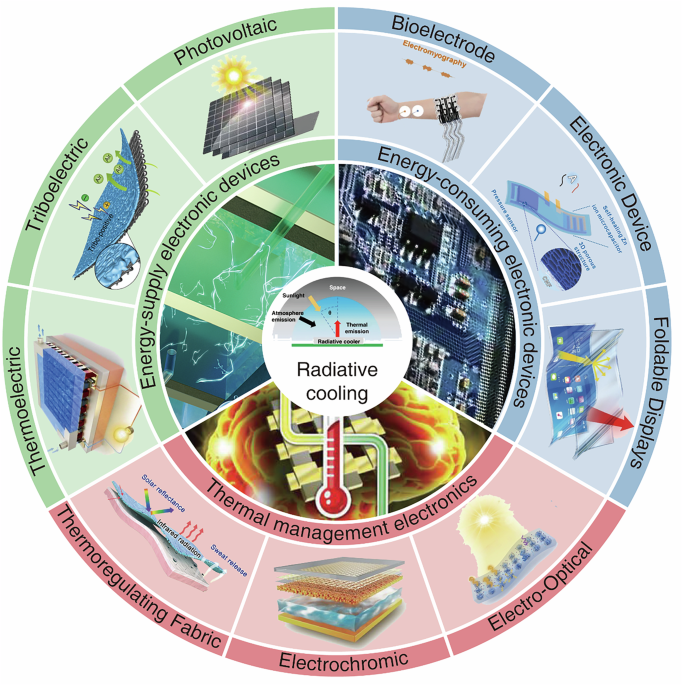
Power supply electronic devices
Thermoelectric devices
The Seebeck effect is the physical basis of thermoelectric energy conversion. Its essence lies in the carrier transport mechanism driven by a temperature gradient across the interface of heterogeneous conductors43. When two semiconductor materials form a closed loop, the hot-end carriers (electrons/holes) are excited by lattice thermal vibrations and diffuse toward the cold end along the temperature gradient (ΔT)44,45,46. In this process, the difference in the Fermi level leads to a self-consistent balance between the carrier concentration gradient and the thermal diffusion rate, establishing the steady-state open-circuit voltage through the thermoelectric potential equation (V = αΔT, where α is the material’s intrinsic Seebeck coefficient)47. The output power density of the thermoelectric device is positively correlated with the square of the temperature difference (\({\rm{P}}={\left({\rm{S}}\Delta {\rm{T}}\right)}^{2}{\left(4{\rm{R}}\right)}^{-1}\))48. Here, S denotes the Seebeck coefficient and R represents the resistance. This characteristic makes the natural thermal gradient between human skin (32–36 °C) and the environment a potential energy source for wearable thermoelectric systems49,50. Although the human body-driven temperature difference is significantly smaller than that from industrial waste heat51, its continuous and stable operation and natural compatibility with wearable scenarios (requiring no external heat source or moving parts) provide a unique self-powered advantage for low-power electronic devices29,52,53.
However, the ambient temperature in tropical/subtropical regions can reach above 35 °C in summer. Superimposed solar radiation reduces the effective temperature difference between the human body and the environment, leading to decreased device power output54,55. For this reason, radiative cooling technology has shown unique advantages. Through spectrally selective regulation, the cold-end temperature of the thermoelectric device can be reduced without energy consumption, enabling greater output power. Based on this principle, Jiang et al. proposed an expandable self-cooling nanofabric consisting of two layers of expanded polytetrafluoroethylene (ePTFE) membranes sandwiching a layer of SiO₂ nanofiber membrane (Fig. 5a). It exhibits high solar reflectivity (~0.94) and mid-infrared thermal emissivity (~0.94). Its cooling performance was verified by indoor and outdoor tests. Under direct sunlight, the simulated skin temperature was reduced by an average of ~10.3 °C. The actual average cooling power during outdoor testing reached ~73.69 W m⁻². In addition, the fabric provides a stable temperature gradient for the wearable ionic thermoelectric generator (iTEG), enabling human body heat recovery56.

a Scalable self-cooling nano fabrics56. Copyright 2025, Elsevier. b Janus-structured stretchable thermoelectric skin57. Copyright 2023, John Wiley and Sons. c Bioinspired all-day radiative cooling TEG50. Copyright 2024, Elsevier. d Flexible TEG-energy storage integrated system48. Copyright 2021, Elsevier.
To increase the temperature difference across the device for higher output power, Jung et al. proposed a stretchable, breathable thermoelectric skin based on a Janus structure (Fig. 5b). Boron nitride-polydimethylsiloxane (BP) and graphene nanosheet-polydimethylsiloxane (GP) nanofibers were developed as substrates exhibiting radiative cooling (RC) and solar heating (SH) functions. Mode switching according to solar intensity maximizes the thermal gradient between the human body and the environment. Specifically, BP nanofibers provided a radiative cooling effect of ΔT = 4 °C, while GP nanofibers achieved high-efficiency photothermal conversion with high solar absorptivity. In the morning RC mode, the flippable thermoelectric skin (FoTES) reached a maximum power output (Pmax) of 5.73 μW cm⁻². In the afternoon SH mode, it reached a Pmax of 18.59 μW cm⁻². This study addresses the problems of low output performance and poor wearing comfort in wearable thermoelectric generators, providing sustainable power for wearable electronics57.
In addition, enhancing output power can be achieved not only by increasing the temperature difference across the device but also by modifying the thermoelectric device geometry. Inspired by the thermal regulation mechanisms of long-horned beetles and Hercules beetles, Zhang et al. developed a multi-scale metamaterial for all-day radiative cooling (Fig. 5c). The material exhibits high solar reflectivity (96%) and high mid-infrared emissivity (91%), achieving an average radiative cooling effect of 5.8 °C during the day and 8.4 °C at night. A circular thermoelectric generator was designed with a radiative cooler-to-P/N leg area ratio of 2.7. Consequently, the RC-C-TEG exhibited 150% higher output voltage than conventional RC-TEGs. When attached to the human body, it generated a power density of 143 mW m⁻². This work proposes an optimization strategy to further improve such technologies50.
Excess generated electricity that cannot be utilized immediately results in energy waste. Therefore, storing electricity in batteries promptly can significantly improve energy utilization efficiency. Building on this concept, Khan et al. proposed a thermoelectric generator (TEG_rad) harvesting human body heat, integrated with a flexible polyvinylidene fluoride-hexafluoropropylene (P(VdF-HFP)) radiative cooling heat sink (Fig. 5d). This heat sink exhibits an emissivity of 97.47%. Under natural convection, TEG_rad achieves a power density of 12.48 µW cm⁻² at a temperature difference of 1.9 °C, surpassing previously reported flexible TEGs. Compared with a TEG using a finned heat sink (TEG_fin) with 6.3 mm high fins, TEG_rad occupies less than half the volume and delivers higher power output both day and night. Furthermore, a flexible lithium-sulfur battery is integrated with TEG_rad to provide a stable power supply48.
Triboelectric devices
The triboelectric nanogenerator (TENG) was invented in 201258. Its working principle relies on the coupling of contact electrification and electrostatic induction. When two materials of different electronegativity contact each other, charge transfer at the interface generates oppositely charged surfaces. During separation induced by external force, the resulting electrostatic charge induces a potential difference, driving electrons to flow through an external circuit to balance the electric field. Cyclic contact-separation motion produces alternating current, enabling mechanical-to-electrical energy conversion59. TENG is particularly effective for converting irregular, low-frequency, low-amplitude mechanical energy, making it well-suited for harvesting ambient energy.
At present, TENG demonstrates promising application prospects in wearable personal energy harvesting and building energy harvesting. As application functionality and comfort requirements increase in diverse scenarios, users raise higher demands for TENG performance60,61,62,63. Temperature control during operation represents a primary concern. Radiative cooling enables passive TENG cooling without compromising power generation, motivating extensive research on their integration31,64,65. For example, Li et al. fabricated recyclable tantalum pentoxide/thermoplastic polyurethane (Ta₂O₅/TPU) composite fiber membranes via electrospinning (Fig. 6a), integrating passive daytime radiative cooling (PDRC) technology into the TENG system. The integrated system achieved a TENG output current density of ~77 mA m⁻², a transfer charge density of 207.7 μC m⁻², and a power density of ~0.0142 W m⁻², while achieving a maximum temperature reduction of ~25 °C. The material withstood at least 10 recycling cycles. Furthermore, this work demonstrates its application potential in fields such as smart car covers, offering new strategies for green electronic device design31.

a Recyclable radiative cooling TENG31. Copyright 2024, American Chemical Society. b Multifunctional antibacterial TENG fabric66. Copyright 2023, Elsevier. c Stretchable self-cooling SEBS TENG67. Copyright 2023, Elsevier. d Micro-pyramid hybrid sensor TENG68. Copyright 2022, Springer Nature. e All-weather sustainable glass integrating TENG and RC for energy harvesting and saving69. Copyright 2024, Springer Nature.
TENG is limited by its relatively low power density and cannot meet the energy supply requirements of large equipment. However, it is highly compatible with the low power consumption and flexibility requirements of wearable electronic devices. This inherent compatibility has promoted the in-depth integration of TENG and smart textiles. Nevertheless, wearable devices for human applications need to consider comfort and durability. For this reason, Cheng et al. designed and prepared a multifunctional textile-based triboelectric nanogenerator with outdoor Radiative cooling, antibacterial and UV protection properties (Fig. 6b). It adopts a low-cost and scalable chemical modification method. The composite yarn is prepared with stainless steel wire as the core layer, and antibacterial and UV-resistant cotton thread along with polyethylene thread as the sheath layer and then woven into a two-dimensional fabric. The antibacterial rate of the generator against Escherichia coli and Staphylococcus aureus exceeds 90%, and the UPF value is as high as 328. The surface temperature is about 6.9 °C lower than that of pure cotton fabric under strong direct sunlight. As a self-powered motion sensor, it can assist users in adjusting their exercise plans. It shows great potential in the development of wearable electronic devices and artificial intelligence66.
While meeting comfort requirements, people have also incorporated sensing functions into TENG fabrics. For example, Fan et al. combined electrospinning and electrostatic spraying techniques (Fig. 6c). A wearable triboelectric nanogenerator based on styrene-ethylene-butylene-styrene (SEBS) nonwoven fabric was prepared. Micro-nanoparticles of in-situ deposited polyvinylidene fluoride-hexafluoropropylene/silicon dioxide (PVDF-HFP/SiO₂) impart high surface roughness, water resistance, enhanced power density output, and cooling performance. The liquid metal-silver-SEBS (LM-Ag-SEBS) electrode after alloying reaction and mechanical activation maintains good conductivity under 500% strain for 500 cycles. The device has an output voltage of 114.5 V and a power density of 445 mW m⁻². It can serve as a small power supply for devices such as watches and LED arrays. It can also function as a self-powered sensor to monitor human movements. The radiative cooling textile based on this device exhibits a solar reflectivity (Rsolar) of 83% and a long-wave infrared emissivity (εLWIR) of 95%. Temperature reductions of about 9.5 °C and 5.5 °C were achieved with and without convective wind conditions, respectively67. Zhang et al. fabricated multifunctional electrospun micro-pyramid arrays (EMPAs) using electrospinning self-assembly technology to further improve both output power and sensing performance (Fig. 6d). These arrays combine gradient micro-pyramid geometry, excellent multidisciplinary properties, and ultra-thin, ultra-light, breathable structures, providing various wearable devices with superior performance and favorable non-sensing properties. For example, a 47-μm-thick EMPA radiative cooling fabric achieves approximately 4 °C cooling at a solar intensity of 1 kW m⁻². The EMPA piezoelectric-triboelectric hybrid sensor achieves a sensitivity of up to 19 kPa⁻¹, a detection limit as low as 0.05 Pa, and a response time of ≤0.8 ms. With triboelectric and piezoelectric outputs reaching 105.1 μC m⁻², this nanogenerator opens new avenues for wearable device applications in multiple fields68.
Certainly, triboelectric devices integrated with radiative cooling capabilities can function not only in wearable energy supply systems but also on buildings or vehicles to harvest energy from rainwater. These application scenarios typically require transparent devices with excellent hydrophobicity. Based on this, Lee et al. proposed an all-weather energy-harvesting glass surface device integrating a TENG and RC, to overcome limitations of existing weather-dependent energy devices that are constrained by specific conditions and locations (Fig. 6e). This device converts mechanical energy from raindrops into electricity during rainfall, while reducing interior temperatures for energy conservation on sunny days. Its unique feature is the optimal all-weather energy utilization achieved through systematic design of a triboelectric layer exhibiting high transparency, charge storage density, and hydrophobicity, combined with a radiative cooling component optimized by an evolutionary algorithm. A single raindrop generates 248.28 W m⁻² with an energy conversion efficiency of 2.5%. Compared with conventional glass, it reduces interior temperatures by up to 24.1 °C (average: 8.2 °C). The device maintains high visible-light transparency (~80%), enabling applications in low-power electronics, buildings, and vehicles. It also exhibits adaptability to diverse geographical and climatic conditions69.
Solar cell
The core principle of solar cells (SCs) is based on the photovoltaic effect in semiconductor materials70. Under illumination, photons with energy exceeding the semiconductor band gap are absorbed by a photovoltaic (PV) cell. This excites electrons from the valence band to the conduction band, generating electron-hole pairs. Driven by the built-in electric field at the PN junction, photogenerated carriers undergo spatial separation, with electrons migrating to the n-type region and holes to the p-type region. Consequently, a potential difference forms between the electrodes. Connecting an external circuit enables directional charge flow through the load, producing direct current71,72,73,74,75. As illumination-powered devices, solar cells represent an ideal power source for flexible electronics including wearables. To achieve flexibility in wearable applications, contemporary solar cells primarily utilize flexible structures76.
The energy conversion efficiency of solar cells is limited by the photon absorption characteristics of semiconductor materials. Specifically, only photons with wavelengths matching the bandgap (accounting for ~20% of the solar spectrum energy) induce effective electronic transitions77,78,79,80,81,82,83. The remaining energy is dissipated as heat through thermalization (above-bandgap energy) and non-radiative recombination. This inherent energy dissipation mechanism significantly elevates the operating temperature of solar cells. A 1 °C temperature increase reduces output power by ~0.37 W and electrical efficiency by 0.06 percentage points84. Furthermore, a 10 °C rise in PV module temperature accelerates degradation by twofold77. To mitigate solar cell operating temperatures, researchers have explored approaches including forced air cooling, water cooling (spraying/immersion), heat pipes, thermal radiators, and thermoelectric conversion. However, these methods require external rigid equipment, incompatible with flexible solar cells, while increasing system complexity, cost, and energy consumption. Radiative cooling, by contrast, offers a promising approach for enhancing photoelectric efficiency due to its spectral selectivity, zero energy consumption, environmental compatibility, direct surface applicability, and flexibility compatibility. Given limited studies on radiative cooling for flexible solar devices, this review first addresses rigid panels before discussing flexible counterparts. Based on radiative cooling principles, Jia et al. fabricated a transmissive daytime radiative cooling system integrated with solar cells in series (Fig. 7a), simultaneously generating photovoltaic power and cooling effects. Under clear skies, this hybrid system achieved cooling power densities up to 40 W m⁻² and photovoltaic power densities of 103.33 W m⁻² (corresponding to 11.42% power conversion efficiency versus 12.92% for unmodified cells). Simulations indicate that enhancing cooling heat transfer efficiency and minimizing emitter solar absorptivity could further improve performance85.

a Transmissive radiative cooling SC system85. Copyright 2025, Elsevier. b Textured PDMS radiative cooling film86. Copyright 2021, Elsevier. c cost-effective PDMS film enhances flexible solar cells87. Copyright 2019, Elsevier. d Ultra-thin hybrid coating boosts next-gen USC efficiency88. Copyright 2022, American Chemical Society.
However, this direct integration fails to enhance solar energy conversion efficiency. To achieve stronger cooling for efficiency improvement, Wang et al. proposed a polydimethylsiloxane (PDMS) film with periodic pyramid textures for radiative cooling on encapsulated commercial silicon solar cells (Fig. 7b). The film exhibits >0.9 average transmittance across the silicon absorption spectrum (0.3–1.1 µm) and ~1 average emissivity in the mid-infrared band. Outdoor tests demonstrated passive cooling of 2 °C for encapsulated multicrystalline silicon solar cells with the film, with an average temperature difference reaching ~4 °C in sealed environments. This approach enhances photoelectric conversion efficiency and offers broad applicability in photovoltaic systems due to its excellent optical and mechanical properties86.
This radiative cooling PDMS film can also function in flexible solar devices. Theoretical modeling by Lee et al. demonstrated PDMS as an efficient thermal emitter for cooling flexible thin-film solar cells (Fig. 7c). Compared with standard polyethylene terephthalate (PET) substrates, a planar 200-μm-thick PDMS layer exhibits >0.9 emissivity across 4–26 μm. Pyramid-textured PDMS achieves near-unity emissivity in the 8–13 μm atmospheric window. Modeling indicates that pyramid-structured PDMS reduces temperatures of organic, perovskite, and microcrystalline silicon flexible solar cells by 11 K, 12 K, and 16 K, respectively, enhancing both efficiency and stability. PDMS further offers high flexibility, manufacturing scalability, and low cost (~$0.19 m⁻²), establishing it as an ideal thermal management material for flexible thin-film solar cells87.
To advance flexible solar devices, Perrakis et al. proposed an ultra-thin radiative cooling coating compatible with ultra-thin polymer and perovskite solar cells (USCs) (Fig. 7d). Conventional radiative coolers are typically too thick or fragile for USCs. Via coupled opto-electro-thermal modeling, a submicron organic-inorganic hybrid coating was designed. PTB7-Th:PC₇₁BM organic solar cells (OSCs) and methylammonium lead trihalide (MAPI) perovskite solar cells (PSCs) were investigated. This coating provides high spectral selectivity over 0.28–4 μm. In the sub-bandgap region (λBG–4 μm; λBG ≈ 0.8 μm), it enhances PSC solar reflectance, reducing thermal load by ~30 W m⁻². Above the bandgap (0.28 μm–λBG), it increases short-circuit current density by 1.2% and 1.0% for OSCs and PSCs, respectively. Within the thermal wavelength range (≥4 μm), broadband high emissivity enables effective cooling, with maximum temperature reductions of ~6 K (OSCs) and ~7.2 K (PSCs). USC power conversion efficiency increased by >~1.5% (maximum: ~3.1%). This hybrid coating enables next-generation stable, high-efficiency ultra-light solar cells88.
Energy-consuming electronic devices
Bioelectrodes
The refinement and normalization of health monitoring requirements have led to innovations in physiological sensing technology89,90. Traditional bioelectric signal monitoring equipment is limited by its large size, rigid structure, and complex wire connections, and cannot adequately meet the demands for continuous daily monitoring91. This has driven the rapid development of wearable epidermal bioelectrodes. Wearable epidermal bioelectrodes are flexible electronic devices that conform to the contour of the skin. Their principle relies on combining highly conductive materials (such as hydrogels, metal nanowires, or conductive polymers) with a flexible substrate. Low-impedance, high-fidelity contact with the skin surface is achieved through biomimetic micro-nanostructure design, enabling reliable acquisition of human electrophysiological signals (such as electrocardiogram, electromyography, and electroencephalogram) or dynamic biochemical signals (such as metabolites in sweat)92,93,94,95.
However, during long-term wear, heat accumulation at the device-skin interface may not only lead to unstable signal acquisition but also cause discomfort and skin allergies96. To address this issue, Kim et al. fabricated a wireless soft wearable bioelectronic device incorporating an integrated nanofabric radiative cooler (NFRC) (Fig. 8a). This device monitors the stress level of outdoor workers in hot environments. It integrates the NFRC with nanomembrane sensors for effective thermal management. The NFRC is composed of electrospun P(VdF-HFP), exhibiting an average solar reflectivity of ~96% and an average atmospheric window emissivity of 96%. This design enables the device to achieve a subambient temperature ~41.1% lower than devices lacking the NFRC and extends battery operating time by ~18.2%. Field verification during outdoor agricultural activities demonstrated continuous, real-time, and reliable monitoring of outdoor worker stress32. Wearable epidermal bioelectrodes often experience deformations such as stretching and compression during use. Therefore, concurrently with ensuring temperature stability, signal stability under strain must also be maintained97,98.

a Wireless radiative cooling bioelectronic patch32. Copyright 2023, John Wiley and Sons. b Strain-insensitive wearable thermoelectric sensor99. Copyright 2024, American Chemical Society. c Super elastic multi-signal monitoring fabric42. Copyright 2023, Springer Nature d Temperature-adaptive smart textile100. Copyright 2024, American Chemical Society. e Passive isothermal triboelectric sensor101. Copyright 2025, John Wiley and Sons.
To this end, Jung et al. developed a fully stable wearable electronic device based on polydimethylsiloxane nanofibers (PDMS NFs) and liquid metal (LM) conductors (Fig. 8b). The device is suitable for indoor and outdoor applications. PDMS NFs were fabricated by coaxial electrospinning and exhibit a thermally stable structure with a solar reflectivity of 94% and a thermal emittance of 96%. This enables the integrated thermoelectric device to dissipate heat efficiently under illumination, achieving a maximum temperature reduction of 6.6 °C (note space). The LM conductor exhibits strain-insensitive electromechanical properties, maintaining stable performance over 10,000 stretch-release cycles with minimal resistance change under 100% strain. Furthermore, the device accurately acquires photoplethysmography (PPG) signals under harsh conditions, including 30% stretching and direct sunlight, while exhibiting minimal contact resistance with commercial electronic chips99.
Numerous physiological signals can be acquired on the surface of human skin, and single-signal monitoring is often insufficient to meet comprehensive health monitoring requirements. To address this limitation, Dong et al. developed a hyperelastic, radiatively cooling metamaterial fabric for health monitoring, featuring high passive radiative cooling capability (Fig. 8c). This material achieves high-fidelity monitoring of electrocardiogram (ECG), surface electromyography (sEMG), and electroencephalogram (EEG) signals via liquid metal printing. Simultaneously, polytetrafluoroethylene (PTFE) particles are uniformly dispersed within SEBS fibers, and micropore dimensions are optimized. This structure enables high solar reflectance (92.4% average broadband reflectivity across the solar spectrum) and high infrared emissivity (94.5% average emissivity within the atmospheric window). A temperature reduction of up to 17 °C is achieved in daytime outdoor environments, and this passive radiative cooling performance is maintained under 50% strain42.
Naturally, individuals encounter not only hot weather in daily life but also cold conditions, making stable physiological signal monitoring in cold climates a critical requirement. To address this challenge, Choi et al. designed a weavable thermally adaptive smart textile (TAST) featuring high solar reflectivity and selective infrared emissivity/transmittance (Fig. 8d). These core-shell fibers were fabricated by coaxial extrusion. Compared with conventional textiles, TAST achieves 6–10 °C passive radiative cooling outdoors. It exhibits excellent mechanical strength, breathability, and washability, while integrating capacitive sensing, radiative cooling, and Joule heating capabilities. The system monitors human physiological signals and adaptively regulates temperature, achieving a heating effect exceeding 10 °C within 5 min under a low applied voltage (3–5 V). This technology is poised to advance smart wearable thermal regulation for enhanced human health and societal well-being100.
However, powering wearable devices remains a critical challenge. Integrating Joule heating devices increases their power consumption. To address this issue, Zhong et al. developed a passive isothermal sensor that combines radiative cooling with thermal insulation (Fig. 8e). A hierarchical cellulose aerogel (HCA), assembled from hollow microfibers, serves as the top tribo-negative layer. This HCA exhibits a solar reflectivity of 95.6%, an infrared emissivity of 92.7% within the atmospheric window (8–13 μm), an ultralow thermal conductivity of 28.9 ± 1.1 mW·m⁻¹·K⁻¹, and robust mechanical properties. The HCA-based triboelectric sensor (H-TS) operates reliably within a temperature range of 0 to 100 °C and maintains stable performance during tasks such as handling thermally distinct objects and outdoor health monitoring in summer conditions101.
Wearable electronic devices
Wearable electronic devices are advancing rapidly toward miniaturization and high integration102,103,104. The temperature rise caused by Joule heating accumulation during device operation has become increasingly significant105. Among existing thermal management solutions, heat-conducting microchannels are constrained by material thermal conductivity and exhibit inefficient heat dissipation. Phase change materials suffer from insufficient cycling stability. Active cooling approaches significantly increase system complexity due to additional power supply modules106.
Radiative cooling technology is distinguished by its unique spectral regulation capabilities107. By selectively reflecting sunlight and efficiently radiating infrared heat, this approach enables continuous device heat dissipation without external energy input108. Simultaneously, it exhibits excellent compatibility with the mechanical and optical properties of flexible electronics, providing an efficient and adaptable thermal management strategy for wearable devices. Based on this principle, Gao et al. developed a locally confined polymerization (LCP) method to fabricate structured plastics, regulating nano- and microarchitectures through liquid-liquid phase separation (Fig. 9a). The resulting material features an average micropore diameter of ~10 µm, achieves ~96% solar reflectance across 500–1500 nm, and maintains ~0.9 emissivity within the atmospheric window. Compared with conventional plastics, it provides 7.5 °C greater sub-ambient cooling under solar irradiation and reduces electronic circuit temperatures by 8.6 °C. Furthermore, the plastic demonstrates shape reconfiguration, crack healing, and regeneration capabilities. After regeneration, emissivity variation remains below 6% while retaining a compressive modulus of ~650 MPa, exhibiting both efficient cooling performance and enhanced environmental sustainability109.

a Microporous self-healing radiative plastic109. Copyright 2021, John Wiley and Sons. b SiO₂-doped flexible CPI/Ag cooling film110. Copyright 2024, Elsevier. c hBN/SiO₂ composite thermal-conductive film41. Copyright 2024, American Chemical Society. d Ultrathin soft radiative interface for skin electronics111. Copyright 2023, The American Association for the Advancement of Science.
However, the radiative cooling power of a single material is insufficient to satisfy the high heat dissipation requirements of flexible electronic devices. To this end, Liang et al. introduced a strategy for preparing high-performance SiO₂-doped colorless polyimide (CPI)/Ag flexible films via controllable self-assembly of SiO₂ nanoparticles (Fig. 9b). Unlike traditional flexible radiative cooling films that struggle to balance cooling performance, thermal stability, and mechanical properties, the CPI/Ag film exhibits unique advantages. It achieves a solar reflectivity of 96.58% (0.4–2.5 μm) and a mid-infrared emissivity of 91.24% (5–20 μm). Under direct sunlight, its temperature is 7 °C lower than the ambient temperature and 10 °C lower than that of a bare aluminum device. The simulated net radiative cooling power reaches approximately 127 W m⁻² at ground level and approximately 360 W m⁻² in outer space at 300 K. In addition, the film exhibits a glass transition temperature (Tg) of approximately 331 °C and a tensile strength of 78 MPa. These properties endow it with broad application prospects in the field of radiative cooling for electronic devices110.
In order to achieve the synergistic effect of heat conduction and radiative heat dissipation, the design of composite thermal conductive networks has become a new research direction. Zhao et al. proposed a multi-shape co-doping strategy to prepare high-thermal-conductivity radiative cooling films for thermal management of electronic devices (Fig. 9c). The study employed polyvinylidene fluoride-hexafluoropropylene (PVDF-HFP) as the substrate, co-doping it with hollow SiO₂ particles coated with hexagonal boron nitride (hBN) nanosheets and hBN flakes. This composite structure, comprising 0D hollow particles and 2D micro-sized hBN flakes, not only enhances radiation performance but also facilitates the formation of a heat conduction network. After simulation optimization, the film exhibits excellent performance: a solar reflectivity of 94.9%, a mid-infrared emissivity of 91.2%, and a thermal conductivity as high as 1.32 W m⁻¹ K⁻¹. Outdoor experiments demonstrated that the film reduces the heater temperature to 31.3 °C from 58.8 °C, which is 7.2 °C cooler than achieved with a low-thermal-conductivity radiative cooling substrate. the net cooling power during the day reaches 102.5 W m⁻². This approach provides a new strategy for efficient cooling of electronic devices41.
In view of the extreme deformation requirements of flexible electronic devices, the mechanical adaptability of ultrathin radiation interfaces has become a research focus. Li et al. proposed an ultrathin and soft radiative cooling interface (USRI) for thermal management of skin electronic devices (Fig. 9d). Compared with traditional heat dissipation solutions, this study is significantly unique. Traditional heat dissipation methods such as conduction and convection require additional cooling systems, which have problems with large volume and high-power consumption. The use of highly thermally conductive materials is limited by the contradictory relationship between thermal conductivity and mechanical flexibility of the materials. USRI is a micron-scale polymer coating. It has near-unit infrared emissivity and high solar reflectivity and can reduce the temperature of skin electronic devices through radiation and non-radiative heat transfer. Experiments have shown that it can reduce the temperature of the device by more than 56 °C, the overall infrared emissivity of 200-μm-thick USRI is 97%, and the effective solar reflectivity of 3500-μm-thick USRI is more than 91%. In addition, USRI has good mechanical flexibility, which can enable electronic devices to be stably cooled under extreme deformation. It can also improve the efficiency of wireless power transmission and the stability of sensor signals, providing an effective strategy for thermal management of advanced skin electronic devices111.
Flexible displays
Electricity used for lighting accounts for approximately 20% of global annual electricity consumption and contributes 6% of global greenhouse gas emissions112. Although LEDs are more energy-efficient than traditional incandescent lamps, thermal management poses a challenge for semiconductor LED products. Typical LED power conversion efficiency is only 20%–30%, and the remaining 70–80% of the input power is dissipated as waste heat113. The junction temperature of LED chips is typically 60–130 °C, and insufficient heat dissipation significantly diminishes luminous efficiency and induces premature device failure114. Existing heat dissipation methods, such as finned heat sinks, thermoelectric coolers, microchannel coolers, and heat pipes, exhibit limitations. For instance, finned heat sinks and heat pipes are commonly used115. However, such auxiliary cooling systems are bulky, require integration of additional components with LED products, and increase costs116,117.
Radiative cooling can reduce the operating temperature of LED chips in indoor environments and improve luminous efficiency. Owing to its inherent flexibility, radiative cooling is also applicable to emerging flexible displays. Building on this concept, Dang et al. proposed a ground radiative cooling strategy for high-power LED lamps, utilizing a material transparent to thermal radiation (e.g., polyethylene (PE)) as the front cover (Fig. 10a). This approach reduces the LED chip operating temperature by 3.9 °C indoors and 3.7 °C outdoors while increasing luminous efficiency by 3.0%. A 4000-h aging test demonstrated that this method extends LED lamp lifetime by 21.7%. If all global lighting were powered by LEDs, this technology could save 128 terawatt-hours of electricity annually and reduce carbon dioxide emissions by 55 million tonnes118.

a Ground-facing PE radiative LED cover118. Copyright 2024, Elsevier. b NanoPE sky-facing radiative lampshade112. Copyright 2025, Springer Nature. c Transparent PMMA-SiO₂ cooling metamaterial33. Copyright 2024, Springer Nature.
However, this ground-directed radiative cooling method cannot effectively utilize the atmospheric transparency window, thereby limiting its cooling power. To address this limitation, Dang et al. proposed a sky-directed radiative cooling strategy for outdoor LED streetlamps. They employed nanoporous polyethylene (nanoPE), which exhibits infrared transparency and visible-light reflectivity, as the lampshade material (Fig. 10b). In indoor tests, this approach reduced the LED chip temperature by 7.8 °C while increasing efficiency by 4.9%. Outdoor testing demonstrated temperature reductions of 4.4 °C under clear skies and 3.2 °C under cloudy skies, with an efficiency increase of 4.4%. Widespread adoption of this design for outdoor LED lighting in the United States could save 1.9 TWh of energy annually, reducing carbon dioxide emissions by 1.3 million tonnes112.
With the development of wearable devices, flexible displays have attracted increasing attention. However, their potential thermal problems constrain development. To address this issue, Lee et al. proposed a transparent radiative cooling metamaterial for foldable and flexible displays (Fig. 10c), synthesized by randomly distributing 6–24 wt% polymethyl methacrylate (PMMA)-infiltrated silica (SiO₂) aerogel particles (PMMA-SiO₂ microstructures) within transparent polyimide (c-PI). A 50-μm-thick specimen of this metamaterial exhibits 85.5% visible-light transmittance (400–800 nm) and 94.6% emissivity in the atmospheric window (8–13 μm), compared to 60.2% for c-PI. The elastic modulus is 2.51 GPa (2.2 times that of c-PI), the tensile strength is 79.8 MPa (1.6 times that of c-PI), and the water vapor transmittance exhibits 66 g m⁻²·day⁻¹ (c-PI exhibits 172 g m⁻²·day⁻¹). Under indoor lighting (AM 1.5 G) and outdoor conditions, the temperature rise for devices subjected to heat fluxes of 100 W m⁻² and 400 W m⁻² can be reduced by 6.9 °C and 8.3 °C, respectively. This metamaterial also enhances the optical performance and thermal management capabilities of light-emitting diodes and flexible displays33.
Personal and building thermal management
Electro-optical smart windows
The electro-optical smart window is an intelligent dimming device based on the principle of electro-optical effect119. The refractive index of the material is dynamically adjusted through an external electric field, enabling intelligent control of light and heat transmission. Its core material undergoes molecular arrangement or electronic structure changes under an applied voltage, resulting in changes in transmittance or reflectivity120. This allows the optoelectronic smart window to switch between light transmission and radiative cooling modes, and to change the degree of cooling by changing the voltage to adapt to different application scenarios. It can be widely used in scenes such as building curtain walls and car skylights, effectively reducing air conditioning energy consumption and improving indoor comfort.
Currently, the most prevalent material in photoelectric smart windows is polymer-stabilized liquid crystal (PSLC). This material exhibits flexibility and adaptability to various surfaces. However, conventional PSLCs suffer from high saturation voltage and low mechanical strength. To address these limitations, Shi et al. developed high-performance PSLC films for smart windows (Fig. 11a). Conventional PSLCs are hindered by low mechanical strength, poor electro-optical performance, and limited durability, restricting widespread application. Therefore, the study designed and synthesized a multifunctional molecule, O12M. Through a two-step self-assembly process with the aminosilane coupling agent KH550, O12M forms a vertical alignment layer that induces vertical alignment of liquid crystals. Hydrogen bonding predominantly occurs between O12M and KH550 at room temperature, while C═N bonds form at elevated temperatures, endowing the alignment layer with enhanced thermal stability. Consequently, the resulting PSLC film exhibits an ultra-low saturation voltage—lower than that of many PSLC films utilizing alternative vertical alignment layers—along with enhanced durability, and 60–100% higher mechanical strength. The shear strength is also significantly improved compared to the commercial vertical alignment agent DMOAP. This film demonstrates excellent stability, maintaining performance after 15,000 cycles or 48 h of heating at 100 °C. In addition, the prepared flexible PSLC film offers good bending resistance and a radiative cooling effect. In the opaque state at summer noon, the temperature beneath it is more than 10 °C lower than the ambient temperature, while in the transparent state, it is more than 5 °C lower121.

a Vertical-aligned self-healing PSLC film121. Copyright 2024, John Wiley and Sons. b Quad-band spectral-regulation smart window122. Copyright 2025, John Wiley and Sons. c PN heterostructure integrated PDLC dimming film123. Copyright 2024, John Wiley and Sons. d Hydrogen-fluorine synergistic PDLC for NIR control124. Copyright 2024, American Chemical Society.
Building on optimized PSLC performance, research focus has shifted to developing multifunctional spectral regulation. Qin et al. designed a LaB₆/PVA/PDLC composite smart window capable of simultaneously modulating ultraviolet (UV), visible, near-infrared (NIR), and mid-infrared (mid-IR) band transmittance (Fig. 11b). The study synthesized morphologically diverse titanate nanomaterials doped into PDLC films, achieving nearly 100% UV radiation blocking. LaB₆/PVA was introduced as a NIR shielding layer, reducing NIR transmittance below 50%. Monomer and titanate nanomaterial modification increased the PDLC film’s mid-IR emissivity to 93.79%. The optimized PDLC film exhibits a contrast ratio of 210.65, a threshold voltage of 6.68 V, a passive radiative cooling power of 131.24 W m⁻², and experimentally demonstrated daytime temperature reduction of 3.4 °C. This study offers design principles for developing energy-saving smart windows tailored to multi-band spectral requirements122.
To decouple electro-optical response and thermal management performance, novel heterostructure materials have been integrated into smart window design. Zhang et al. investigated the impact of p-n heterostructure on the electro-optical and thermal regulation properties of PDLC dimming films (Fig. 11c). WO₃, Ag₂O, and WO₃/Ag₂O p-n heterostructures were synthesized via coprecipitation and characterized by XRD, SEM, TEM, and XPS. Compared with pristine films, the p-n heterostructure significantly enhanced the electro-optical performance. For instance, a 20-μm-thick composite film exhibited a saturation voltage (Vsat) reduction from 24.8 V to 15.2 V (a 38.7% decrease). The threshold voltage (Vth) decreased from 12.7 V to 9.8 V (a 22.9% decrease), and the contrast ratio reached 132. Additionally, the film displayed high mid-infrared emissivity. MATLAB simulations indicated maximum daytime and nocturnal radiative cooling powers of 97.63 W m⁻² and 136.24 W m⁻², respectively. This work innovatively applies p-n heterostructures to PDLC films, effectively addressing high operating voltage and low contrast ratio issues, thereby offering a novel strategy for developing high-efficiency, energy-saving smart windows123.
Through synergistic optimization of material components and intermolecular interactions, smart window photothermal regulation precision can be enhanced. Ma et al. fabricated smart windows with passive radiative cooling and switchable near-infrared transmittance via molecular engineering (Fig. 11d). Unlike prior studies, this work investigates not only fluorinated acrylate monomers’ impact on PDLC electro-optical properties but also hydrogen bonding effects. Increasing monomer fluorine content progressively reduces PDLC off-state transmittance, threshold voltage (Vth), and saturation voltage (Vsat), e.g., Vth decreases from 30.0 V to 2.0 V. Varying the carboxyl-to-fluorine atomic ratio causes off-state transmittance to first decrease then increase, while Vth and Vsat decrease with rising fluorine content. A PDLC film containing 2.6 wt% carboxyl monomer and 2.2 wt% fluorine monomer achieves optimal infrared shielding. Simulated sunlight experiments reveal that specific hydrogen-fluorine groups enable effective near-infrared shielding and enhanced thermal management, e.g., sample B6 exhibits 84.42 W m⁻² energy input power versus 99.18 W m⁻² (B1) and 138.77 W m⁻² (C2). This approach shows significant potential for flexible smart windows, camouflage materials, etc124.
Electrochromic smart windows
Electrochromic smart windows modulate material optical properties via an applied electric field125. Nanoscale structural changes induced by ion insertion/extraction enable dynamic, coordinated management of the solar spectrum (visible to near-infrared) and mid-infrared radiation126. The core mechanism involves voltage-driven dual modulation of the material’s band structure and thermal emissivity, allowing intelligent switching between radiative cooling, solar transmission, and thermal reflection modes127. During summer operation, mid-infrared emissivity is enhanced while near-infrared solar radiation is blocked; conversely, in winter, visible light transmission increases and indoor radiative heat loss is suppressed128.
Electrochromic technology overcomes static thermal performance limitations of traditional windows. Through spectrally selective regulation, building envelopes dynamically balance light and heat according to climate conditions. While maintaining natural lighting quality, this approach significantly optimizes building energy consumption, providing a programmable solution for energy savings across all climate zones. Moreover, electrochromic smart windows exhibit flexibility, enabling deployment on diverse surfaces. Building on this concept, Zhao et al. developed a dual-mode flexible electrochromic device using reversible silver deposition for all-season thermal regulation of curved building envelopes (Fig. 12a). Conventional transparent building envelopes exhibit substantial energy losses, with existing solutions proving inadequate. The key innovation involves voltage-pulse-controlled reversible silver deposition/dissolution, enabling rapid switching between radiative cooling and solar heating modes. Solar reflectivity modulates from 15.7 to 89.1%, and solar transmittance from 0.02 to 72.9%. This optical modulation capability exceeds that of tungsten oxide thin film-, polymer-dispersed liquid crystal-, and suspended particle device-based electrochromic windows. Under ~700 W m⁻² solar irradiance, radiative cooling mode achieves an average 1.6 °C temperature reduction (maximum 4.3 °C), while solar heating mode yields an average 17.1 °C increase (maximum 23.7 °C). Simulations confirm global energy-saving potential for building skylight applications, particularly in tropical/subtropical and monsoon climate regions, with annual HVAC energy savings exceeding 50% in optimal cases. Additionally, the device demonstrates rapid tinting (<60 s), extended cycling (>300 cycles maintained), and bending-stable multifunctionality129.

a Dual-mode silver-based electrochromic device129. Copyright 2024, American Chemical Society. b Multi-band electro-thermochromic smart window28. Copyright 2023, Springer Nature. c Aqueous copper electrochromic envelope130. Copyright 2023, Springer Nature.
Building on dual-mode breakthroughs, researchers now pursue multi-band collaborative photothermal management. Sheng et al. introduced a co-assembly fabrication strategy for smart windows integrating electrochromic and thermochromic functions to achieve dynamic solar regulation (Fig. 12b). Unlike conventional smart windows limited to transparent/opaque switching, this design enables intelligent band-specific sunlight control. In the electrochromic module (SLE), gold nanorod (Au NR) aspect ratio and mixing configuration are tuned for selective 760–1360 nm near-infrared absorption. Synergized with W₁₈O₄₉ nanowires, near-infrared radiation decreases by 90% under 1-sun illumination, reducing indoor temperatures by 5 °C. Nanomaterial ordering lowers haze from 37.7% (disordered) to 14% while maintaining 70% visible transmittance. The thermochromic module (WRT) extends the response range from 68 °C to 30–50 °C via W-VO₂ nanowire doping modulation. At elevated temperatures, it blocks >40% near-infrared radiation with ~65% visible transmittance. Large-area simulations reveal that SLE windows reduce total building energy consumption by 16.3% (Riyadh) and 19.6% (Hong Kong), versus WRT’s 5.2% and 6.7% reductions28.
While advancing spectrally selective regulation, researchers pursue enhanced material safety and cost efficiency. Sui et al. developed a water-based flexible electrochromic building envelope using graphene ultra-wideband transparent electrodes and reversible copper electrodeposition for all-season radiant thermal control (Fig. 12c). This approach demonstrates distinct advantages over conventional methods. Materially, the copper-based aqueous electrolyte is nonflammable, costs 79.3% less than standard Ag-DMSO electrolytes, and eliminates associated safety hazards. Performance-wise, thermal emissivity modulates between 0.07 and 0.92 (Δε ≈ 0.85), the highest contrast among non-mechanical mid-infrared switching devices. After 1800 deposition-stripping cycles, Δε decreased by only 21%, outperforming Ag-DMSO systems (300–400 cycle lifespan). Building energy simulations indicate annual HVAC energy savings up to 43.1 MBtu in specific U.S. regions, averaging 8.4% energy reduction. This provides lossless energy conservation for poorly insulated or historical structures130.
Personal thermal management
Increasing extreme climate events globally expose populations to damaging thermal extremes131. Consequently, scientific focus has shifted toward personal thermal management. Guo et al. integrated a CNT/cellulose aerogel layer, cotton fabric, and a CuNW-based conductive network (Fig. 13a). The highly conductive, uniform CuNWs, synthesized via one-step liquid-phase reduction, achieve 0.3 Ω sq⁻¹ sheet resistance at 9 mg cm⁻² density. Under 1.8 V applied voltage, laminated fabric containing 5 mg cm⁻² CuNWs reaches 70.2 °C within 80 s, demonstrating exceptional Joule heating and effective human-body mid-infrared reflectance. Meanwhile, freeze-dried CNT/cellulose aerogel on the fabric’s reverse side confers efficient photothermal conversion and thermal insulation. At 1000 W m⁻² irradiance, fabric temperature attains 74.0 °C after 280 s. Furthermore, the laminate exhibits robust thermal stability, breathability, and dielectric strength, enabling reliable cold-weather protection132.

a CNT/CuNW composite thermal fabric132. Copyright 2021, American Chemical Society. b PE/ZnO radiative cooling nanofabric133. Copyright 2022, American Chemical Society. c Janus leather-like nanotextile134. Copyright 2024, John Wiley and Sons. d Double-sided PVDF/ZrO₂-Mxene film135. Copyright 2024, Elsevier.
Iqbal et al. fabricated scalable radiative cooling nanofabrics (RCNFs) via electrospinning and post-heat pressing, comprising polyethylene fibers and ZnO nanoparticles (Fig. 13b). Unlike conventional textiles, RCNFs uniquely reflect 91% of solar irradiance (0.25–2.5 μm) and transmit 81% of mid-infrared body radiation (8–13 μm) to space. Outdoor testing showed RCNF-covered simulated skin 9 °C cooler than cotton-covered equivalents, eliminating auxiliary cooling needs. Despite marginally reduced breathability versus cotton, RCNFs maintain superior abrasion resistance, thermal dissipation, and durability, exhibiting 3-fold faster drying, slightly higher moisture permeability, and negligible optical/mechanical degradation after 50 washes133.
Nevertheless, these studies only focus on single heating or cooling, and cannot cope with sudden changes in extreme climates. To this end, many scientists have developed dual-mode fabrics that combine heating and radiative cooling. For example, Cheng et al. proposed a breathable dual-mode leather-like nanotextile (LNT) prepared by one-step electrospinning technology for efficient passive radiative cooling and heating (Fig. 13c). Unlike most current thermal management materials with single functions, narrow temperature regulation range, lack of breathability, softness, and stretchability. LNT has an asymmetric wrinkled photonic microstructure and Janus wettability. It is made of polyurethane (PU)-based fiber membranes deposited layer by layer, combining radiative cooling and heating properties, gradient wettability, and double-sided leather texture. The cooling side has a skin-like wrinkled structure with an average solar reflectivity of 94.8% and an infrared emissivity of 95.0%. The heating side has a cowhide-like wrinkled structure with a solar absorptivity of 95.3%. The thermal management area of LNT is 44.1 °C, which is 28.3 °C wider than ordinary textiles. Actual wearing tests show that compared with ordinary textiles, LNT can reduce the human microenvironment temperature by 1.6–8.0 °C or increase it by 1.0–7.1 °C. This provides new possibilities for the development of all-weather smart clothing134.
However, fabric solar heating alone cannot provide sufficient warmth on cloudy days or at night, potentially leading to dangerous heat loss in cold conditions. To address this, Meng et al. developed a double-sided film for 24-h active/passive personal thermal management (Fig. 13d). Unlike previous single-function or inefficient dual-mode materials, this design offers significant advantages. The cooling side, featuring PVDF-HFP/ZrO₂, achieves 97.1% solar reflectivity due to ZrO₂ nanoparticles’ high refractive index and PVDF-HFP nanofibers’ strong scattering. Atmospheric window infrared emissivity reaches 93%, enabling sub-ambient cooling of 8.8 °C (daytime) and 7 °C (nighttime). The heating side’s MXene/CNT composite absorbs 95.1% solar radiation, producing a 19 °C temperature rise. It also exhibits excellent Joule heating, maintaining 84.8 °C surface temperature at 2.5 V. Simple flipping enables mode switching, providing efficient thermal management in dynamic environments135.
link


More Stories
Researchers Reveal Molecular Secrets of Flexible Electronics
Growth Outweighs Uncertainty for Flexible and Printed Electronics: OE-A Survey
SEMI FlexTech Announces 2026 FLEXI Award Winners