
Middle East Healthcare IT Market Summary
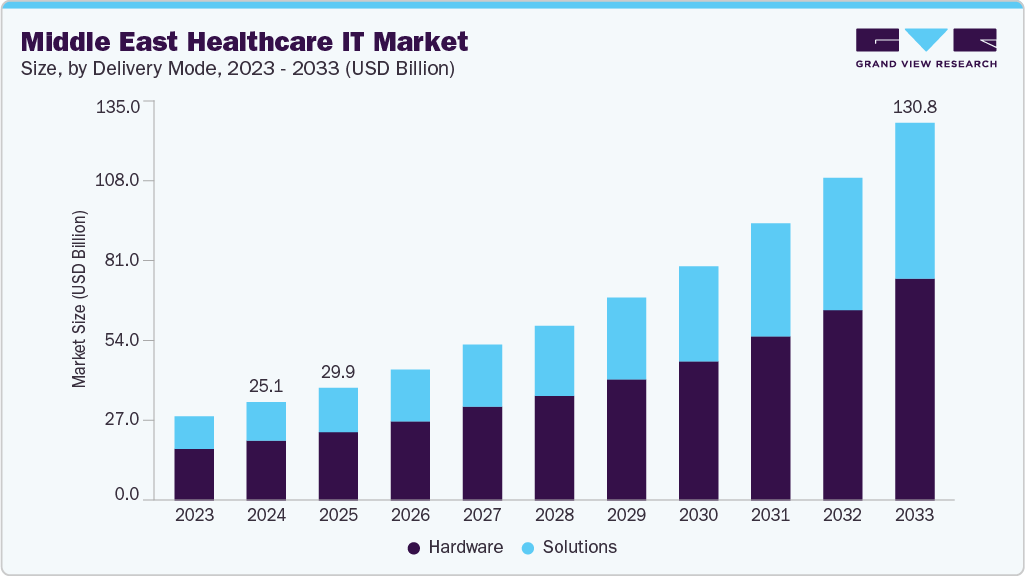
The Middle East healthcare IT market size was estimated at USD 53.33 billion in 2024 and is projected to reach USD 214.92 billion by 2033, growing at a CAGR of 16.5% from 2025 to 2033. Increasing usage of smartphones, a growing demand for remote patient monitoring for improved out-of-hospital care, technologically advanced healthcare IT infrastructure, and an increase in initiatives and investments supporting eHealth and digital transformation are driving overall market growth.
Key Market Trends & Insights
- Saudi Arabia dominated the market and accounted for a 23.45% share in 2024.
- By application, the electronic health records (EHR) segment led the market with a share of over 45.22% in 2024.
- By delivery mode, hardware emerged as the leading delivery mode segment in 2024 and accounted for 60.55% of the market share.
- By end use, the healthcare providers segment was the leading in 2024 and accounted for 59.26% of the market share.
Market Size & Forecast
- 2024 Market Size: USD 53.33 Billion
- 2033 Projected Market Size: USD 214.92 Billion
- CAGR (2025-2033): 16.5%
- Saudi Arabia: Largest market in 2024
- UAE: Fastest growing market
The market is rapidly expanding, driven by large-scale government modernization programs, accelerated digital transformation, and rising demand for integrated, patient-centric care. Countries such as Saudi Arabia, the UAE, and Qatar invest heavily in health IT infrastructure, focusing on interoperability, digital licensing, unified records, and smart healthcare delivery. For instance, the UAE’s Ministry of Health and Prevention has advanced national platforms such as Riayati under the National Unified Medical Record (NUMR) program, enabling unified access to clinical data across thousands of healthcare facilities and enhancing provider collaboration.
Healthcare providers across the region are increasingly adopting electronic health records (EHRs), clinical decision support systems, telehealth platforms, and hospital information systems to improve efficiency and care coordination. The UAE has also introduced Internet of Things (IoT) applications in healthcare. Emirates Health Services (EHS) uses connected devices to monitor real-time patient metrics such as blood pressure, glucose levels, heart rate, and oxygen saturation, integrating this data into unified health records. In February 2025, the Ministry of Health and Prevention launched a National Unified Licensing Platform that consolidates licensing services for healthcare professionals across all federal and local authorities, standardizing and simplifying the process nationwide.
Key Success Factor of Healthcare IT adoption in the Middle East:
-
Development of AI solutions that address specific regional challenges and opportunities, such as government priorities, infrastructure limitations, and cultural nuances
-
Ambitious government plans to invest in AI research, development, and adoption, including initiatives like Saudi Arabia’s Vision 2030 and the UAE’s AI Strategy 2031
-
Collaborations with local businesses and government agencies to understand their needs and co-create solutions
-
Compliance of the solutions with evolving data privacy regulations and potential algorithmic bias limitations
-
Localizing AI solutions to support Arabic language and cultural references to enhance user experience and increase accessibility
Market Concentration & Characteristics
The chart below illustrates the relationship between market concentration, industry characteristics, and industry participants. The x-axis represents the level of industry concentration, ranging from low to high. The y-axis represents various industry characteristics, including industry competition, impact of regulations, level of partnerships & collaborations activities, degree of innovation, and regional expansion. For instance, the Middle East healthcare IT industry is slightly fragmented, with many product & service providers entering it. The degree of innovation, the level of partnerships & collaboration activities, and the impact of regulations on the industry are high. However, moderate growth was observed in regional expansion.
The degree of innovation in the Middle East healthcare IT industry is moderate to high, fueled by ongoing digital health transformation initiatives, strong government backing, and increasing consumer expectations for seamless, technology-enabled healthcare experiences. Regional healthcare systems are rapidly adopting AI-powered chatbots, remote monitoring tools, and personalized patient portals to enhance service delivery and improve patient satisfaction. For instance, in June 2023, SANTECHTURE launched two AI-driven RCM solutions, THYNK and CODEMINE, at the HealthTech Summit in Riyadh, enhancing clinical documentation, medical coding, and revenue management for Saudi healthcare providers, in line with Vision 2030 reforms.
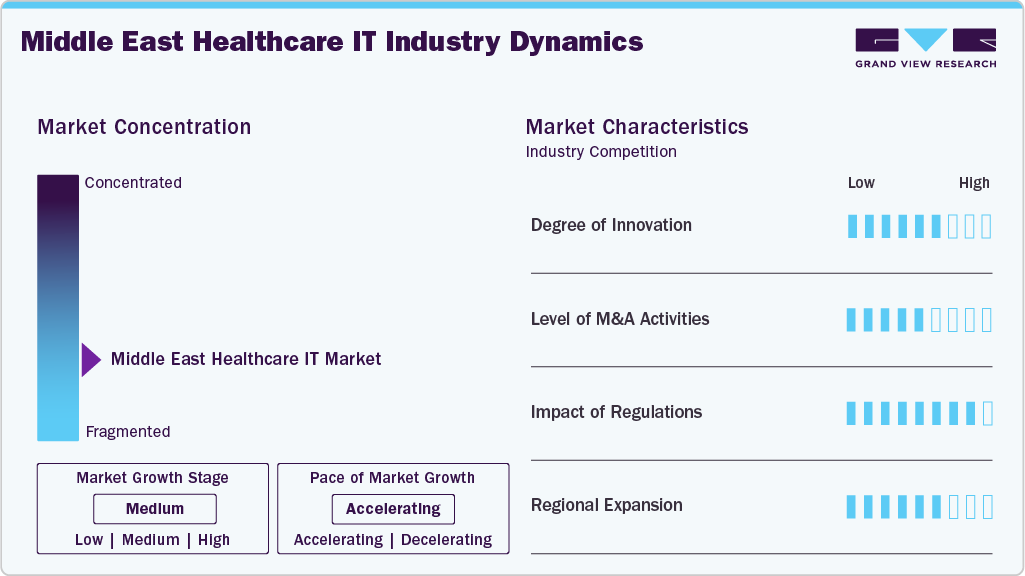
The level of partnerships and collaboration among key players in the Middle East healthcare IT industry is moderate, reflecting the region’s strategic push to build robust, interoperable, and future-ready digital health ecosystems. For instance, in May 2024, Accumed partnered with Ecaresoft to modernize revenue cycle management for outpatient care centers in Saudi Arabia by integrating Accumed’s RCM expertise with Ecaresoft’s advanced SaaS platforms, aiming to boost operational efficiency and patient care.
The impact of regulations on the Middle East healthcare IT industry is high, as governments implement strict digital health frameworks to safeguard data privacy, ensure interoperability, and enhance patient safety. The UAE enforces the 2019 Health Data Law, ADHICS standards in Abu Dhabi, and NABIDH requirements in Dubai. Saudi Arabia’s Personal Data Protection Law (PDPL) and SeHE policies mandate secure EHR exchange and cybersecurity compliance. Similarly, Qatar’s PDPPL imposes strong data governance and breach penalties.
The level of regional expansion in the Middle East healthcare IT industry is moderate, driven by rising healthcare digitization efforts and strong government initiatives across the Gulf Cooperation Council (GCC) countries. As national health systems in the UAE, Saudi Arabia, and Qatar move toward unified health information platforms, there is growing demand for healthcare IT solutions.
Case Study: Digital Transformation at King Faisal Specialist Hospital & Research Centre
Delivery Mode Insights
The hardware segment held the largest revenue share of 60.55% in 2024, driven by ongoing investments in modernizing hospital infrastructure and expanding digital health capacity. Governments and private providers are prioritizing the deployment of advanced servers, storage systems, imaging equipment, and networking devices to support electronic health records (EHR), telemedicine, and health information exchange platforms. The rapid adoption of cloud-linked data centers and demand for secure and scalable hardware to manage rising patient volumes further reinforces hardware’s strong position in the region’s healthcare IT landscape.
The solutions segment is anticipated to witness significant growth in the market, fueled by the rapid adoption of electronic health records (EHR), telemedicine platforms, population health management tools, and advanced analytics solutions. In addition, the rise of AI- and cloud-based healthcare applications is accelerating demand for integrated solutions that can deliver scalability, efficiency, and better patient outcomes across the region.
Application Insights
The electronic health records (EHR) segment held the largest revenue share of 45.22% in 2024. Strong government-led digital health transformation initiatives support this growth. Countries such as Saudi Arabia, the UAE, and Qatar are making significant investments in nationwide EHR rollouts as part of their strategic visions to modernize healthcare infrastructure and improve care quality. The rising demand for integrated hospital information systems and the need to centralize patient data across public and private facilities are accelerating adoption. In addition, regulatory mandates for health data interoperability, the shift toward value-based care, and the growing focus on patient safety and clinical efficiency reinforce EHR demand.
With regional healthcare providers transitioning toward digital-first models and insurance-driven care delivery, EHR platforms are increasingly viewed as the foundation layer for advanced healthcare IT solutions such as analytics, population health management, and telehealth integration. This makes the segment the largest today and strategically vital for long-term market growth.
The tele-healthcare segment is anticipated to witness one of the fastest CAGRs in the market, primarily driven by government-backed digital health initiatives and the accelerated shift toward remote care models post-COVID-19. Countries such as Saudi Arabia and the UAE have introduced dedicated telemedicine regulations and reimbursement frameworks, which are encouraging providers to integrate virtual consultation platforms, chronic disease monitoring, and home-based care solutions into their service delivery. The rising prevalence of lifestyle diseases, large rural and underserved populations, and the push to reduce hospital congestion further fuel demand. In addition, high smartphone penetration, expanding 5G infrastructure, and strong investment by both public and private players create a supportive ecosystem for tele-healthcare adoption.
End-use Insights
The healthcare providers segment held the largest revenue share in 2024, driven by the growing need to optimize clinical outcomes and streamline care delivery. Hospitals, clinics, and physician practices increasingly leverage healthcare IT solutions such as EHR systems, telehealth platforms, and clinical decision support tools to enhance efficiency, improve data management, and deliver personalized care. Key factors fueling this trend include the region’s shift toward value-based care, rising patient expectations for digital services, and regulatory mandates emphasizing interoperability, patient safety, and quality of care.
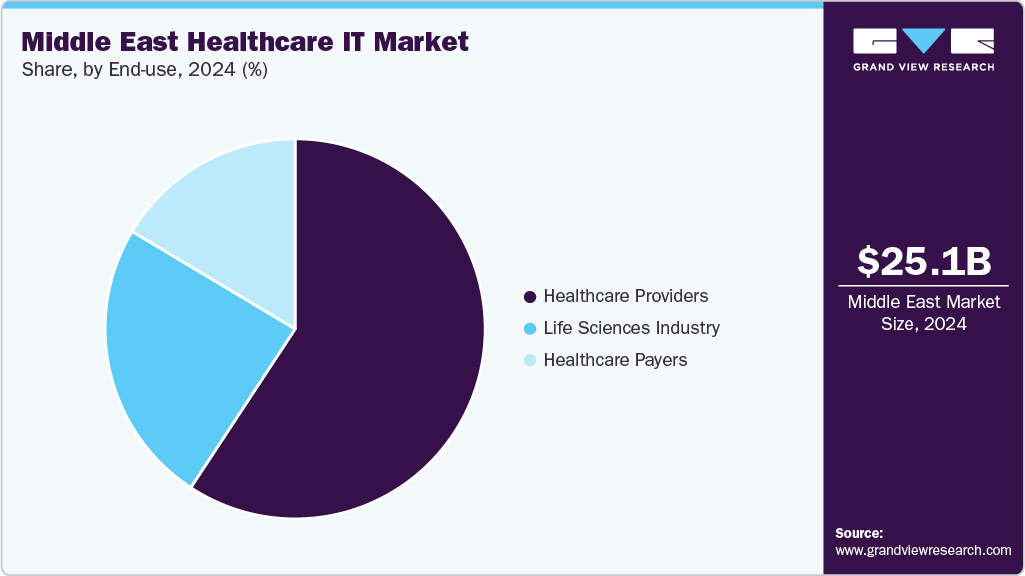
The life sciences industry is projected to be the fastest-growing end-use segment in the market, driven by increasing investments in clinical research, biopharma innovation, and digital transformation of R&D processes. Growing adoption of advanced analytics, AI-driven platforms, and electronic data capture systems enables more efficient clinical trials and regulatory compliance.
Country Insights
UAE Healthcare IT Market Trends
The UAE healthcare IT market is advancing rapidly with strong government support, highlighted by the National Unified Digital Platform launch in April 2024, which integrates electronic health records nationwide. Key initiatives such as Malaffi in Abu Dhabi and Riayati in Dubai have already connected millions of patient records and thousands of providers, improving interoperability and care coordination. In addition, the UAE is promoting the use of IoT in healthcare to enable remote monitoring and data-driven clinical decisions, reinforcing its goal of building a smart, AI-enabled healthcare system.
Saudi Arabia Healthcare IT Market Trends
The healthcare IT market in Saudi Arabia is rapidly advancing under Vision 2030, driven by initiatives like the Seha Virtual Hospital, the world’s largest virtual hospital connecting over 200 facilities and delivering AI-powered telemedicine services to thousands of patients. Complementing this, the Sehhaty app provides millions of citizens with access to medical records, virtual consultations, and preventive care, while national AI programs, such as disease risk screening, highlight the Kingdom’s commitment to predictive and personalized healthcare through digital transformation.
Oman Healthcare IT Market Trends
The healthcare IT market in Oman is undergoing a strategic digital transformation driven by its Health Vision 2050 and alignment with Vision 2040. The Ministry of Health’s Al-Shifa system now operates in over 200 facilities across hospitals, police, defense, and education sectors-offering comprehensive electronic medical records and integrated administrative management. Oman is testing blockchain integration within its National Health Information System to enhance data security and streamline administrative processes. At the same time, telehealth platforms facilitated more than 1.2 million consultations in 2024, helping to increase access to care and reduce rural readmissions. With the National Health Policy launch in April 2025, the country is reaffirming its commitment to creating a secure, accessible, and future-ready healthcare IT ecosystem.
Key Middle East Healthcare IT Company Insights
The market is highly fragmented, with many small and large players operating. This leads to intense competition between smaller players to sustain their position. Strategies such as new product launches and partnerships are key to propelling market growth.
Key Middle East Healthcare IT Companies:
- Philips Healthcare
- Veradigm Inc. (formerly Allscripts Healthcare Solutions, Inc.)
- Athenahealth, Inc. (Acquired by Hellman & Friedman and Bain Capital)
- GE Healthcare
- Agfa- Gevaert Group
- Hewlett Packard Enterprise Development LP
- Optum, Inc.
- IBM
- Oracle
- SAS Institute, Inc.
- IQVIA
- SAP
- Accenture
Recent Developments
-
In May 2024, Qatar joined SNOMED International, marking a strategic step toward enhancing interoperability and data consistency across its healthcare ecosystem. This move supports Qatar’s broader digital health goals by enabling standardized clinical terminology nationwide.
-
In January 2024, IBM inaugurated its regional headquarters in Riyadh, reinforcing its commitment to Saudi Arabia’s digital economy. The new hub is expected to accelerate innovation in sectors like healthcare through advanced cloud computing and AI-driven solutions.
“IBM is helping clients in Saudi Arabia reshape their business models and leverage emerging technologies to increase productivity and drive innovation. Establishing a regional headquarters in Riyadh will extend IBM’s footprint in the Kingdom and the wider region, with the goal of spurring more transformation and innovation.”
-Arvind Krishna (Chairman and Chief Executive Officer)
-
In July 2024, TruDoc Healthcare partnered with e& enterprise to launch the engageX solution powered by the NICE CXone platform. This solution revolutionized healthcare communications in the MENA region by enabling seamless management of patient inquiries across multiple channels (voice, chat, email, video) through a single interface, enhancing patient engagement, security, and operational efficiency. This collaboration supports TruDoc’s mission to deliver innovative, patient-centric telehealth services with advanced AI-driven tools for improved care accessibility and experience.
-
In April 2024, Mubadala Health partnered with Oracle to run its Oracle Cerner electronic health records (EHR) system on Oracle Cloud Infrastructure (OCI) via the Oracle Cloud Dubai Region. This initiative aims to enhance care delivery, improve operational efficiency, and support over 10,000 concurrent users with real-time data access across its integrated healthcare network.
“We are thrilled to have signed this significant agreement and to have established such an important relationship with Oracle. This milestone agreement is another step in our digital transformation journey and will allow for exponential improvements in how care is provided to the community”.
– Khalid Al Amadi, Senior Director, Informatics and Integration at Mubadala Health.
Middle East Healthcare IT Market Report Scope
|
Report Attribute
|
Details
|
|
Market size value in 2025
|
USD 63.49 billion
|
|
Revenue forecast in 2033
|
USD 214.92 billion
|
|
Growth rate
|
CAGR of 16.5% from 2025 to 2033
|
|
Actual data
|
2021 – 2024
|
|
Forecast period
|
2025 – 2033
|
|
Quantitative units
|
Revenue in USD million/billion, and CAGR from 2025 to 2033
|
|
Report coverage
|
Revenue forecast, company ranking, competitive landscape, growth factors, and trends
|
|
Segments covered
|
Product, delivery mode, end-use, country
|
|
Country scope
|
Saudi Arabia; UAE; Kuwait; Qatar; Oman
|
|
Key companies profiled
|
Philips Healthcare; Veradigm Inc. (formerly Allscripts Healthcare Solutions, Inc.); Athenahealth, Inc. (Acquired by Hellman & Friedman and Bain Capital); GE Healthcare; Agfa-Gevaert Group; Hewlett Packard Enterprise Development LP; Optum, Inc.; IBM; Oracle; SAS Institute, Inc.; IQVIA; SAP; Accenture
|
|
Customization scope
|
Free report customization (equivalent up to 8 analysts working days) with purchase. Addition or alteration to country, regional & segment scope.
|
|
Pricing and purchase options
|
Avail customized purchase options to meet your exact research needs. Explore purchase options
|
Middle East Healthcare IT Market Report Segmentation
This report forecasts revenue growth at the regional and country levels and provides an analysis of the latest industry trends in each of the sub-segments from 2021 to 2033. For this study, Grand View Research has segmented the Middle East healthcare IT market report based on application, delivery mode, end-use, and country:
-
Application Outlook (Revenue, USD Million, 2021 – 2033)
-
Computerized Provider Order Entry Systems
-
Electronic Prescribing Systems (E-Prescribing Solutions)
-
Laboratory Information
-
Clinical Information Systems
-
Medical Imaging Information Systems
-
Radiology Information Systems
-
Monitoring Analysis Software
-
Picture Archiving and Communication Systems
-
-
Electronic Health Records
-
Licensed Software
-
Technology Resale
-
Subscriptions
-
Professional Services
-
Others
-
-
Tele-healthcare
-
Revenue Cycle Management
-
eClinical Solutions
-
Electronic Clinical Outcome Assessment (eCOA)
-
Electronic Data Capture (EDC) & CDMS
-
Clinical Analytics Platforms
-
Clinical Data Integration Platforms
-
Safety Solutions
-
Clinical Trial Management System (CTMS)
-
Randomization and Trial Supply Management (RTSM)
-
Electronic Trial Master File (eTMF)
-
eConsent
-
-
Population Health Management (PHM)
-
Digital Healthcare Supply Chain Management
-
Software
-
Hardware
-
Services
-
-
Clinical alarm management
-
Nurse Call Systems
-
Physiological Monitors
-
Bed Alarms
-
EMR Integration Systems
-
Ventilators
-
Others
-
-
Healthcare Customer Relationship Management (CRM)
-
Technology Solutions in the Healthcare Payers
-
Enrollment and Member Management
-
Provider Management
-
Claims Management
-
Value based Payments
-
Revenue Management and Billing
-
Analytics
-
Personalize/CRM
-
Clinical Decision Support
-
Data management and support
-
Others
-
-
Healthcare Analytics
-
Descriptive Analysis
-
Predictive Analysis
-
Prescriptive Analysis
-
-
-
Delivery Mode Outlook (Revenue, USD Million, 2021 – 2033)
-
Solutions
-
Software
-
On-Demand/On-premise
-
Cloud-based/ Web-based
-
-
Services
-
-
Hardware
-
-
End-use Outlook (Revenue, USD Million, 2021 – 2033)
-
Healthcare Providers
-
Healthcare Payers
-
Life Sciences Industry
-
Pharma & Biotech Organizations
-
Medical Device Manufacturers
-
Contract Research Organizations (CROs)
-
Academic institutes
-
-
-
Country Outlook (Revenue, USD Million, 2021 – 2033)
-
Saudi Arabia
-
UAE
-
Kuwait
-
Qatar
-
Oman
-
Frequently Asked Questions About This Report
b. The Middle East healthcare IT market size was estimated at USD 53.33 billion in 2024 and is expected to reach USD 63.49 billion in 2025
b. The Middle East healthcare IT market is expected to grow at a compound annual growth rate of 16.5% from 2025 to 2033 to reach USD 214.92 billion by 2033.
b. Electronic health record segment dominated the Middle East healthcare IT market with a share of 45.22% in 2024. This is attributable to strong government-led digital health transformation initiatives. Countries such as Saudi Arabia, the UAE, and Qatar are making significant investments in nationwide EHR rollouts as part of their strategic visions to modernize healthcare infrastructure and improve care quality.
b. Some key players operating in the Middle East healthcare IT market include Koninklijke Philips N.V., Veradigm Inc. (formerly Allscripts Healthcare Solutions, Inc.), Athenahealth, Inc. (Acquired by Hellman & Friedman and Bain Capital), GE Healthcare, Agfa-Gevaert Group, Hewlett Packard Enterprise Development LP, Optum, Inc., IBM, Oracle, SAS Institute, Inc., IQVIA, SAP, and Accenture.
b. Key factors that are driving the market growth include increasing usage of smartphones, a growing demand for remote patient monitoring for improved out-of-hospital care, technologically advanced healthcare IT infrastructure, and an increase in the number of initiatives and investments supporting eHealth and digital transformation.
link




More Stories
CHAI’s AI oversight ambitions falter with scrapped AI labs
Nutrition in healthcare brings opportunity for industry growth and innovation
Lewis and Clark County job industry sees biggest growth in healthcare