
Piezoelectric materials are capable of converting between mechanical energy and electrical energy. When mechanical deformation occurs, they produce an electrical signal, facilitating follow-up processing, and when an electric field is applied, they produce a strain, effecting desired motions. Compared with other devices or mechanisms that implement this conversion, piezoelectric materials have high electromechanical efficiency and remarkable scalability, allowing for miniaturization even down to the scale of microelectromechanical systems (MEMS)1,2,3,4. For this reason, they are very widely used in sensing and actuating5,6,7,8.
Recently, in contrast to its brittle solid counterparts, flexible piezoelectric materials (FPM) are gaining attention for applications where flexibility is a primary metric, such as wearable devices. These devices are commonly designed to be compact and lightweight to meet portability needs and to include various functional modules for sensing and for feedback of multiple signals9,10,11. Typical applications include motion sensing12,13,14,15, physiological monitoring16,17,18,19, human-machine interaction20,21,22, and wearable transducers for on-body imaging and diagnosis23,24,25. To be able to adapt to the moving human body, some flexibility of the involved functional materials becomes highly desirable. In addition to sensing and actuating, harvesting energy from the motions of humans requires devices that can withstand large deformations that are no possible with brittle piezoelectric materials26. Hence, FPM can also be used for harvesting kinetic energy from heartbeat27,28, breathing29,30, pulse31, and even gastrointestinal peristalsis32 in some wearable devices, making energy harvesting another major use in the application of FPM in wearable devices.
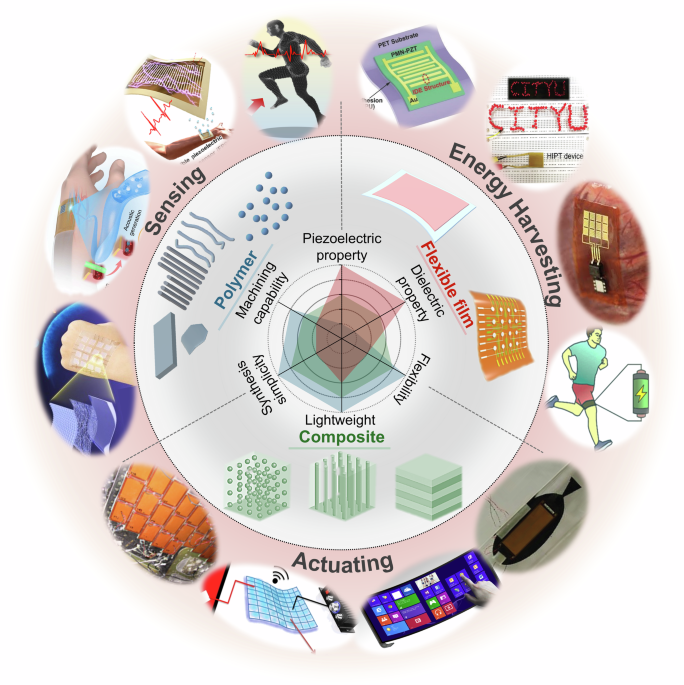
There are three main approaches to achieving the flexibility of piezoelectric materials: intrinsically flexible piezoelectric polymers33, flexible piezoelectric composites (FPC) formed by combining piezoelectric ceramics with flexible materials34, and inorganic flexible piezoelectric films fabricated on flexible substrates through direct deposition35 or film transfer techniques36,37. Figure 1 presents a radar chart summarizing the distinct physical properties of these three materials, as well as their best suited application scenarios. Piezoelectric polymers, such as polyvinylidene fluoride (PVDF), offer excellent flexibility and ease of processing, often fabricated in the form of sheets and fibers that can be integrated into devices through textile techniques. However, their piezoelectric performances are typically weak; although there are several attempts to enhance them38,39,40, they still fall short compared to the other types of FPM. Research on these materials usually focused on developing new processing methods41,42,43,44 and exploring novel applications15,17,45. Piezoelectric composites are composed of high-performance piezoelectric ceramics (e.g., lead zirconate titanate (PZT)) and flexible polymers, aiming to combine the benefits of the two. However, there is a significant trade-off between performance and flexibility, and having a good compromise through material modification or composite structure design can be complicated46,47. Inorganic piezoelectric thin films form a new class of FPM that have emerged alongside advances in thin-film fabrication technology. They are basically composed of inorganic piezoelectric materials in single- or poly-crystalline thin film coated on flexible substrates, and hence they retain the high piezoelectric performance of the original materials. Unfortunately, their high cost and the challenge of producing large-area films remain to be resolved48,49.

The radar chart at the center of the figure illustrates the performance characteristics of the three types of flexible piezoelectric materials (FPM). The blue legend represents polymers, the red represents inorganic flexible thin films, and the green represents composites. The middle ring (gray shading) shows schematics of the three types of FPM, while the outer ring (pink shading) shows their respective application areas. Schematics of composite is reproduced with permission from ref. 250. Copyright 2017 Wiley-VCH GmbH. Schematics of flexible film is reprinted with permission from ref. 215. Copyright 2020 American Chemical Society. Images arranged clockwise starting from the 12 o’clock are reprinted with permission from ref. 61. Copyright 2015 Wiley-VCH GmbH, ref. 196. Copyright 2021 Wiley-VCH GmbH, ref. 27. Copyright 2014 National Academy of Sciences, ref. 251. Copyright 2022 Elsevier, ref. 204. Copyright 2018 Wiley-VCH GmbH, ref. 206. Copyright 2014 IOP Publishing, ref. 45. Copyright 2021 Springer Nature, ref. 252. Copyright 2016 Cambridge University Press, ref. 253. Copyright 2021 Elsevier, ref. 17. Copyright 2023 Springer Nature, ref. 176. Copyright 2023 American Chemical Society, and ref. 254. Copyright 2024 Springer Nature.
The field of FPM roughly commenced in 1975, when Hamilton Watch launched their Pulsar calculator watch, which can arguably be credited as the world’s first example of ‘wearable electronics’. And another memorable moment was in 2006, when Nike and Apple introduced a portable fitness kit capable of recording human movement (similar to the functions of today’s smartwatches and fitness bands). Since then, flexible piezoelectrics have witnessed explosive growth. Figure 2 shows the trend in the number of publications and patents relevant to FPM or their applications since 1975. We see that these numbers both went from a few per year to over a thousand per year, indicating a rapidly growing field of research and industrial applications.

Growth of (a) publications and b patents related to flexible piezoelectrics since 1975. All analytical data were extracted from the data platform ‘LENS.ORG’255.
Remarkable progress in the field of FPM has been made. While a few excellent reviews have addressed the energy harvesting or sensing functions of individual FPM28,50,51,52,53, this review aims to provide a comprehensive and up-to-date overview of recent advances across all three types of FPM, further addressing the potential challenges and viable solutions in their commercialization, thereby aiming to facilitate future research and applications.
In Section “Typical flexible piezoelectric materials”, we introduce the performance, characteristics, and synthesis/fabrication method of each of the FPM. In Section “Applications of flexible piezoelectric material”, fundamental functions and suited applications of the FPM are discussed in detail. Finally, we offer a perspective on the future of FPM, addressing potential challenges and proposing possible solutions in Section “Multifunctionalityand integration of flexible piezoelectric devices”.
Typical flexible piezoelectric materials
As early as 1880, French physicists Pierre Curie and Jacques Curie first discovered the piezoelectric effect when they observed that applying mechanical stress to a quartz crystal generated electric charges on its surface54,55. This discovery marked the beginning of piezoelectric material research. The subsequent discovery of piezoelectric ceramics, especially PZT ceramics in the 1940s, significantly accelerated the application of piezoelectric materials56. However, piezoelectric materials were all brittle and non-flexible at that time. It wasn’t until the early 1970s, with the emergence of polymeric piezoelectric materials such as PVDF33,57, that the era of flexible piezoelectrics began. With the development of the flexible electronics industry, new research regimes appeared as well, such as composite materials, which are formed by combining high-performance piezoelectric ceramics with flexible polymers and piezoelectric thin films, which attain flexibility through size effects58,59. In this section, we will categorize and discuss typical FPM from various perspectives, including their subcategories, physical properties, and fabrication methods.
Operating modes are also crucial for the applications of piezoelectric materials. Similar to piezoelectric ceramics, FPM also have multiple operating modes based on the differences between the stress direction and the polarization (electric field) direction. Flexible piezoelectric sensors typically operate in the d33 mode, while cantilever-type energy harvesters operate in the d31 mode60. However, because the piezoelectric coefficient d31 is generally smaller than d33 and d15 in piezoelectric materials, conventional cantilever energy harvesters do not perform under optimal conditions50. Consequently, some groups have indeed achieved d33 or d15 mode operation for energy harvesters by employing interdigitated electrodes61,62 or using eccentric mass blocks63,64. For actuators, typical FPC like macro fiber composite (MFC) provide both d33 and d31 modes based on structural design65. Since many research articles in this literature do not directly specify the operating modes, the author does not explicitly mention them in the following part.
Flexible piezoelectric polymer
Organic polymers usually have excellent flexibility and can withstand a variety of mechanical manipulations such as bending, folding, twisting, and stretching. By controlling their phase and crystallinity to introduce polarity, these polymers can be engineered into piezoelectric materials66,67,68. Various flexible piezoelectric polymers have been investigated, including polyvinylidene fluoride (PVDF)33,57, polyacrylonitrile (PAN)69, polyhydroxy butyrate (PHB)70,71, polylactic acid (PLA)72,73, etc. A comparison between them is presented in Table 1. PLA and PHB are two biodegradable piezoelectric materials with relatively low piezoelectric coefficients d3339. PLA additionally exhibits a high shear piezoelectric coefficient d14, yet lacks optimized strategies to harness this property74. PAN is a piezoelectric polymer discovered in recent years, but current research is limited and its performance is still under debate75,76,77. In contrast, PVDF and its derivatives stand out due to their widely proven superior piezoelectric and mechanical properties. In addition, PVDF also exhibits good biocompatibility, high chemical and thermal stability. All these properties make it a preferred choice for flexible piezoelectric devices39,78,79 and the representing material for piezoelectric polymer.
PVDF is a long-chain semicrystalline polymer composed of H2C = CF2 monomers. Depending on the specific conditions during the polymerization process, the chain conformation of PVDF can exhibit trans (T) or gauche (G) linkages, leading to at least four distinct polymorphs, which are named α, β, γ, and δ. The first three are the most extensively studied, with their structures shown in Fig. 380. The α-phase is the most common and thermodynamically stable form. Its chain conformation is TGTG’, and due to the antiparallel alignment of the dipoles, it is non-polar. The β-phase has a conformation of TTTT, where all chains are in the trans arrangement and the dipoles are aligned in the same direction. This arrangement endows the β-phase with the highest dipole moment, resulting in a higher net dipole moment per unit volume and a theoretical spontaneous polarization of up to 13 μC/cm2 81. Consequently, the increased net dipole moment allows PVDF to generate greater charge output under mechanical stress, leading to a higher piezoelectric coefficient. It has been reported that in undoped PVDF, the β-phase content can be tuned through processing methods. As the β-phase content increases, the d33 value gradually approaches the theoretical prediction. For instance, Gomes et al. reported that pure PVDF with approximately 80% β-phase content exhibited a maximum d33 value of −34 pC/N, while at around 50% content, the value was about −25 pC/N82. The conformation of γ-phase is TTTGTTTG’, it exhibits weak polarization due to the non-fully antiparallel alignment of the dipoles. The γ phase also has the highest melting point among the various polymorphs83. The δ-phase is a derivative of the α-phase, with the same conformation (TGTG’). Their difference lies in that every second chain in the δ-phase is rotated by 180°, which imparts ferroelectricity to this phase. As described above, β-phase PVDF stands out because of its highest dipolar moment per unit cell, hence it has drawn most of the attention in this field.

The T and G represents the trans and gauche linkages, respectively. Reproduced with the permission from ref. 80. Copyright 2019 Wiley-VCH GmbH.
The improvement of PVDF performance
An intuitive way to enhance the piezoelectric properties of PVDF is to synthesize it in such a way that it will have a higher β-phase fraction. The most direct method to obtain the β-phase is to mechanically stretch the α-phase PVDF84,85. However, this method requires reasonable design of parameters such as tensile strain and temperature, and it is also impossible to achieve complete transformation, resulting in the coexistence of the two phases. The α to β transition can also be achieved through high pressure quenching86, electrical poling87, and ultra-fast cooling method88. In practice, a multi-field coupling approach involving pressure, electric fields, and thermal fields is often employed to enhance the conversion rate to the β-phase. For example, commercial PVDF films are usually produced using electrical poling, and mechanical stretching is performed prior to or during the poling to optimize the crystal orientation.
The formation of the β-phase in PVDF can also be promoted by adding nucleating agents or ionic salts during the melting stage. For example, adding an appropriate amount of polymethyl methacrylate (PMMA) to PVDF in its molten state can lead to the direct crystallization of the β-phase. However, excessive PMMA can interfere with the polymerization of PVDF, resulting in a decrease in crystallinity89. Co-polymerizing PVDF monomers with other fluorinated organic monomers, such as trifluoroethylene (TrFE), tetrafluoroethylene (TeFE), or hexafluoropropylene (HFP), is a more effective method than using nucleating agents (Fig. 4)90. The replacement of hydrogen atoms with slightly larger fluorine atoms increases steric hindrance around neighboring G bonds, promoting the formation of T linkages. This process ultimately leads to the creation of polar phases similar to the β-phase (TTTT) structure found in homopolymers. Although the theoretical polarity of the unit structure decreases after copolymerization, the superior β-phase crystallization enhances its macroscopic piezoelectric response. Additionally, since the copolymer directly forms a polar phase, processes such as stretching and poling become unnecessary for these copolymers. Currently, P(VDF-TrFE) is the most widely used FPM among PVDF and its copolymers, with a piezoelectric coefficient reaching up to −38 pC/N, surpassing the −34 pC/N of pure PVDF91. Furthermore, P(VDF-TrFE) can be further copolymerized with a third monomer, chlorotrifluoroethylene (CTFE) or chlorofluoroethylene (CFE), to form a terpolymer. In these terpolymers, CTFE or CFE disrupt the long-range order of P(VDF-TrFE), resulting in the formation of nanoscale polar domains and thereby providing a greater electromechanical strain effect92.

Partially reproduced with the permission from ref. 90. Copyright 2021 Wiley-VCH GmbH.
Aside from the formation of polar phases induced by copolymerization, a morphotropic phase boundary (MPB)-like phenomenon has recently been reported in the copolymer P(VDF-TrFE), analogous to that observed in PZT ceramics. Liu et al. synthesized a gradient-composition P(VDF-TrFE) copolymer by employing a vapor reaction method, in which the flow rates of VDF and TrFE were controlled. When the VDF content in the copolymer is approximately 50 mol%, the piezoelectric coefficient reaches a maximum value of −66 pC/N93. Although the underlying mechanism of this phenomenon is still under investigation94,95,96, this discovery provides a new avenue toward addressing the limitations in the piezoelectric performance of polymer materials.
Fabrication methods of PVDF and its derivatives
As a polymeric material, PVDF can be easily processed into bulk forms, films, fibers, and various complex structures using a variety of methods, such as solution casting, electrospinning, 3D printing, and lithography (Fig. 5). The introduction of electrospinning and 3D printing technologies has enhanced design flexibility of PVDF and other polymers. These methods enable the fabrication of PVDF into fiber forms suitable for textiles or complex three-dimensional structures, significantly expanding its potential application range.

a Schematic diagram of the process for synthesizing ionic salt-montmorillonite (IS-MMT) templated PVDF-based piezoelectric devices using fused filament fabrication (FFF) 3D printing. Reprinted with permission from ref. 43. Copyright 2023 Elsevier. b Schematic diagram of the electrospinning process. Reprinted with permission from ref. 18. Copyright 2019 American Chemical Society. c Process flow of PVDF/RGO-ZnO nanocomposite films synthesized through solution casting. Reprinted with permission from ref. 119. Copyright 2014 Elsevier. d Process flow of PVDF patterning through soft lithography. Shklovsky et al. introduced a sacrificial layer to improve quality of patterned layer. Reprinted with permission from ref. 44. Copyright 2012 Elsevier.
3D printing
3D printing, as one of the additive manufacturing methods, allows for the creation of complex geometries that may be difficult or cost-prohibitive to achieve with traditional manufacturing techniques97,98,99. Initially, 3D printing technology was applied to a series of polymer materials such as PLA, acrylonitrile butadiene styrene (ABS), and nylon, all of which, like PVDF, are thermoplastic. Later, methods for 3D printing PVDF were also developed. Various 3D printing techniques, such as fused deposition modeling (FDM)100, stereolithography (SLA)101, and direct ink writing (DIW)102, fused filament fabrication (FFF)43 have been explored for printing PVDF.
The primary challenge in 3D printing PVDF lies in the fraction of the polar phase. The 3D printing process involves melting and crystallization, which can easily lead to the formation of the non-polar α phase. There are a few solutions to this issue. For instance, Pei et al. successfully prepared PVDF film with periodic superstructures using FFF 3D printing technology by introducing montmorillonite (IS-MMT) template (Fig. 5a)43. They confirmed that the films have the ability to directly form a polar phase through a melt-to-solid transition. Kim et al. employed FDM technology, inducing the formation of β-phase PVDF by applying an in situ electric field during the printing process. Alternatively, additives can also enhance the β-phase content in 3D-printed PVDF103. Islam et al. used DIW technology, incorporating MoS2 nanoparticles (NPs) as an additive, and successfully enhanced the β-phase content of PVDF by 20%104.
Currently, research on using 3D printing technology to fabricate PVDF piezoelectric devices is becoming increasingly popular, enabling advanced applications such as complex-shaped sensors for physiological signal collection43,105, smart orthopedic braces106, and soft robotics107,108. However, it is worth mentioning that although 3D printing has brought novel concepts at the level of applied research, it still cannot match traditional polymer melt-processing methods in terms of efficiency and cost at the industrial scale.
Electrospinning
Electrospinning is the primary method for synthesizing polymeric nanofiber materials. The basic principle involves applying an electric field to a droplet of PVDF, which induces electrostatic forces on its surface. Such electrostatic force will counteract the surface tension and elongate the droplet into a fiber (Fig. 5b)18. The liquid used in electrospinning can be either a solution or a melt, referred to as solution electrospinning and melt electrospinning, respectively. Electrospinning offers several irreplaceable advantages in the fabrication of PVDF and its derivatives. Firstly, the electric field applied during electrospinning can act as a poling field, promoting the α to the β transition in PVDF fibers, thereby achieving higher piezoelectric performance. Secondly, since the precursor is a solution, various additives can be easily incorporated to modify the crystallinity, phase structure, and electrical properties of PVDF. Finally, the use of a coaxial nozzle (coaxial electrospinning) enables the fabrication of core-shell structured nanofibers, further enhancing the mechanical and electrical properties of PVDF fibers.
The electrospinning process for preparing PVDF fibers depends on various parameters, such as liquid concentration, viscosity, molecular weight, voltage, and temperature. Low-viscosity liquids tend to form sprays rather than fibers. The concentration and molecular weight of the solution affect the fraction of the β-phase in the fibers. Research shows that within an appropriate range, higher molecular weight facilitates β-phase formation109. Due to the fact that an electric field can promote the formation of the β-phase, an appropriate increase in voltage during the spinning process can raise the β-phase content. However, an excessively high voltage shortens the flight time during spinning, preventing sufficient polymer chain reorganization and thereby inhibiting the crystallization and formation of the β-phase in PVDF109. Temperature affects the solvent’s evaporation characteristics, making the influence on β-phase formation even more complex. The prevailing view is that an excessively high temperature is detrimental to the formation of the β-phase, which is why room temperature (20–25 °C) is generally used as the spinning temperature109,110,111.
The introduction of additives and the construction of core-shell structures are similar to composite material design. However, to distinguish PVDF fibers from piezoelectric composites with ceramic functional units, they are still categorized as PVDF-based flexible piezoelectric polymers. Studies have demonstrated that incorporating piezoelectric ceramic NPs like PZT, barium titanate (BTO), and ZnO into PVDF fibers as nucleating agents enhances β-phase content112. Meanwhile, incorporating conductive carbon materials like graphene and carbon nanotubes not only aids nucleation but also promotes charge transfer, increasing output voltage113. While additives can enhance performances, excessive amounts or large particle sizes can increase liquid viscosity, hindering fiber formation. Coaxial electrospinning, used for constructing core-shell structures, is considered a major breakthrough in nanofiber fabrication. It not only endows fibers with additional functionalities but also provides new approaches for creating more complex structures. Wang et al. employed coaxial electrospinning to fabricate flexible core-shell silk fibroin (SF)/PVDF nanofibers. The intermolecular interaction hydrogen bonding and electrostatic forces) between PVDF and SF facilitated the ordering of CH2-CF2, resulting in an increased β-phase content up to 66%. Additionally, core-shell structures can be constructed using self-assembly strategies18,114. For instance, Li et al. used hydroxylamine hydrochloride (HHE) to trigger formation of PVDF (core)/HHE (shell) piezoelectric fibers which are suitable biomedical applications (Fig. 5b). Similarly, due to the electric dipoles and hydrogen bonds, they managed to increase the β-phase content and crystallinity to 96% and 80%, respectively18.
Electrospinning not only changes the properties and morphology of PVDF materials but also allows for the formation of fiber structures that can be integrated with textile technology to develop fabric-like piezoelectric devices, greatly expanding the applications of piezoelectric materials in flexible wearable electronics. We will elaborate on this in the application section. Electrospinning also faces limitations in production efficiency, which remains a challenge even with the introduction of multi-nozzle systems. In recent years, a free-surface electrospinning technique has been proposed, achieving more than a 100-fold increase in productivity109,115. With ongoing improvements in equipment and reductions in cost, the industrial-scale production of piezoelectric polymer fibers is becoming increasingly feasible.
Solution casting
The solvent casting method is a simple and cost-effective technique for fabricating PVDF films or coatings. The basic principle involves dissolving PVDF in solvents such as dimethyl sulfoxide (DMSO), dimethylformamide (DMF) or acetone, to form a homogeneous solution. This solution is then poured into a specific mold, and the solvent is evaporated through heating or other methods, ending up with PVDF films or coatings. This method does not directly produce the polar β-phase and requires additional mechanical stretching or poling. Some researchers also added NPs, such as graphene116, titanium dioxide117, or molybdenum disulfide118, to the solvent to promote β-phase nucleation. For example, Jaleh et al. prepared PVDF with reduced graphene oxide (rGO) and ZnO nanocomposite films using the solution casting method, achieving a maximum β-phase content of 83% (Fig. 5c)119.
Soft lithography
Lithography is also an effective technique for fabricating PVDF microstructures and devices. It can be used to process fine structures such as micron- and nano-scale pillars, grooves, and lines. Lithography for polymer materials differs significantly from etching techniques used for silicon-based materials. Instead of using ultraviolet light, ion beams, or electron beams for patterning, it relies on mechanical deformation to transfer patterns from a mold (‘stamp’) onto the surface of flexible materials and is thus also known as nanoimprinting (Fig. 5d). Soft lithography of PVDF originated in the late 20th century. Xu et al. used this technique to fabricate micron-sized PVDF honeycomb structures, though they did not focus on achieving piezoelectric functionality, but rather on the excellent strength-to-weight ratio provided by the open honeycomb architecture120. Their pioneering work inspired the subsequent research. Between 2007 and 2010, Gallego et al. fabricated piezoelectric PVDF films with various micro- and nano-structures using soft lithography techniques and observed effective deformation under electric field stimulation. Additionally, they conducted biocompatibility assessments, suggesting that these piezoelectric PVDF films could be used in biological MEMS applications121,122,123. Since then, this method has gradually evolved with new improvements being proposed. Shklovsky et al. introduced OmniCoatTM (a soluble polymer used to enhance the adhesion and removability of photoresist on substrates) as a sacrificial layer, which reduced micro-defects in the structures and increased the reusability of the ‘stamp’ (Fig. 5d)44.
Flexible piezoelectric composites
Composite materials are heterogeneous systems composed of multiple constituents, each with distinct interfaces and systematically arranged structures. By combining different materials, composite materials can integrate various functionalities, compensating for the shortcomings of single-material systems. Initially, composites were primarily developed for construction purposes, such as plywood and steel-reinforced concrete, to enhance structural strength. The concept of piezoelectric composites was introduced in the 1970s by Japanese researchers Kitayama and Sugawara34. They blended piezoelectric ceramic PZT with the polymer PVDF in specific proportions, creating a piezoelectric composite material with both low density and high piezoelectric properties. This material exhibited excellent impedance matching with human tissues and body fluids, leading to its application in medical transducers and underwater acoustics. At that time, the demand for wearable and conformable devices had not yet surged, so researchers focused more on the low-density characteristics of composite materials. The matrices used for composite materials with piezoelectric ceramics were often rigid polymers, such as epoxy resins, to maintain high mechanical strength. In recent years, with the advancement of wearable technologies, there has been a growing demand for piezoelectric materials that are highly flexible, miniaturized, and highly compatible. As a result, FPC, composed of flexible matrix materials and piezoelectric ceramics, have regained attention and have become a hot research topic. Researchers have been optimizing the mechanical and piezoelectric properties of these materials by experimenting with different combinations of matrices and piezoelectric ceramics124,125,126, varying filler ratios46,127,128, employing various composite methods129,130,131,132,133, and incorporating multi-phase interconnecting structures126,134,135. These efforts have led to numerous innovative results, which will be discussed in the following section.
Type of piezoelectric composites
Piezoelectric composites can be complex. The classical categorizing scheme, first proposed by Newnham and Suchtelen, defines the functional component in composites (e.g., piezoelectric ceramics) as the active phase and the matrix (e.g., polymers) as the passive phase. Based on the spatial arrangement and connectivity between these phases, twelve different categories can be formed, as illustrated in Fig. 6125. Due to limitations in fabrication methods and functional realization, FPC are currently primarily available in four types: 0–3, 1–3, 2–2, and 3–3. The following sections will provide a detailed introduction to each type.

The light blue blocks in the image represent the active phase, while the pink blocks represent the passive phase. In the numbers below each pattern, the first and second numbers indicate the connectivity of the active phase and passive phase in three-dimensional space, respectively. Reproduced with permission from ref. 125. Copyright 1978 Elsevier.
0–3 type piezoelectric composites
0–3 type FPC are formed by suspending micron- or nanosized piezoelectric ceramic powders in a flexible polymer matrix. This type of composite, which features the simplest structure and has been the most extensively studied, is widely used in flexible piezoelectric devices. Due to the small size and non-connective nature of the ceramic fillers, 0–3 composites exhibit excellent flexibility, enabling stretching, bending, and twisting in all directions, almost matching the flexibility of the polymer matrix itself. However, since the piezoelectric performance of the composite primarily originates from the ceramic fillers, achieving high piezoelectric performance requires increasing the ceramic content. The volume fraction of the ceramic component, on the one hand, can reduce flexibility if beyond the percolation threshold, potentially leading to the formation of a rigid composite, and on the other hand, may cause filler agglomeration, resulting in performance degradation. Therefore, balancing flexibility and piezoelectric performance is crucial46,127,128,136.
Two common practices in this regard include using high-performance piezoelectric ceramic powders as the filler, and selecting flexible piezoelectric polymers like PVDF as the matrix material to provide additional contributions to the piezoelectric performance. For the former, incorporating high-performance piezoelectric ceramics such as PZT, BTO, or lead magnesium niobate-lead titanate (PMN-PT) is a logical approach. Sappati et al. fabricated a 0–3 type PZT/Polydimethylsiloxane (PDMS) piezoelectric composite, achieving a piezoelectric coefficient of 78 pC/N with a PZT volume fraction of 28%, and a Young’s modulus of only 10 MPa, both superior to those of PVDF polymers137. Zhou et al. carbon-coated PZT, BTO, and potassium sodium niobate (KNN), and fabricated 0–3 type piezoelectric composites for energy harvesting (Fig. 7a)126. Among these, the PZT-based sample achieved the highest peak power density of 59.75 μW/cm2. For the latter practice, we mentioned in the previous chapter that NPs can act as nucleating agents to promote the formation of the β-phase, while PVDF itself can also compensate for the piezoelectric performance of the ceramics. Zhao et al. used PVDF as a matrix to composite oriented BTO NPs, achieving high-performance nanogenerators that illuminated blue LEDs (Fig. 7b)138. They speculated that the piezoelectric output was the sum of BTO and PVDF. However, a drawback of PVDF is its relatively high Young’s modulus (0.5–3 GPa)68. Although already much lower than that of the ceramics (e.g., PZT ~ 60–100 GPa)139, it is significantly higher than other matrix materials such as PDMS ( ~ 1–3 MPa)140, resulting in inferior flexibility.

a Schematic of carbon coated PZT/BT/KNN@PDMS composites and its working principle of charge distribution. Reprinted with permission from ref. 126. Copyright 2021 Elsevier. b BTO NPs@PVDF composite film with uniform and oriented structure and its application in energy harvesting for powering LEDs. Reprinted with permission from ref. 138. Copyright 2015 Elsevier. c Flexible 1–3 type PZT-silicone rubber composite structure and its piezoelectric coefficient under bending. Reprinted with permission from ref. 131. Copyright 2023 American Chemical Society. d PZT nanowire@PDMS-based nanogenerator. Reprinted with permission from ref. 143. Copyright 2012 American Chemical Society. e Structural diagram and photograph of MFC. Reprinted with permission from ref. 129. Copyright 2007 IOP Publishing. f 3D printed MFC and its optical photos. Reprinted with permission from ref. 130. Copyright 2024 Elsevier. g Photos, structural diagram, and electrical response under compression of piezoelectric composites with a 3D-PZT framework. Reprinted with permission from ref. 134. Copyright 2018 Royal Society of Chemistry. h Ferroelectric/piezoelectric response and the d33 under bending and stretching state of CNT@3–3–3 composite. Reprinted with permission from ref. 135. Copyright 2023 Oxford University Press.
1–3 type piezoelectric composites
1–3 type piezoelectric composites are composed of arrays of piezoelectric ceramic nanorods embedded in a matrix material. Due to the directional nature of the array, stress transfer along the axis of the nanorods is more efficient, and the piezoelectric response is improved. However, this directivity also limits the flexibility of 1–3 type composites. In practical applications, the directions of the applied electric field and the force need to be considered, which restricts the flexibility of their use141. The choice of matrix material for 1–3 type piezoelectric composites is similar to that of 0–3 type composites and will not be discussed in detail here. The main focus of research in this area is on the uniform synthesis of nanorod structures and the issue of stress transfer.
The traditional fabrication of pillar structures in 1–3 type piezoelectric composites typically employs the dice-and-fill method131,132,133. While this method results in well-ordered pillar arrays, it is limited by the mechanical machining scale, making miniaturization difficult. Hao et al. used this method to prepare a 1–3 PZT/silicone rubber composite, which exhibited good flexibility and an electromechanical coupling coefficient of 0.7. However, due to its relatively large size, it is more suitable for underwater acoustic transducer applications (Fig. 7c)131. Dielectrophoresis is a common method for constructing 1–3 type composites, where short fibrous fillers are aligned by an electric field to form a columnar arrangement. Using this technique, Stuber et al. fabricated a 1–3 lithium-sodium-potassium niobate (KNLN)/PDMS FPC, achieving d33 and g33 values comparable to those of the most advanced PZT ceramics142. Nanowire growth methods can also be used to fabricate 1–3 type FPM, such as hydrothermal synthesis and electrospinning. Gu et al. employed electrospinning to produce PZT nanowires, which were then cut and aligned to fabricate a highly oriented 1–3 type PZT/PDMS composite, demonstrating an exceptionally high output voltage (Fig. 7d)143. In addition to the above reports, we believe that nanoimprinting technology can also be used to fabricate 1–3 type composites, enabling the design of oriented columnar structures at small scales. There have been reports of BTO nanorod arrays being fabricated via nanoimprinting144, but further composite formation has not yet been reported.
2–2 type piezoelectric composites
Unlike 0–3 and 1–3 type piezoelectric composites, 2–2 type piezoelectric composites are often overlooked, even in reviews focused on piezoelectric composites. However, 2–2 type composites do have a notable commercial product—the macro fiber composite (MFC). MFC was first developed by Langley Research Center of National Aeronautics and Space Administration (NASA) and are currently mass-produced and commercially sold by Smart Material Corporation. Unlike the traditional 2–2 type composites where the functional elements and matrix are stacked layer by layer over a large surface area, MFC and similar 2–2 type piezoelectric composites feature fibers aligned parallel to their length. The neatly aligned fibers are then encapsulated with epoxy resin and sealed on the top and bottom surfaces with polyimide (PI) films that have interdigitated electrodes (Fig. 7e)129. This arrangement is better suited for withstanding bending strain.
Currently, two methods for manufacturing MFC are reported, namely, the dice-and-fill method and 3D printing technology. Zhang et al. fabricated PZT-based 2–2 type piezoelectric fiber composites using both methods130,145. The composites produced by both methods exhibited similar free strain, however, the 3D printing method offered greater design flexibility in terms of structure (Fig. 7f)130. Wang et al. replaced PZT with the lead-free piezoelectric KNN, and the performance of the resulting MFC was comparable to that of PZT-based MFC. They also demonstrated its effectiveness in vibration reduction applications146. MFC and their derivative series of 2–2 type FPC have been extensively tested in applications such as shape control, vibration control, strain sensing, and energy harvesting146,147,148. However, due to the limited flexibility of the matrix material, their applications in biomedical sensing are still quite limited.
3–3 type piezoelectric composites
In 3–3 type piezoelectric composites, the piezoelectric ceramics need to be directly connected to the matrix material in three-dimensional directions. Since such composites are interconnected in all three dimensions, achieving its flexibility is generally challenging. However, some researchers have endowed piezoelectric ceramics with certain flexibility by constructing a high-porosity honeycomb framework, thereby fabricating 3–3 type FPC134,149,150.
Porous piezoelectric ceramic frameworks can be constructed using foaming or templating methods. For example, a polyurethane foam template can be immersed in a piezoelectric ceramic sol, then dried and sintered to form a porous framework. After that, flexible PDMS is backfilled into the framework to create the piezoelectric composite. Zhang et al. prepared 3–3 type PZT/PDMS piezoelectric composites using this method, which not only exhibited excellent flexibility but also demonstrated superior piezoelectric and thermoelectric effects compared to traditional low-dimensional piezoelectric composites (Fig. 7g)134. The continuous framework of 3–3 type FPC ensures high stress transfer efficiency and avoids the issue of particle agglomeration seen in 0–3 type composites, even with a high filler content.
The synergy between flexibility and piezoelectric performance
As mentioned earlier, FPC are formed by combining flexible polymers with brittle piezoelectric ceramics, becoming both flexible and piezoelectric. However, there is a significant trade-off between these two characteristics. Achieving a balance between them, or more ideally, finding the sweet spot in composition, has long been a primary goal for researchers.
The flexibility of composites primarily depends on the matrix material. Besides reducing the filler content, another way to enhance flexibility is selecting polymers with lower Young’s modulus. For example, PDMS and silicone rubber, which are widely used in the literature, have a Young’s modulus of ~1–5 MPa140,151, significantly lower than the 0.5 GPa of PVDF68. Therefore, PDMS is an excellent choice from a flexibility perspective. Wu et al. analyzed the modulus of various materials compared to that of human skin and concluded that materials with a Young’s modulus lower than human skin are more suitable for flexible wearable devices52.
However, improving piezoelectric performance not only depends on high-performance ceramic fillers with a large enough ceramic volume fraction but also requires addressing the mismatch in dielectric and mechanical properties between the ceramics and the matrix material. Although PVDF as a matrix material can contribute to the composite’s piezoelectric performance, its low flexibility may lead to plastic deformation under excessive bending. Increasing the ceramic volume fraction also poses challenges to flexibility. Achieving high piezoelectric performance while maintaining high flexibility hinges on enhancing the compatibility between the ceramics and the matrix, thereby maximizing the potential of the ceramic fillers. Innovative structural designs offer promising solutions to this issue. A prime example is the 3–3 type porous PZT/PDMS piezoelectric composite mentioned earlier, prepared using a foaming method. As another example, Tang et al. fabricated a porous ceramic framework from high-performance PZT powder using the foaming method, then coated it with a relaxor ferroelectric polymer, polyvinylidene fluoride-trifluoroethylene-chlorofluoroethylene (P(VDF-TrFE-CFE)), doped with carbon nanotubes to modulate the local electric field distribution within the PZT framework and finally PDMS was used as the substrate to create CNT@3–3–3 composites. This flexible composite piezoelectric material achieved a d33 of 120 pC/N and a d33* of 250 pm/V, comparable to bulk piezoelectric ceramics, while also allowing for a 50% elastic strain (Fig. 7h)135. This approach provides a practical and effective pathway for developing piezoelectric composites that combine high flexibility with high piezoelectric performance.
Flexible inorganic piezoelectric films
In spite of the significant advancements in the performances of piezoelectric composites through new structural designs and optimized fabrication processes, researchers continue to push the limits. A key area of exploration is how to achieve, or even surpass, the performance of bulk ceramics while maintaining flexibility in piezoelectric materials. The mechanical tolerance of inorganic ceramic materials at the nanoscale has emerged as a breakthrough. By growing nanoscale piezoelectric ceramic/single-crystal thin films or thinning bulk ceramics to the nanoscale, piezoelectric ceramics/single-crystals have demonstrated remarkable flexibility. Moreover, their crystal structure is preserved, and unlike composites, they no longer rely on a polymer matrix for stress transfer, showcasing exceptional performance.
There are various methods for fabricating inorganic piezoelectric thin films, including sol-gel152,153,154, mechanical thinning155, physical/chemical deposition36,156,157,158, etc. The sol-gel and hydrothermal methods are well-established and cost-effective processes that can be used to prepare piezoelectric materials such as PZT, BTO, and KNN. However, these methods often struggle with achieving uniformity and single crystallinity in the films, making them more suitable for producing polycrystalline or amorphous films. On the other hand, physical sputtering (e.g., magnetron sputtering, pulsed laser deposition (PLD)) and chemical deposition (e.g., metal-organic chemical vapor deposition (MOCVD), plasma-enhanced chemical vapor deposition (PECVD), atomic layer deposition (ALD)) can produce high-quality or even single-crystal films. These approaches further enhance the performance of inorganic piezoelectric materials, making them superior to bulk ceramics. However, due to their higher costs, these methods are mainly employed in the fabrication of thin films for semiconductor, MEMS, and other micro-nano technologies.
Inorganic thin films are typically grown on various inorganic substrates, such as silicon, silicon-on-insulator (SOI), alumina, magnesium oxide, and perovskite oxides (e.g., STO, LAO, YAO, LSAT, etc.). These substrates provide excellent support and epitaxial alignment, allowing the thin films to grow layer by layer. However, the rigid nature of these substrates prevents the thin films from bending, even though the films themselves possess inherent flexibility. To address this issue, two main approaches have been applied: the first involves the direct in situ growth of thin films on flexible substrates, while the second employs film release and transfer techniques to move the films from rigid substrates to flexible ones. The following sections introduce these approaches in detail.
In situ direct growth
In situ direct growth involves depositing inorganic piezoelectric thin films directly onto substrates that inherently possess flexibility. While the idea is straightforward, it presents numerous challenges during practical implementation. The primary challenge stems from the heat tolerance of flexible substrates. The fabrication of inorganic piezoelectric thin films typically requires exposure to high temperatures. For instance, the sol-gel method necessitates annealing at temperatures exceeding 500 °C, and during pulsed laser deposition, the substrate often needs to be heated to similar temperatures to facilitate crystal formation. However, many flexible materials, such as the polymers commonly used in composites (e.g., PDMS, PVDF, PI, silicone rubber), have melting points below 300 °C, making them unsuitable for supporting high-temperature thin film growth. To address this, one could opt for inorganic piezoelectric thin films that can grow at low temperatures, such as AlN and ZnO. These materials can be deposited at temperatures below 100 °C without the need for subsequent annealing, making them compatible with polymer substrates159. However, the piezoelectric coefficient of AlN and ZnO are very low ( <20 pC/N), and this limits their applications160. To enable the growth of high-performance piezoelectric thin films, such as PZT and BTO, on flexible substrates, two types of substrates have been proposed that combine both flexibility and high-temperature resistance.
The first is metal foils, such as stainless steel, copper, platinum, and aluminum. Metal foils with micron-scale thicknesses exhibit good flexibility, affording bending at large curvatures. In addition, they possess excellent electrical and thermal conductivity, so they can also serve as electrodes. However, these foils do not provide lattice orientation for the piezoelectric materials, and some metals may oxidize or react with the piezoelectric material at high temperatures. As early as the beginning of this century, researchers began exploring the growth of BTO-based materials on metals such as Cu and Ni for tunable dielectric applications. For example, Kingon et al. attempted to grow PZT films on Cu, using a Ni/Ni–phosphide interface to prevent oxidation of the Cu. Although flexibility was not directly addressed, this work represents an early exploration of achieving flexibility in piezoelectric films on metal foils161. Similarly, Cheng et al. deposited lead-free KNN films on stainless steel and Pt foils using spin-coating, which demonstrated high breakdown fields and piezoelectric coefficients (Fig. 8a)153.

a Photographs of KNNLT-CZ5-Mn4 on stainless steel/Pt foil and the displacement and d33 of KNNLT-CZ5-Mn4@Pt under various radii. Reprinted with the permission from ref. 153. Copyright 2021 American Chemical Society. b Process of BTO film growth and device fabrication on mica and the photograph of resultant device. Reprinted with the permission from ref. 157. Copyright 2019 Wiley-VCH GmbH. c Schematic diagram of film lift-off/transfer process based on wet etching. Reprinted with the permission from ref. 158. Copyright 2020 Wiley-VCH GmbH. d Schematic diagram of laser lift-off (LLO) process and the function of PZT-based NG fabricated by LLO. Reprinted with the permission from ref. 170. Copyright 2014 Wiley-VCH GmbH. e Photograph and schematic of PMN-PT film exfoliation from graphene-coated STO and cross-sectional TEM of the exfoliated PMN-PT. Reprinted with the permission from ref. 36. Copyright 2020 Springer Nature.
Mica, a layered silicate compound, has excellent chemical inertness, mechanical properties, and high-temperature durability. Due to the weak van der Waals (vdW) forces between its layers, it can be easily cleaved into thin sheets, just a few tens of micrometers thick, with atomic-level flatness. When thin films are further sputtered onto these sheets, the film adheres to the mica substrate via vdW forces. Although the bonding energy is relatively low (~40–70 meV), under appropriate growth conditions, it provides sufficient adhesion and can induce epitaxial growth162. Thus, mica serves as an excellent flexible substrate for fabricating flexible thin-film devices. Various functional films, including transparent conductive oxides (ITO)163, phase-transition materials (VO2)164, magnetic materials (CoFe2O4)165, and piezoelectric materials (PZT)154,156, have already been successfully grown on mica. This approach has pioneered the field known as ‘MICAtronics’ for flexible piezoelectric devices. Wang et al. and Zhang et al., using sol-gel and pulsed laser deposition methods, respectively, successfully grew PZT piezoelectric films on mica substrates154,156. Both works observed that the remanent polarization of the PZT films on mica surpassed that of high-quality PZT films grown on rigid substrates. This improvement is attributed to the weak clamping effect induced by the vdW forces of the mica substrate. Additionally, the films grown on mica can be subjected to secondary transfer. Hyeon and Park successfully grew BTO piezoelectric films on mica and then patterned them using micro-nanofabrication techniques to create f-PEH devices. These devices were further transferred onto a PI substrate using PDMS thermal release tape (Fig. 8b)157. The authors suggest that this method could enable the multilayer stacking of inorganic flexible piezoelectric devices.
Growth and transfer
The technique of transferring thin films from mica substrates, as mentioned above, is indeed promising. However, a more common and effective approach is to directly release inorganic piezoelectric thin films from rigid substrates such as STO and Al2O3 and then transfer them onto flexible substrates. This process mainly involves two steps: thin film growth and transfer. The growth techniques have been discussed earlier. There are currently two main techniques for the thin film transfer: wet etching, and mechanical exfoliation.
Wet etching is currently the most established technique for transferring oxide thin films. This method involves pre-growing a soluble sacrificial layer between the film and the substrate, and then using an etchant to selectively dissolve the sacrificial layer, thereby releasing the film. The most common sacrificial materials include Sr3Al2O6, MgO, LSMO, SrCoO2.5, and silicon. MgO, LSMO, and SrCoO2.5 require etching in acidic solutions. Qi, Bakaul, and Zhou, among others, have successfully used these sacrificial layers to transfer and grow PZT piezoelectric thin films, achieving free-standing films with performance comparable to epitaxial films grown on rigid substrates166,167,168. However, acidic etchants can potentially affect the film itself, making it essential to precisely control the etching conditions, including acidity, temperature, and duration, during the release process. Sr3Al2O6 is a recently discovered water-soluble sacrificial layer material that exhibits good structural compatibility with perovskite films, making it widely used for transferring epitaxial perovskite films. Initially employed for transferring ferroelectric films like BiFeO3169, it has quickly expanded to include piezoelectric films such as PZT and BTO. For instance, Gu et al. used Sr3Al2O6 to transfer an epitaxial BTO film from a STO substrate to a flexible polyethylene terephthalate (PET) substrate, and they also demonstrated the reusability of the STO substrate (Fig. 8c)158.
Mechanical exfoliation techniques, which do not rely on sacrificial layers or chemical reactions, can be categorized into two main types: laser lift-off (LLO) and remote epitaxy. LLO is a classic mechanical delamination technique that involves precisely focusing high-energy laser beams onto the interface between the film and the substrate. This localized heating causes the interface to melt, allowing the film to separate from the substrate. One key advantage of LLO is the elimination of the need for sacrificial or intermediate layers. However, the substrate must be transparent to the laser, and there is a risk of thermal damage to the film. Park et al. successfully employed this technique to transfer PZT films from a sapphire substrate to a plastic substrate, creating a nanogenerator capable of powering over 100 blue LEDs (Fig. 8d)170. Similar LLO techniques have also been used to transfer other perovskite piezoelectric films, such as BTO and KNN. Remote epitaxy is another advanced technique, sharing similarities with the secondary transfer method of films grown on mica. Both methods leverage the weak vdW forces between the film and substrate, allowing the film to be separated from the substrate by applying a stronger external force. In 2020, Kum et al. developed a remote epitaxy method by inserting a bilayer graphene sheet between the film and the substrate. This graphene sheet prevents strong bonding while still enabling remote interaction, allowing epitaxial growth without direct atomic bonding. They demonstrated the feasibility of transferring various films, including ferroelectric materials like BTO and PMN-PT, using this approach (Fig. 8e)36. Yang et al. further validated the potential of remote epitaxy and successfully transferred KNN films using this method171.
At the end of this section, we would like to note that the transfer technology for piezoelectric thin films not only allows for the fabrication of high-performance flexible piezoelectric films but also serves as a versatile tool for studying the unique property changes of piezoelectric materials under strain conditions such as bending and stretching48,49,58,166. However, from the perspective of realizing and applying flexible devices, thin film transfer methods still face significant challenges in terms of technical difficulty, process cost, production efficiency, and yield. For instance, it is difficult to suppress film cracking during the transfer process. Researchers have explored solutions such as developing new types of sacrificial layers172, using specialized support materials or transfer techniques48, and introducing capping layers173 to protect free-standing films, but practical device applications remain distant. The subsequent discussion on the applications of FPM in devices will mainly focus on polymers, composites, and directly grown thin films.
Applications of flexible piezoelectric material
The typical applications of FPM are similar to those of traditional piezoelectric ceramics, primarily in sensing, actuation, and energy harvesting. However, the inherent flexibility of these materials opens up a broader range of applications, such as wearable electronics, implantable monitoring devices, and self-powered systems. The multifunctionality of piezoelectric materials also plays a crucial role in ensuring device integration and miniaturization in these scenarios. The following section provides an overview of the typical applications and functional integration of FPM.
Sensing
Given their ability to directly convert between electrical and mechanical energy, piezoelectric materials are ideal for mechanical sensing applications. The rich mechanical signals embedded in human activities, such as joint movement, skin sensation, pulse, and even blood flow, can be captured and converted to electrical signals by piezoelectric materials. Since they generate a voltage spontaneously in response to stimulation, piezoelectric materials support event-driven sensing strategies triggered by human motion, physiological signals or ambient stimuli without continuous power input, thereby reducing energy consumption.
A straightforward human motion monitoring application is via patch-like PVDF sensors. For instance, Li et al. developed a piezoelectric sensing patch by coating fiber-like PVDF onto a polyurethane substrate, enabling the detection of joint movements174. The piezoelectric properties of PVDF can be further enhanced through textile and special structural designs. Kim et al. blended PVDF piezoelectric fibers with PET structural fibers to create a nearly two-meter-long piezoelectric textile. This textile demonstrated durability comparable to traditional fabrics and was capable of monitoring bending, walking, and running movements (Fig. 9a)14. Additionally, Fan et al. later developed 3D piezoelectric nanofibers with more complex structures and enhanced functionalities175. Inspired by Kirigami art, Kim et al. and Zhang et al. used mechanical cutting and twisting techniques to create PVDF piezoelectric sensors with three-dimensional structures, enabling the monitoring of finger movements and walking postures (Fig. 9b)15,42.

a 2-meter-long PVDF/PET warp yarn and application of pressure sensor based on it in walking detection. Reprinted with the permission from ref. 14. Copyright 2022 Springer Nature. b Concept of the Kirigami piezoelectric strain sensor and application of Kirigami piezoelectric strain sensor to haptic glove. Reproduced with the permission from ref. 15. Copyright 2022 Springer Nature. c Schematic illustration and photograph of flexible optoacoustic blood ‘stethoscope’ (OBS) attached on human skin and its versatile functionalities in vascular monitoring. Reprinted with the permission from ref. 17. Copyright 2023 Springer Nature. d flexible on-skin telehaptic system where P(VDF-TrFE) is used to monitor dynamic pressure. Reprinted with the permission from ref. 20. Copyright 2022 Springer Nature. e Schematic diagram of the working mechanism of flexible US-induced retinal stimulating piezo-array (F-URSP). Reprinted with the permission from ref. 182. Copyright 2022 Springer Nature.
Compared to the significant mechanical changes involved in human movement, physiological activities such as pulse, heartbeat, and blood flow produce very subtle stress, requiring sensors with higher sensitivity. Therefore, composite materials and thin films are more suitable in physiological signal sensing. As early as 2014, Dagdeviren et al. constructed a piezoelectric sensing array using ultrathin PZT sheets, enabling the detection of blood pressure waves16. In 2017, the same research group developed a flexible, ingestible gastrointestinal sensor based on PZT film encapsulated in PI, which was used to evaluate gastrointestinal motility32. Kim et al. created a flexible piezoelectric pressure sensor with high vapor permeability by combining PZT NPs with various polymers, achieving the identification of systolic and diastolic blood pressure176. Although PZT offers high sensitivity, its lead content poses potential health risks. Consequently, non-lead-based piezoelectric materials like BTO and III-N group materials (AlN, GaN) have also been applied in physiological signal monitoring. Chen et al. used a film transfer technique to fabricate flexible piezoelectric devices from III-N films, which generated a piezoelectric response even under micron-level deflections, allowing for real-time pulse wave monitoring177. Of course, flexible polymers like PVDF also have their applications in physiological signal monitoring. Leveraging its flexibility and processability, Tang et al. developed a PVDF fiber piezoelectric sheath structure that can be directly attached to the outer wall of blood vessels for hemodynamic sensing178. Jin et al., utilizing PVDF’s flexibility, transparency, and low acoustic impedance, combined it with optical units and PDMS lenses to create a flexible photoacoustic blood ‘stethoscope’ that can be attached to the skin, achieving 3D imaging of blood vessels and blood flow in vitro17.
A major trend of the application of FPM in achieving biomimetic functions is the development of artificial skin. Human skin contains a rich array of sensory cells that can perceive various mechanical stimuli (such as touch, pressure, and stretching), as well as changes in temperature, humidity, and chemical stimuli. The perception of mechanical stimuli can be effectively mimicked using piezoelectric materials. By combining piezoelectric materials with other functional materials, it is possible to replicate some of the sensory functions of human skin. He et al. developed an electronic skin with tactile sensing and atmospheric detection capabilities by integrating PVDF with tetrapod ZnO (T-ZnO) NPs, which have both piezoelectric and gas-sensitive properties, on a textile substrate. This device also features self-powering capabilities179. Jin et al. created a dual-mode tactile sensor array by combining polypyrrole (PPy), which has piezoresistive properties, with a PVDF array. This array can detect both static and dynamic pressures, and the same research group also developed a tactile actuator based on a PZT array. When combined, these components enable remote transmission and sharing of tactile sensations (Fig. 9d)20. Moreover, piezoelectric materials can capture acoustic signals, and their application in acoustic biomimetics is often overlooked. As early as 2011, Inaoka et al. proposed using piezoelectric materials to mimic cochlear hearing180. Later, Lee et al. developed a flexible piezoelectric acoustic sensor by utilizing laser lift-off transferred PZT films to simulate the function of natural hair cells, with potential applications in treating sensorineural hearing loss181. Taking advantage of its sensitivity to ultrasound, Jiang et al. utilized a PMN-PT array as the sensing unit to create a biomimetic visual prosthesis, offering a promising path for visual restoration for the blind (Fig. 9e)182.
Energy harvesting
Given the growing emphasis on energy-efficient solutions in modern society and the demand for flexible and convenient power sources in wearable electronics, harnessing mechanical energy from environmental changes and human motion to power devices and to enable autonomous operation have become a hot topic in the development of wearable technology. In fact, this need is not entirely new. A classic example of a wearable device—the mechanical watch—uses an automatic rotor mechanism to harvest mechanical energy from human movement to power the watch’s hands. Today, however, most wearable devices rely on electrical power, making it a necessity to convert mechanical energy from the human body or the environment into electrical energy.
Piezoelectric materials, with their innate ability to convert mechanical energy into electrical energy and vice versa, have thus become a focal point in the field of energy harvesting. Currently, there are numerous studies, including reports on the three types of FPM mentioned in this article, that highlight their applications in energy harvesting. Many reviews have summarized the underlying principles, typical materials, and application scenarios in this field. Rather than repeating those details here, we will focus on introducing some of the latest developments. As discussed earlier, flexible polymers like PVDF have advantages in sensing applications. However, in the field of energy harvesting, materials with higher piezoelectric coefficients are more desirable. As a result, flexible inorganic piezoelectric films and piezoelectric composites have seen more extensive research and reporting in this area. Flexible polymers such as PVDF often serve as the matrix of piezoelectric composites.
Various inorganic piezoelectric materials have been reported for their energy harvesting applications. This includes perovskite type materials like PZT, BTO, and KNN, as well as wurtzite-structured materials such as ZnO, AlN, and GaN. It is worth noting that the world’s first piezoelectric nanogenerator was developed by Wang et al. in 2006. Although the output voltage was only 8 mV, they discussed the possibility of using piezoelectric nanowires to power microdevices183. In 2010, they successfully light a commercial LED by harvesting energy through an array of nanowires184. Piezoelectric nanowire structures can withstand greater mechanical strain without breaking. Since then, other types of piezoelectric materials have been fabricated into nanofibers and nanowires to evaluate their energy harvesting performance. For example, Wu et al. developed a PZT nanowire generator that produced an output voltage of 6 V with a power density of 200 μW/cm3 185.
Compared to nanofibers, piezoelectric thin films retain the high piezoelectric properties of inorganic materials and offer higher space efficiency and researchers have started using these films to create more efficient energy harvesters. PZT thin films can be fabricated directly on substrates such as mica or metal foils. Wang et al. used a sol-gel process to grow high-quality PZT films on 2D mica, and through mechanical exfoliation, thinned the mica substrate to 20 μm, successfully creating a flexible piezoelectric thin-film energy harvester. This device achieved an output voltage of 120 V and an energy density of 42 mW/cm3, far exceeding the performance of nanowire-based harvesters. They also evaluated the device’s bending and electrical durability, confirming over 40,000 cycles of operation (Fig. 10a)154. Hwang et al. employed LLO technology to transfer a PZT energy harvester onto a PET substrate, achieving a maximum output voltage of 200 V, sufficient to power a wireless temperature sensor node28. Piezoelectric single crystals based on PMN-PT, known for their high piezoelectric performance, have also been introduced into thin-film energy harvester research61,186,187. Hwang et al. first demonstrated the energy harvesting capabilities of PMN-PZT, achieving an output voltage of 100 V and lit up of 104 LEDs (Fig. 10b)61. More recently, they tested a similar material, lead indium niobate-PMN-PT (PIN-PMN-PT), to evaluate its energy output from large animal heartbeats.186 Since lead-based materials like PZT pose environmental and health risks, researchers are also exploring more eco-friendly alternatives, such as BTO or KNN, for energy harvesting applications. The first report of a BTO thin-film energy harvester dates back to 2010, when Park et al. used chemical etching to exfoliate BTO devices grown on silicon substrates, achieving a power density of 7 mW/cm3, although the output voltage was only 1 V188. Han et al. recently fabricated an amorphous perovskite CaCu3Ti4O12 (CCTO) thin film on a plastic substrate, which produced a high output voltage of 38.7 V and an energy density of 2.8×10⁶ μW/cm3 (Fig. 10c)189.

a PZT film/mica-based energy harvester demonstrating a bending lifetime of 40,000 cycles and a peak power density of 42.7 mW/cm3. Reprinted with the permission from ref. 154. Copyright 2018 Elsevier. b PMN-PZT energy harvester that can light up 104 LEDs by bending. Reprinted with the permission from ref. 61. Copyright 2015 Wiley-VCH GmbH. c Structure and poling process of amorphous CCTO and comparison of power density between harvester based on CCTO and various other thin film-based energy harvesters. Reproduced with the permission from ref. 189. Copyright 2024 Springer Nature. d Nanogenerator based on ZnO nanowire composites. Reprinted with the permission from ref. 190. Copyright 2010 American Chemical Society. e Energy harvester based on BCZT multilayer composites, capable of generating peak power up to 209 μW/cm2. Reprinted with the permission from ref. 195. Copyright 2023 Elsevier. f BTO NPs-based large-scale nanocomposite generator. Reprinted with the permission from ref. 191. Copyright 2012 Wiley-VCH GmbH. g Schematic diagram of the manufacturing process of hierarchically interconnected piezoceramic textile (HIPT) and its capability to power 75 LEDs. Reprinted with the permission from ref. 196. Copyright 2021 Wiley-VCH GmbH.
In addition to inorganic films, composite piezoelectric materials, such as the commercially available MFC, have also been explored for energy harvesting. These composites offer advantages such as simple fabrication processes, relatively low cost, and excellent mechanical durability. The first flexible piezoelectric energy harvester with a composite structure was developed by Wang et al., who also introduced the concept of the nanogenerator. They fabricated the device by dispersing ZnO conical nanowires into a flexible PMMA polymer matrix, forming a composite structure. Although this device produced an output voltage of only 2 V and a peak energy density of ~40 nW/cm2, it successfully powered an LCD screen (Fig. 10d)190. This work initiated widespread research into FPC for energy harvesting, with studies focusing not only on selecting traditional functional materials (such as PZT, BTO, and ZnO) but also on optimizing the composite structure. The simplest composite structure is the 0–3 type. As early as 2012, Park et al. developed a large-scale energy harvester using BTO NPs embedded in a PDMS matrix, which generated a maximum open-circuit voltage of 3.2 V under bending, although no energy density was reported (Fig. 10f)191. Zhang et al. replaced the PDMS with bacterial cellulose (BC), achieving an open-circuit voltage of 14 V and a peak output power of 0.64 μW/cm2, reportedly ten times higher than that of BTO/PDMS192. Wankhade et al. combined PZT with PVDF, a polymer that already exhibits piezoelectric properties, achieving a peak power output of 36 μW/cm2 in their energy harvester193. Shortly after, Zhou et al. further enhanced the performance of PZT/PDMS and BTO/PDMS composites by coating PZT and BTO particles with carbon and dispersing them into PDMS, resulting in peak power outputs of 59.8 and 45.4 μW/cm2, respectively126. Liu et al. utilized cold casting to create a PZT framework with a gradient porous structure, which they combined with PDMS to form an FPC. This gradient structure exhibited superior output performance compared to randomly oriented PZT/PDMS composites, achieving a peak power density of 110 μW/cm2 194. Similarly, Yan et al. also used cold casting to fabricate a highly oriented, layered porous barium calcium zirconate titanate (BCZT) ceramic framework, which was cut perpendicular to the pore direction and filled with PDMS, resulting in a multilayer porous composite energy harvester with a peak power density of 209 μW/cm2 (Fig. 10e)195. However, this structure resembles a 2–2 composite, leading to a reduction in flexibility.
Researchers have also explored 3D ceramic frameworks to create 3–3 type FPC. While these structures exhibit improved load transfer efficiency, the peak energy density reached only 11.5 μW/cm2, likely due to the suboptimal performance of the ceramic fillers134. Gu et al. used electrospinning to fabricate a 1–3 composite energy harvester, combining highly aligned, ultra-long PZT nanowires with PDMS. This harvester achieved a peak output voltage of 209 V and a peak current of 53 μA, although no energy density was reported143. Hong et al. took a different approach by weaving sub-millimeter-scale PZT/P(VDF-TrFE) composite fibers into a flexible piezoelectric fabric. The energy harvester based on this fabric achieved an instantaneous maximum power density of 750 μW/cm2 and was able to light up 75 LEDs simultaneously (Fig. 10g)196. This structure can also be considered a 1–3 type composite.
2–2 structured MFC are also used in energy harvesting. Smart Material Inc. has developed evaluation kits, electronic circuits, and generator components based on MFC energy harvesters. Gao et al., Liu et al., and Shan et al. have each demonstrated the ability of MFC to harvest energy from human motion, wind kinetic energy, and water vortex-induced motion, generating maximum output powers of 1.6, 0.54, and 1.32 mW, respectively147,197,198.
At the end of this chapter, we would like to emphasize that there appears to be a lack of standardized metrics and definitions within the field of energy harvesting. This deficiency complicates quantitative comparisons among results from various studies, with some research presenting values that seem implausible. This concern has also been highlighted in a recent review on energy harvesting, and it is hoped that future publications will implement standardized data reporting practices199.
Actuating
Compared to the diverse applications of FPM in sensing and the extensive research in energy harvesting, their applications in the field of actuators are relatively limited. The primary reason for this is that the main application scenario for flexible piezoelectrics—wearable devices—could hardly provide sufficient energy to drive the actuators, meaning that current devices still rely on external energy input. Currently, the use of FPM in actuators is mainly focused on three areas: active vibration and acoustic field control, driving of biomimetic devices, and sensory feedback as mentioned in the previous section.
In the field of vibration suppression, the application of MFC actuators has long been validated, with over 15 years of use in aerospace, automotive, and construction industries. Recently, Wang et al. developed a similar MFC actuator using lead-free KNN piezoelectric ceramic fibers, demonstrating its significant potential in cantilever beam vibration control (Fig. 11a)146. In terms of active acoustic field control, Hou et al. created a FPC by combining PZT-8 with Ag-PDMS (Fig. 11b1, b2), achieving modulation of various acoustic field patterns, which can be applied in medical ultrasound imaging (Fig. 11b3)200. Additionally, Shehzad et al. reported the development of transparent, flexible speakers using PVDF, which feature a simple and lightweight structure, showing promising smart applications (Fig. 11c)45.

a Lead-free KNN-based MFC actuator used for active vibration control. Reprinted with the permission from ref. 146. Copyright 2024 Elsevier. b1 Schematic illustration of PZT/PDMS-based flexible piezoelectric ultrasonic transducers (FPUT). b2 Photograph of FPUT exhibiting its flexibility. b3 Modulation of acoustic field focus through adjusting the curvature of FPUT, enabling ultrasonic imaging at different spatial locations. Reprinted with the permission from ref. 200. Copyright 2023 Springer Nature. c Schematic diagram of PVDF-based flexible speaker (transducer). Reprinted with the permission from ref. 45. Copyright 2021 Springer Nature. d1 Design and prototype of MFC-driven biomimetic soft robotic fish. The abbreviation ‘CFRP’ represents carbon-fiber-reinforced polymer. d2 Bending propulsion modes of robotic fish at different driving frequency. Reprinted with the permission from ref. 204. Copyright 2018 Wiley-VCH GmbH. e Concept, structure and photograph of PVDF-based flexible tactile-feedback touch screen. Reprinted with the permission from ref. 206. Copyright 2014 IOP Publishing. f1 Schematic illustration and photographs of conformal modulus sensor (CMS) based on PZT nanoribbons. f2 Schematic illustration and photograph of CMS system used for in vivo evaluations on the skin of a cancer patient. f3 Evaluated data from this patient. Reprinted with the permission from ref. 25. Copyright 2015 Springer Nature.
For the actuation of bionic devices, as early as 1989, Tzou reported the use of flexible PVDF as an actuator to drive a finger-like device capable of grasping objects. Although the concept of flexible biomimetics was not explicitly proposed at the time, this can be considered a pioneering effort201. In 2002, MFC was commercialized, and researchers found that this FPM was particularly well-suited for driving biomimetic wings or fins. In this regard, Ming from The University of Electro-Communications in Japan made remarkable contributions. In 2009, he developed a biomimetic flapping wing aircraft powered by MFC202. In 2012, inspired by the movement of insect wings, he improved the flapping wing structure, resulting in enhanced performance203. Unfortunately, the lift-to-weight ratio of the biomimetic flapping structure was insufficient to support autonomous flight in flapping wing robots, leading subsequent research to focus more on tail fin biomimicry for flight attitude control. Similarly, MFC has been applied to the motion of tail fins in underwater biomimetic robots for propulsion and directional control. Zhao et al. designed a MFC-driven soft robotic fish with a caudal fin, achieving swimming speeds up to 60 cm/s and turning rates of 50°/s (Fig. 11d)204. However, this prototype still relied on external wired power supply. In an earlier study, Cen and Erturk also investigated the underwater dynamics of MFC propulsion and realized an untethered robotic fish by integrating microcontroller and amplifier. Although its speed reached only 7.5 cm/s, it is more representative of practical applications205. Research on the underwater driving mechanisms, design simulations, and other aspects of MFC continues to emerge to date.
Lastly, in terms of tactile feedback using flexible piezoelectric films, we previously mentioned the touch-sensing, transmission, and feedback system developed by Jin and colleagues20. In this system, the tactile feedback component consists of an actuator array made of small PZT ceramic pieces attached to a flexible PI film. This actuator array can reproduce tactile information collected by the sensor array, showing great potential for application in virtual reality. For more conventional vibration feedback, Ju et al. fabricated transparent and flexible P(VDF-TrFE-CTFE) films as vibrators and layered them between the capacitive sensor and flexible display panel of a touchscreen, ultimately achieving vibration feedback for touchscreens (Fig. 11e)206. Furthermore, the use of transducers made from FPM has also been explored in medical diagnostics. Dagdeviren et al. developed an ultra-thin stretchable mechanical actuator and sensor network using PZT nanoribbons (Fig. 11f1), which can measure the viscoelastic properties of soft surfaces, including human skin, with a resolution higher than what human touch can detect, allowing for the screening of microscale skin lesions (Fig. 11f2, f3)25. Hu et al. also developed a wearable ultrasound device by integrating a 1–3 piezoelectric composite transducer array with liquid-metal composite electrodes and stretchable polymer substrates, enabling real-time imaging monitoring of heartbeats24.
Multifunctionality and integration of flexible piezoelectric devices
So far, we have discussed three main applications for FPM. Despite sharing similar terminologies and primary performance parameters, different types of FPM exhibit distinct advantages in different scenarios. Polymers, composites, and inorganic films are, respectively, more suitable for sensing, actuation, and energy harvesting. In practical applications, such as wearable and implantable electronics, there is a growing demand for multifunctional devices capable of integrating diverse functions into a single component. This integration can lead to more compact, portable, and unobtrusive products. To achieve these goals, researchers have explored various approaches, resulting in several intriguing demonstration devices.
One of the main approaches for realizing multifunctionality in FPM is the integration of sensing and energy harvesting functions. Devices with this capability are defined as self-powered sensors. For instance, Zhao et al. wove BTO/carbonized electrospun polyacrylonitrile (PAN-C) composite fibers into a mesh and integrated them with a PDMS matrix to fabricate a flexible sensor that can monitor human motion without external power207. Although there are many similar reports, we believe that these instances do not represent true functional integration. Multifunctionality should involve the realization of two distinct functionalities within the same device. For the piezoelectric sensors mentioned above, since piezoelectric materials naturally generate electricity, it could be argued that all piezoelectric sensors are inherently self-powered. Therefore, this combination does not align with our understanding of functional integration. A more reasonable integration should enable piezoelectric materials to simultaneously harvest energy and store it, power devices, or supply partial energy to other systems, in addition to sensing external signals. Many have reported applications such as pacemakers, LCDs, and LED lights, in light of energy storage or driving external devices using FPM. Wu et al. made a preliminary attempt by fabricating a flexible KNN-based piezoelectric energy harvester that could both power an LED and serve as a mechanical sensor. They designed a self-powered collision warning system demonstrator that utilized these two functions (Fig. 12a)208.

a KNN-based energy harvester for both sensing and LED driving. A collision warning system was developed by combination of these two functions. Reprinted with the permission from ref. 208. Copyright 2018 Royal Society of Chemistry. b A multifunctional piezoelectric platform capable of performing microphone, speaker, and sensor functions within a single device. Reprinted with the permission from ref. 209. Copyright 2022 Springer Nature. c a Flexible sensor array based on PZT film, applicable for human motion monitoring and microphone voice recognition. Reprinted with the permission from ref. 211. Copyright 2024 Elsevier. d A self-powered sensor made from LiCl-doped PVDF, where the introduction of LiCl enables the sensor to detect both pressure and humidity. Reprinted with the permission from ref. 215. Copyright 2023 Elsevier.
The integration of sensing and actuation is a more intuitive realization of multifunctionality, as the two functions work in opposite directions: the former converts mechanical energy into electrical energy, while the latter does the reverse. MFC have been reported to be compatible with both sensing and actuation functions. Li et al. used 3D printing to develop MFC-like devices, termed 3D-flexible piezoelectric composites (3D-FPC), which integrate robotic actuation and joint movement sensing into a single device130. Zhang et al. grew ZnO films on metal foils and, using specific structural designs, fabricated a flexible acoustic platform. By selecting different excitation frequencies, the platform achieved the integration of speaker (actuator), microphone, and sensor functions (Fig. 12b)209. As a step further, the researchers explored the application in near-field communication, ranging, and positioning in both air and water210. Zhen et al. developed a flexible sensor array using mechanically thinned PZT films. This array features an excellent bending radius of 4.23 mm, high sensitivity of 15.08 mV/kPa and a rapid response time of 5 ms. The multifunctionality is demonstrated by distinguish human motion when applied at human joints and capture sound vibrations and muscle movements to realize voice recognition when attaching it to the throat. It is worth mentioning that the integration of machine learning into the speech recognition process has resulted in an high accuracy rate of 98.18% (Fig. 12c)211. The introduction of machine learning enables the in-depth analysis of physiological signals for health-related needs, as well as gestures, position, and motion detection for human–machine interaction212. Moreover, by establishing distinct signal features corresponding to different behaviors, the decoupling and analysis of multimodal signals can be achieved213,214. This approach aligns with the developmental trend towards multifunctionality in flexible piezoelectric devices.
In flexible piezoelectric devices, aside from the piezoelectric material itself, components like flexible substrates/support layers and electrode materials also play crucial roles. Adding functionality to these peripheral materials can further enhance the multifunctionality of flexible piezoelectric devices, broadening their application scenarios. For example, platinum (Pt), besides serving as an electrode, is also an excellent temperature-sensing material. Chen et al. fabricated a Ti/Pt/PZT/Cr/Au multilayer structure on a plastic substrate as a force-sensing unit and used lithography and printing techniques to create a spiral Pt grid as a temperature sensor. This thin-film multimodal sensor achieved high-precision sensing with a resolution of 0.5 Pa and 0.3 °C (Fig. 12d)215. Composite techniques also offer a convenient way to achieve multifunctionality. Guan et al. embedded LiCl and polyvinyl alcohol (PVA) into a flexible PVDF piezoelectric matrix to form a composite material. PVDF acts as a pressure and heat sensor (due to its thermoelectric properties), while LiCl serves as a humidity sensor. This composite was used to monitor physiological behavior such as breathing and pulse216.
Reports on the integration of actuation and energy harvesting functions are still rare for the moment. This is mainly due to the fact that the energy harvested by piezoelectric materials is insufficient to drive actuation in real time. However, if energy storage components, such as batteries or capacitors, could be incorporated—mimicking a kinetic energy recovery system—mechanical energy could be continuously harvested and stored as electrical energy, and discharged when needed to achieve vibration or sound generation. If this is achieved, then it might lead to more compact wearable devices and extended battery life. (Fig. 13).

Part of images are reprinted with the permission from ref. 250. Copyright 2022 Springer Nature, ref. 45. Copyright 2021 Springer Nature, ref. 17. Copyright 2023 Springer Nature, ref. 256. Copyright 2020 Elsevier, ref. 186. Copyright 2024 Elsevier.
link



More Stories
Researchers Reveal Molecular Secrets of Flexible Electronics
Growth Outweighs Uncertainty for Flexible and Printed Electronics: OE-A Survey
SEMI FlexTech Announces 2026 FLEXI Award Winners