

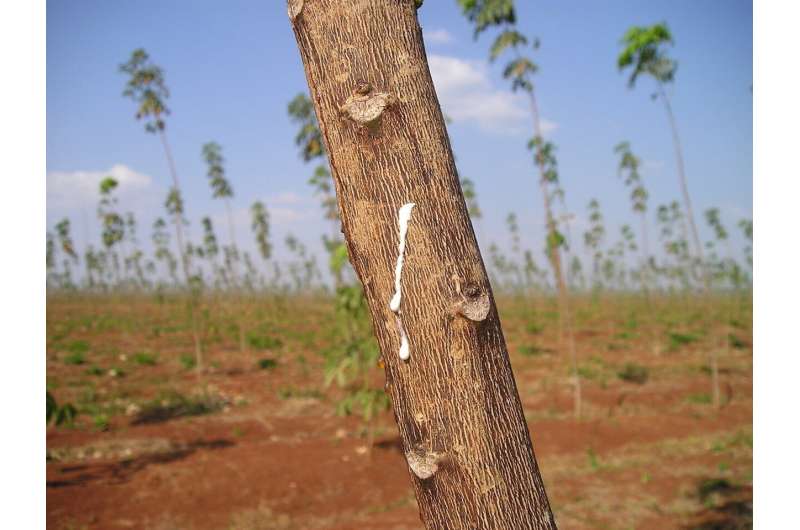
Flexible electronics—including wearable devices, stretchable sensors, and soft robotics—require materials that integrate mechanical flexibility, stretchability, and durability with additional attributes like electrical conductivity. A review in the journal Small considers the potential of natural rubber as a sustainable resource to minimize the carbon footprint of flexible electronics.
The authors examine how natural rubber might be used in different types of flexible sensors, self-powered systems, and energy-harvesting devices, and they consider possible modifications that might enhance natural rubber’s electrical and mechanical properties. The review also discusses challenges and opportunities associated with natural rubber–based flexible electronics, offering insights into future research and plausible commercial applications.
“For years, my research team has been working on the possibilities of using natural rubber and its derivatives for flexible sensors and triboelectric nanogenerators, and we have seen that the inherent properties of gum material can be tuned to generate a new class of sustainable material-based flexible electronics,” said corresponding author Titash Mondal, Ph.D., of the Indian Institute of Kharagpur.
“We are working toward understanding further fundamentals associated with such a system and are making efforts to have an effective lab-to-market transition through appropriate partners.”
More information:
From Trees to Tech: The Contribution of Natural Rubber in Next-Gen Flexible Electronics, Small (2025). DOI: 10.1002/smll.202506264
Small
Citation:
Could natural rubber be a sustainable resource for next-gen flexible electronics? (2025, August 6)
retrieved 6 August 2025
from
This document is subject to copyright. Apart from any fair dealing for the purpose of private study or research, no
part may be reproduced without the written permission. The content is provided for information purposes only.
link



More Stories
Researchers Reveal Molecular Secrets of Flexible Electronics
Growth Outweighs Uncertainty for Flexible and Printed Electronics: OE-A Survey
SEMI FlexTech Announces 2026 FLEXI Award Winners