
Design of the universal interfacial connections
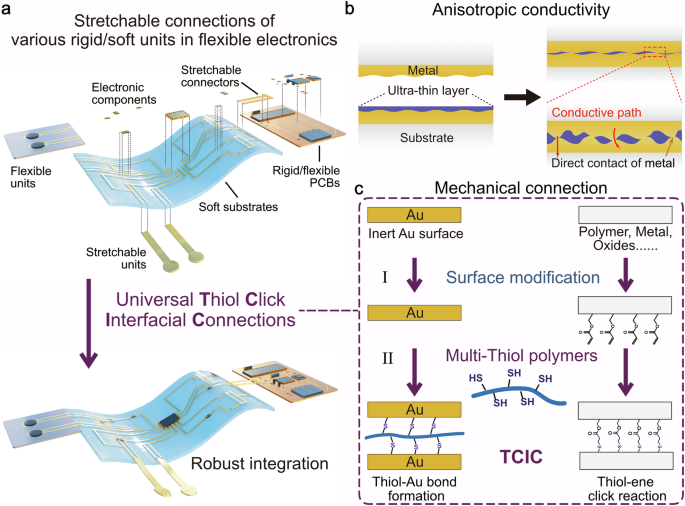
For reactions on surfaces or at interfaces, salinization after plasma treatment is one of the most convenient methods. However, plasma treatment is not suitable for Au, a frequently used material in flexible electronics. Nevertheless, Au is well known to react with thiols or disulfides to form Au-S bonds, which provide covalent connections with Au surfaces. Based on this idea, the universal interfacial connection strategy was proposed and optimized (Fig. 1c). The units/components for flexible hybrid electronics first underwent a two-step surface modification: plasma treatment and salinization. After the modification, the inert Au surface remained unaffected, while other surfaces were covalently grafted with acrylate groups. Then, multi-thiol polymers (MTPs, Fig. S1a) were used as interfacial connectors, which could form thiol-Au bonds and undergo thiol-ene click reactions, thus realizing the covalent interfacial connections that were named “thiol click interfacial connection”. TCIC was applicable to most materials used in flexible and conventional electronics, including rubbers, plastics, metals, oxides, and even papers.
The conditions for TCIC were quite mild and simple; the first surface modification was realized by air plasma treatment for 30 s, followed by vapor-phase modification with 3-(trimethoxysilyl)propyl acrylate at rt for 24 h (Fig. S2a). Then the interfacial connection was achieved by applying MTP solution with sodium ethoxide as the catalyst, contacting the surfaces, and reacting at mild temperatures (rt to 60 °C). As the amount of interfacial MTPs was low, it would not fully block the metal surfaces, thus keeping the electrical conductivity between the conductor surfaces.
Interfacial bond formation
To validate the formation of covalent bonds between surfaces during TCIC, MTP was used to connect various materials used in flexible electronics. First, PDMS was selected to confirm the surface modification and interfacial thiol-ene click reactions. The modification of acrylate groups was evidenced by contact angle measurements (Fig. S2b). Further experiments confirmed that this step would not affect the electrical and mechanical properties of the treated materials (Fig. S3). When MTP was applied, only surface-modified PDMS films were connected (Fig. 2a), which confirmed that the thiol-ene click reaction occurred and the MTP itself did not function as an adhesive. The conditions of TCIC were unified as 100 mg/ml MTP solution in acetone, 1.5 h placement at 60 °C with 0.5 kPa pressure, for reliable comparison among different material combinations (Fig. S4). Under the same condition, commercial anisotropic conductive film adhesive (3 M ACF 7303) provided interfacial toughness of ~3 N/m for PDMS, much lower than the TCIC (over 20 N/m). Besides, after 24 h placement at rt without heating, the interfacial toughness could reach similar values as 1.5 h placement at 60 °C (Fig. S4b), indicating that in practical applications, TCIC could be very mild and convenient.

a Interfacial toughness of surface-modified and unmodified PDMS films connected by MTP after 1.5 h reaction at 60 °C. b Lap shear tests of Cu sheets with different surfaces. c, Raman spectrum of MTP-coated Au@SEBS surface, confirming the formation of thiol-Au bonds. d Changes in the Raman spectra of MTP before and after 3 months of storage at 4 °C. 210 cm−1 stood for the thiol group, and 510 cm−1 stood for disulfide bonds. e Illustration of the covalent bonds formed at interfaces connected by TCIC. The conversion from thiols to disulfides at rt could continuously strengthen the interfaces. f The interfacial toughness of TCIC-connected PDMS films gradually enhanced with prolonged rt placement. g 180° peel tests of soft-soft combinations. The PDMS + PDMS combination had almost 0 interfacial toughness. Au@PDMS was not shown as the Au layer would easily detach from PDMS and result in almost 0 interfacial toughness. h 90° peel tests of soft-flexible/rigid combinations with PDMS or SEBS as the soft stretchable materials. The PDMS + Cu combination had high interfacial toughness, and the PDMS film fractured early during the peeling tests; thus, their toughness values were not obtained.
Cu sheets were further used to confirm TCIC on Au surfaces. Cu and Au-coated Cu (Au@Cu) were surface-treated as in the TCIC process; bare Cu sheets that were only plasma-treated were also tested. As shown in Fig. 2b, the Au-coated Cu sheets had increased connection strength than acrylate-modified Cu. The characteristic peaks at the 240–270 cm−1 band in the Raman spectrum confirmed the existence of thiol-Au bonds (Fig. 2c). The surface of bare Cu was oxidized during plasma treatment and could better react with thiol groups to form thiol-Cu bonds (bond energy of Cu-S is 274.5 ± 14.6 kJ/mol, Au-S is 253.6 ± 14.6 kJ/mol)42, leading to the highest connection strength. The acrylate-modified Cu had a lower reaction site density than bare metals and thus had the lowest strength. Nevertheless, all three groups were well connected by TCIC.
The surface acrylate groups were a monolayer, so the thiol-ene reaction would quickly be “saturated”. The excess thiol groups in the MTP would then be slowly oxidized into disulfide bonds. The Raman spectra of MTP samples confirmed the oxidation (Fig. 2d). The characteristic peak of thiol groups appeared at 210 cm−1, and the disulfide bond peak appeared at 510 cm−1. After storing it for 3 months, the ratio of disulfides to thiols significantly increased, indicating continuous interfacial bond formation after the initial connection by TCIC (Fig. 2e). It was also validated by the self-strengthening interfaces in TCIC-connected PDMS. With longer placement times, the interfacial toughness continuously increased and reached about 233 N/m after 3 months (Fig. 2f). Moreover, even after self-strengthening, the physical properties of the connected materials would not be affected (Fig. S5), which was beneficial for applications in flexible electronics.
Mechanical strength and stretchability
The interfacial toughness of different material combinations was measured to validate the universality of TCIC. PDMS and SEBS were selected as typical materials for soft-soft connections (Fig. 2g). For combinations with PDMS, the interfacial toughness was significantly improved compared to almost 0 without TCIC. Due to the excellent self-adhesion of SEBS, when SEBS or Au-coated SEBS (Au@SEBS) was connected to itself, TCIC exhibited lower interfacial toughness. However, after rt placement, their interfacial toughness increased rapidly and reached a comparable value to the SEBS control group (Fig. S6) and neutralized this issue. When SEBS was connected to other materials, TCIC still greatly enhanced the connection strength (Fig. S7a). For soft-rigid connections, PDMS and SEBS, as stretchable soft parts, were successfully connected with various rigid parts, including flexible materials PI, PET, and paper; electronic materials Cu, Ag, Ti, Sn, Si, and ITO (Fig. 2h and Fig. S7a). Contact angle tests confirmed the modification of acrylate groups on the material surfaces, suggesting that the interfacial thiol-ene reactions promoted the connections (Fig. S7b). The tough bonding of PDMS and SEBS with other materials proved that TCIC was a universal method for various materials.
The improved interfacial strength provided the possibility for robust connections between stretchable and flexible/rigid units. The connected hybrid units kept the stretchability of the soft parts; their lap shear strength and mechanical stretchability (maximum strain) were summarized in Fig. 3a. All the combinations exhibited decent strength and acceptable stretchability, especially the SEBS combinations due to the excellent stretchability of SEBS. Typical tensile curves for the shear stretching tests were selected (Fig. 3b, c), representing the connection of PDMS or SEBS with rubbers, plastics, metals, and papers. The curves for all material combinations are in Fig. S8.

a Summary of mechanical stretchability (strain at break) of TCIC-connected soft-flexible/rigid combinations. Typical tensile curves of TCIC connected. b PDMS, and c, SEBS with other materials. d The common materials used in electronic components, and TCIC connected electronics components with Au@SEBS stretchable conductors. Left: an LED unit bridging two Au@SEBS films. Right: a chip with 8 pins bridging two Au@SEBS films.
The connections of stretchable materials with materials for manufacturing conventional electronic components (metals, silica, and oxides) have already been realized by TCIC. To further confirm that TCIC could construct stable connections between stretchable circuits and electronic components, rigid LEDs and chips were connected to stretchable materials (Fig. 3d). They could be well connected and achieve high stretchability (Fig. S9). The stretchability between PDMS/SEBS and various flexible/rigid materials validated that TCIC was a universal method for constructing reliable mechanical connections.
Electrical conductivity and stretchability
Unanticipated, the added MTP layer did not block the electron pathway between the surfaces, and TCIC-connected Au@Cu kept their high conductivity (Fig. S10). More accurate measurements confirmed the low contact resistance of TCIC which was only ~1.5 mΩ with 50 mg/mL MTP and ~3.5 mΩ with 50 mg/mL MTP for 1 cm2 contact area between Cu@PI (Fig. S11a). And the oxidation of MTP layer would not result in increased contact resistance (Fig. S11b). To understand the mechanism, the MTP interlayer was exposed by a sacrificial layer method (Fig. S12a), followed by characterization by a conductive atomic force microscope (C-AFM). As the amount of MTP was quite small (the solution applied was 0.7-0.8 μL/cm2), the MTP interlayer was thinner than 10 nm with imperfections (Fig. 4a), leaving exposed metal surfaces. When connected, these exposed points from two surfaces contact each other and build conductive pathways (Fig. 4b), especially when one of them is a deformable soft unit. The conductivity mapping by C-AFM confirmed the leaky conductive sites in the MTP interlayer (Fig. 4c), and with less MTP the exposed conductive sites could be increased (Fig. S12b). The absence of conductive fillers guaranteed an anisotropic conductivity of TCIC, making its applications more convenient.

a 3D AFM height map of exposed Au surface after TCIC treatment with 100 mg/mL MTP. b The mechanism for the electron pathways at the MTP interlayer after TCIC. c Exposed conductive sites revealed by conductive AFM. d Comparison of electrical stretchability of connected Au@SEBS films by self-adhesion or TCIC. e The electrical stability of TCIC connected Au@SEBS and commercial Cu@PI, which simulates PI PCBs. f The electrical stretchability of TCIC-connected striped EGaIn@PDMS films. The films could not be connected without MTPs. g The electrical stability of TCIC connected striped EGaIn@PDMS. The resistance fluctuation was caused by the deformation of the liquid metal during stretching. The electrical stretchability of various electronic materials connected to h, Au@SEBS, i EGaIn@PDMS by TCIC.
The electrical stretchability of TCIC was measured with Au@SEBS and liquid metal-coated PDMS (EGaIn@PDMS) (Fig. S13a). Au@PDMS is also popular, but the poor Au-PDMS interface limited their stretchability after connection (Fig. S13b). The electrical stretchability was first confirmed by connecting two Au@SEBS films (Fig. 4d). As Au@SEBS could be refined to an excellent self-connective stretchable conductor41, the control group exhibited higher electrical stretchability. The reason was the stronger MTP-Au interface than the Au-SEBS interface. Although the Au was more tightly bonded to SEBS than to PDMS, the Au would still be peeled off from SEBS by TCIC during stretching before mechanical failure (Fig. S14a). Nevertheless, TCIC-connected Au@SEBS films showed good stability and could be further improved by using striped Au@SEBS films (Fig. S14b). Moreover, the TCIC-connected Au@SEBS exhibited better electrical stretchability in the strain range of 0-40%. As shown in Fig. S14c, even though strain/stress concentration appeared at the edges of the connection, the MTP layer also dissipated the stress of the covered Au, leading to slower and less crack formation during stretching. Further, Au@SEBS films were connected to patterned commercial Cu@PI films, which simulated the connections of stretchable units with flexible PCBs. After 3,000 stretching cycles at 40% strain, the resistance increased by only 17% at 40% strain (Fig. 4e), indicating the good stability of TCIC-connected electronics.
EGaIn@PDMS, benefiting from liquid metal, had excellent mechanoelectrical performance, but the poor adhesion of PDMS and liquid metal hindered their connection. TCIC could overcome this problem and realized robust connections for EGaIn@PDMS (Fig. 4f). The EGaIn@PDMS had to be stripped as liquid metal would easily peel off from PDMS, and bare PDMS surfaces were required to provide mechanical connections. TCIC-connected EGaIn@PDMS also exhibited excellent stability; it remained highly conductive during and after 10,000 stretching cycles at 60% strain, regardless of the fluctuation caused by the deformation of liquid metal (Fig. 4g). The mechanical properties of the connections also tolerated cyclic stretching (Fig. S15), indicating the robustness of TCIC.
The electrical stretchability of combinations between stretchable and flexible/rigid conductors was measured (Fig. 4h and i). They all exhibited certain electrical stretchability, and the combination of stretchable conductors and commercial Cu@PI could endure cyclic bending and twisting (Fig. S16), confirming the universality of TCIC. For several most encountered conductive materials in electronics, Sn, Cu, and Au, the electrical stretchability all reached more than 40% strain. For Au@SEBS samples, the stretchability was limited by the Au-SEBS interface in the stretchable conductor (Fig. S17). Unlike Au@SEBS, EGaIn@PDMS samples had better conductivity, but their mechanical failure occurred earlier than electrical failure (Fig. S18). The selection between these two stretchable conductors should be done considering the practical requirements of the connections. The above results confirmed the universality of TCIC and the good electrical stretchability and stability of TCIC-connected electronics.
Comparison between TCIC and other recently reported stretchable connections41,43,44,45,46 was summarized in Table S1. TCIC had good mechanical durability and electrical stability; its fabrication and application were also one of the simplest. Most importantly, TCIC was applicable to most materials encountered in flexible electronics, endowing it with excellent universality. TCIC was also compared to commercial ACF, silver paste, and other reported ACFs47,48,49,50 (Fig. S19 and Table S2), showing its advantages in convenience and performance.
Applications of TCIC in flexible hybrid electronics
TCIC was mild, fast, and universal for most materials used in electronics, which made it possible to integrate rigid electronic components with stretchable units quickly and stably for the fabrication of flexible hybrid devices. To illustrate the convenience and performance of TCIC, stretchable circuits on various flexible substrates were fabricated. Due to the excellent electrical stretchability of EGaIn@PDMS, circuits on PDMS exhibited satisfactory performance. TCIC-integrated LED on EGaIn@PDMS could be stretched to more than 80% strain while still lighting brightly (Movie S1). The TCIC-mounted LED was stable and could withstand more than 4000 stretching cycles without decay in light luminance (Fig. 5a). On the contrary, the attached LED on EGaIn@PDMS under the same conditions without MTP would easily detach from the circuits (Fig. 5b and Movie S2). Based on the EGaIn@PDMS, stretchable circuits with multiple LED sites were fabricated (Fig. 5c). The circuits exhibited excellent stretchability along different directions (Fig. 5d). Even when the LEDs were pulled up by a tweezer and shaken violently, the TCIC-mounted LED circuits would not fail and kept their light-emitting functions (Movie S2). The integration of LED with EGaIn@PDMS circuits confirmed the stability and high performance of TCIC in manufacturing flexible hybrid devices.

a Relative change in light intensity of an LED mounted on EGaIn@PDMS circuit by TCIC during cyclic stretching for 4000 cycles at 80% strain. The LED became brighter when being stretched as the contact area between LED pins and liquid metal increased after deformation. b LEDs were unable to stay on EGaIn@PDMS without TCIC treatment. c Schematic of the stretchable LED circuits on EGaIn@PDMS. d The TCIC-mounted LEDs could endure large strain during both the X- and Y-axis stretching. Scale bar: 3 cm. e Relative change in light intensity of an LED mounted on Au@SEBS circuit by TCIC. f A paper-based photoresistor-controlled flexible device. Scale bar: 1 cm. g Illustration of the gesture visualizing glove integrated from various soft/rigid units by TCIC. h Coding of the four colored lights on the gloves and four representative gestures with their corresponding codes.
Au@SEBS circuits were also fabricated by TCIC. As shown in Fig. 5e, the light of LED on Au@SEBS decayed significantly when being stretched due to the increased resistance of Au@SEBS at the edges of the soft-rigid interfaces. The overall stretchability could be improved by constructing stable rigid islands via TCIC (Fig. S20), exhibiting the versatile application strategies of TCIC.
To further prove the versatility of TCIC, paper, a common and cheap substrate, was used for fabricating flexible circuits. The circuits could be directly drawn on paper by conductive inks, such as copper and silver paints. Without any soldering process, LEDs were mounted on paper circuits by TCIC and could withstand twisting or bending (Fig. S21a and Movie S3). For more complicated and precise circuits, the conductive lines were produced by thermal vapor deposition of Au on papers with masks. A circuit was fabricated on paper and linked to an LED on Au@SEBS (Fig. S21b) with all interfaces connected by TCIC. The circuit had a photoresistor as control (Movie S4). This TCIC-integrated flexible hybrid device could function under deformation (Fig. 5f), validating the versatility of TCIC.
Finally, a multi-materials integrated gesture-visualizing glove was designed and fabricated with the entire system connected by TCIC. The glove was composed of multiple components and units, including the substrate nitrile glove, EGaIn, PI, Au@SEBS, PET, conductive silver paste, LED components, and a rigid battery holder unit (Fig. 5g). LEDs were mounted on EGaIn@PI by TCIC as LED rigid stripes, which were attached to the glove by TCIC. The finger direction of EGaIn@PI was connected to a hollow PET frame and Au@SEBS by TCIC (Fig. S22a). When the finger bends, the adhered Au@SEBS would be stretched with increased resistance, leading to open circuit and function as a switch that senses finger bending (Fig. S22b). The rest circuits on the glove were drawn by a conductive silver paste and connected to the battery holder through stretchable Au@SEBS by TCIC. The whole hybrid device was integrated by TCIC from the above-mentioned materials and units. Four LEDs with distinct colors were connected to four fingers and were ON when the fingers were straight. The colors of the lights indicated the position of the LED and were used for coding the gestures; thus, they could be recognized even in the dark (Fig. 5h and Fig. S23a). The distinct colors made it possible to distinguish the codes better, for instance, codes from single-colored LEDs would be indistinguishable for 0011, 0110, and 1100. The gesture visualization by the glove was also achieved on a human hand (Movie S5), and the gestures could be speculated by the lights in the dark (Fig. S23b). The applications of TCIC in the fabrication of multiple material/unit devices have further proved its stability, universality, convenience, and practicability in flexible hybrid electronics.
link


More Stories
Researchers Reveal Molecular Secrets of Flexible Electronics
Growth Outweighs Uncertainty for Flexible and Printed Electronics: OE-A Survey
SEMI FlexTech Announces 2026 FLEXI Award Winners