
Printing process
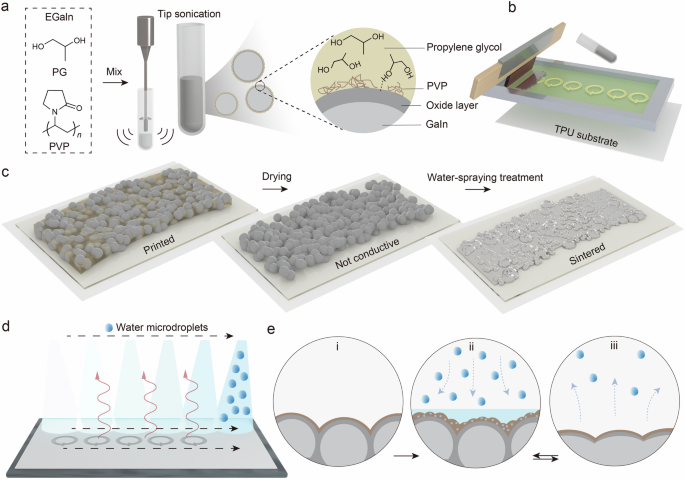
The scalable fabrication process, including ink formulation, screen printing, and sintering, is illustrated in Fig. 1. The ink is formed by dispersing liquid eutectic gallium indium (EGaIn, melting point 15.7 °C) into a solvent by tip sonication. The use of a green and harmless solvent is important to enable scalable production in an open printing environment. The solvent PG was, therefore, chosen as it is widely used in edible items and in pharmaceuticals. PG also has a rather high boiling point of 188.2 °C, which is suitable for screen printing to avoid spontaneous drying in the screen. PVP was chosen as a combined dispersion agent and rheology modifier due to its safety, as it is a common pharmaceutical additive. The ink showed a shear thinning behavior, starting at a shear viscosity of 27 Pa·s at 0.1 s−1 shear rate, followed by a gradual decrease to 2.5 Pa·s at 1000 s−1, which is a suitable viscosity range for screen printing (Supplementary Fig. 1a). The ink produced good printing quality in a semi-automatic screen printer (EKRA E2) when printed on stretchable commercial TPU substrates (Supplementary Fig. 2). After drying, the printed layers were nonconductive due to the electrically insulating oxide layer around the EGaIn particles, thus a sintering step was needed. To allow for industrial manufacturing, the sintering method needs to i) be applicable to large-area surfaces, ii) be compatible with common substrates and printing materials, iii) use harmless chemicals, iv) allow high-throughput, v) keep registration throughout the process (e.g., no deformation of the substrate). To fulfill these requirements, we developed a sintering method based on water spraying by using a programmable spray coater allowing substrate sizes up to A3. The sprayer includes an airbrush that generates microdroplets which are spread over the heated substrate according to a program. The liquid metal particles in the dried ink are covered by a PVP layer (Fig. 1e–i), which is sensitive to humidity. The sprayed water causes the PVP layer to swell (Fig. 1e–ii) and subsequently shrink when dried. The induced mechanical forces in this process cause the oxide layer of the particles to locally break and thereby merge the particles together (Fig. 1e–iii). After several swelling and drying cycles, the previously isolated particles have then merged into a continuous conductive network which causes the conductivity of the printed layers to increase dramatically.

a The ink is produced by dispersing EGaIn into a PG-PVP solution through tip sonication. The EGaIn dispersion is stable due to the adsorbed PVP on the oxide surface. b The ink is screen printed by a conventional printer on the substrate. c After printing and drying, the print is made conductive through water-spray sintering that merges the EGaIn droplets. d Spray sintering is performed on a hotplate with a spraying robot scanning over the substrate. e Repeated cycles of swelling and drying of the PVP layer within the print create internal strain, which causes mechanical sintering of the particles.
Water-spray sintering
The spraying process needs to be carefully controlled to guarantee uniform sintering over large areas. The aim is thus to uniformly spread water droplets over the printed patterns. The key parameters (height, velocity, pitch) of the spraying process are illustrated in Fig. 2a where a specific spray head (airbrush) is used to generate a fixed spray flow. The maximum settings for height (80 mm) and pressure (2 bar, fully open valve) were used to maximize the coverage of a single spraying pass. For characterization of the water deposition density, water with added blue dye was sprayed on A4 white papers (Supplementary Fig. 3a, b). The generated blue traces on the papers were scanned, and the color density was analyzed using an image processing program (ImageJ, Supplementary Figs. 3c and 4). As expected, the water density depended strongly on the spraying velocity (Fig. 2b), with the amount of sprayed water following the expected theoretical trend (Supplementary Fig. 5). The bell-shaped distribution curve confirmed that the sprayed water density was highest in the center and decreased towards the edges. We thereafter investigated how the distance between the spraying scans, or the spraying pitch, influenced the water density distribution curve, and found that 10 mm pitch produced a uniform water distribution (Fig. 2c). For larger pitch values, the contributions from the individual traces can be seen as waves in the water density profile. For smaller pitch values, the distribution of water will be concentrated due to the stacking of individual traces. To verify that these results translated into uniform sintering, printed lines were placed at different positions and orientations with respect to the sprayed area (Fig. 2d). The blue arrows indicate the spraying directions, the red lines represent the distribution of water, the black patterns show the placement of printed lines and blue rectangles are the sprayed area. The measured conductivities for the various positions and orientations within the sprayed area (positions 1, 3, 4) had a narrow distribution, while samples placed on the border of the sprayed area had a slightly larger variation (position 2). We could thus conclude that 10 mm pitch produces a homogeneous sintering result over a large area. Each water-spraying cycle was programmed to cover the whole area of the printed pattern, which typically resulted in multiple spraying sweeps (Fig. 2a). As the sprayed area dried within 2 s due to the heating by the hotplate underneath, there was no need for introducing any waiting time in between cycles.

a Illustration of the parameters of the spraying process. b Sprayed water density as a function of spraying velocity. c Optimization of spraying pitch for 80 mm/s spray velocity. A pitch of 10 mm provides uniform coverage without extensive overlap. d Sintering uniformity for printed conductors at different locations with respect to the sprayed area. e Optimization of the PVP content of the ink with respect to final conductivity. f Sintering efficiency as a function of spraying velocity and number of cycles. g Photographs of sintered printed conductor with different PVP content. h SEM images of printed conductors before and after sintering for various conditions (all scale bars: 5 µm).
As PVP both facilitates the sintering of the particles but also may act as an insulating matrix within the prints, we expected the PVP concentration to heavily influence the results. Indeed, the achieved conductivity varied greatly with the PVP concentration in the ink, reaching a highest conductivity of 7.32 ± 0.30 x 10⁵ S/m for 1.125 wt% PVP (Fig. 2e). Low PVP concentrations proved insufficient to induce the necessary sintering, while high PVP concentrations also reduced the conductivity, likely due to its insulating effect. The macroscopic effect of the PVP concentration on the sintering can be seen in photographs, where the film morphology changes during sintering at higher PVP concentrations but not at lower ones (Fig. 2g).
The degree of sintering also depended strongly on the number of applied spraying cycles and the spraying velocity (Fig. 2f). The hotplate heating ensured that the prints dried in between each spraying passage. The degree of sintering improved with the number of applied spraying cycles until it saturated at around 20 cycles. This was rather expected, as repeated shrinking cycles can rupture and merge more and more of the particles. Fully sintered traces (Supplementary Fig. 6c) have a rougher and shinier look than the non-sintered ones (Supplementary Fig. 6a) and partly sintered samples (Supplementary Fig. 6b). Interestingly, the same monotonic trend cannot be seen for the spraying velocity, which shows a distinct optimum at 80 mm/s. That sintering is inefficient at too high velocities (>80 mm/s) with too little water is quite natural, however the characterization also reveals that too much water (<80 mm/s) can be as detrimental. One hypothesis could be that it is desirable to swell the PVP in place to induce strong shrinkage forces upon drying while flooding the print with water could mobilize the PVP phase and potentially separate it from the particles. Lower spraying velocities created larger water droplets on the surface of the prints, causing uneven water distribution, flowing of particles, and coffee ring effects (Supplementary Fig. 7). For the optimum spraying condition, a water layer of 8 µm average thickness was deposited (calculated from Supplementary Fig. 5 and the spraying pitch), which is similar to the thickness of the printed conductor layer. This small amount of water did not distort the shape of the printed pattern (Supplementary Fig. 8, 9). SEM images of various sintering conductions can provide further insights into the process (Fig. 2h). Figure 2hi-iii shows how particles merge into larger ones with increasing number of sintering cycles (0, 5, 15 cycles). At 15 cycles, for which the conductivity has saturated, most particles have merged into large domains which facilitates the macroscopic conduction. When increasing the PVP concentration beyond the optimal condition (>1.125 wt%, Fig. 2h iv–vi), the merging of large particles is quenched, which explains why the conductivity saturates at a much lower level. Multilayer stacks of conductors could be printed, with total thicknesses of 8, 16, and 22 µm for 1, 2, and 3 layers, respectively (Supplementary Fig. 10a). The efficiency of the sintering remained good, although there was a slight decrease in conductivity for multilayers (Supplementary Fig. 10b). The ink showed excellent storage stability, with stable performance of printed layers for up to 8 months storage time (Supplementary Fig. 1b).
Conductor performance under strain
Next, the electrical performance under strain was evaluated for printed conductors with a printed TPU encapsulation layer on top. The prints showed good quality and line widths down to 200 µm were easily reproduced (Fig. 3a, Supplementary Fig. 8). As the filler particle size was ≤5 µm (Fig. 2h), a finer screen mesh in combination with optimized printing parameters should allow for a substantial reduction in line widths if needed. Printed conductors of different line widths showed similarly good performance under strain and remained highly conductive up to about 800% strain at which the substrates fractured (Fig. 3b). Furthermore, the test samples also demonstrated excellent performance for strain cycling up to 200% strain by maintaining a relative resistance change below a factor of 2 (Fig. 3c). Stress-strain measurements showed increasing elongation of the samples with strain (Supplementary Fig. 11), which explains why the resistance does not fully recover in the relaxed state after higher strains. The strain rate had no major effect on the electrical performance (Fig. 3d). During 500 strain cycles at 50% strain, the relative resistance change stabilized well below a 10% increase of the original resistance (Fig. 3e), which is surprisingly good considering the geometrical change of the conductor during stretching. Altogether, the electrical performance under strain is excellent for the printed conductors, with a very low strain sensitivity.

a Printed test structures with line widths varying from 0.2 to 1 mm. (scale bar 1 cm). b Relative resistance vs strain until break for different line widths. c Resistance vs strain cycles for increasing strain. d) Resistance vs strain cycles at different strain rates. e Strain cycling at 50% strain for 500 cycles.
Two aspects of the resistance-strain data deserve further attention and analysis; the decrease in resistance during strain cycling at moderate strain (Fig. 4b, dashed purple line), and the surprisingly small increase in resistance during stretching at higher strain (Fig. 4b, dashed red line). The first effect is known from literature as strain-induced sintering of particles23. After the water-spray sintering, most of the liquid metal particles are merged but there exist still some insulating domains within the film that can be broken by strain. The observed effect happens during the first strain cycles (Figs. 3e and 4b), which is consistent with the proposed mechanism (Fig. 4a). The result is that the resistance decreases when the printed conductor is exposed to moderate strain, which typically is beneficial.

a Schematic illustration of strain-induced sintering in printed LM conductors. b Normalized resistance under strain cycling. The purple line indicates the region where the resistance decreases due to strain-induced sintering. The red line indicates the region where the resistance scales better with strain than the theoretical geometry factor. c Comparison of normalized resistance between the geometry factor ((1+ε)2, ε is strain) and our conductor. d Schematic illustration proposing the structural cause behind the better-than-theory performance. e Optical profilometer height maps of the printed conductor under strain (scale bar 0.1 mm). f Directionality of the conductive path based on 2D FFT analysis.
The second effect is less obvious, as it has been reported that liquid metal conductors maintain constant conductivity under strain33 and thus the resistance should follow the geometrical scaling ((1+ε)2, where ε is strain) of the conductor under strain34,35. As a conductor gets stretched, the cross-section area decreases, and the length increases (Supplementary Fig. 12), resulting in substantial increase in resistance even if the conductivity is preserved. For 200% strain, the geometry factor is (1 + 2)2 = 9, which implies that for preserved conductivity the resistance should increase with a factor of 9. In our case, however, the resistance only increases by a factor of 3.56 for our printed conductors (Fig. 4c). This implies that the conductivity of the conductors actually increases with strain and reaches an outstanding calculated value of 19 × 105 S/m at 200% strain. To understand this strain effect, we measured height maps using optical profilometry of the printed conductor at various strains (Fig. 4e). This revealed that our printed conductor does not behave like a pure liquid metal, as it is stiffened by integrated PVP domains. Prior to stretching, no major defects were visible in the film. After being pre-stretched to 50%, however, cracks perpendicular to the strain direction were visible. This is rather unfavorable for conduction, as the conductive path mainly goes perpendicular to the relevant direction. Upon stretching, the domains in the film tended to realign into a more random network, which is better for conduction. This was also confirmed by 2D fast Fourier transform (FFT) analysis of the height map, which clearly shows a realignment of the conductive domains in the strain direction (Fig. 4f, Supplementary Figs. 13 and 14). The suggested mechanism is illustrated in Fig. 4d, explaining how our conductor can scale better-than theory predicts by alignment of conductive domains. Similar behavior has been observed in conducting polymers, as the realignment of polymer chains/fibrillar domains can result in a conductivity increase for moderate strains36. One should note, however, that the liquid domains within the printed conductors have the possibility to flow within the PVP framework, making it different from just the realignment of fibrils. SEM images of stretched conductors indeed reveal that a liquid metal layer is formed in the cracks between the thicker and stiffer portions of the print (Supplementary Fig. 15). Upon release of the strain, a new texture is formed on the conductor, indicating remaining morphological changes that are consistent with an observed increase in conductivity. Together, the two described mechanisms can explain the principle behind the outstanding electrical performance of our printed conductors under deformation.
Printed stretchable NFC circuits
To demonstrate the capability of our developed ink and sintering process for large-scale manufacturing, the ink was printed in a semi-automatic screen printer EKRA (Supplementary Fig. 2a, b) within the manufacturing line at the Printed Electronics Arena facility in Norrköping. The prints showed good printing quality over the large-area substrates, onto which the developed sintering process could be applied without modification (Fig. 5a). The NFC circuit design (Fig. 5b) requires printing of several conducting and insulating layers on top of each other. Our process is compatible with this requirement, as vertical interconnect access (VIA) holes could be incorporated as openings in the printed insulating TPU layers, through which the conductor layers were interconnected (Supplementary Figs. 16 and 17). The overprinting compatibility of the liquid metal ink and the TPU ink thus allows for the fabrication of multilayer circuits, which enables the implementation of complex circuitry. The NFC antennas (Supplementary Fig. 18) were designed for an operating frequency of 13.5–14.0 MHz to meet practical use requirements. An NFC chip was mounted onto the antenna circuit to complete the NFC tag, which could be wirelessly read using a mobile phone (Fig. 5b). The printed antennas could be stretched, twisted, and heat-pressed onto textiles while maintaining their functionality (Fig. 5c, Supplementary Videos 1 and 2).

a Screen printed liquid metal pattern on a stretchable TPU substrate by a semi-automatic screen printer (scale bar 5 cm). b Exploded-view illustration of the layers in the stretchable NFC antenna. c The stretchable NFC circuits can be read out by a mobile phone when mounted on skin or on textile. d Scattering parameter S11 under uniaxial strain and different operating distances. e Resistance and resonance frequency of the coil under strain.
The reflection coefficient S11 is a key parameter for characterizing antennas for wireless radio frequency communication. The detecting circular single-turn loop antenna was placed in a customized plastic test fixture (Supplementary Fig. 19) to avoid metal interference. The manufactured NFC tags were tested under different strains and operating distances (Fig. 5d). Typically, the resonance frequency will decrease during stretching, as the increasing coil area results in higher inductance, which lowers the resonance frequency. As the size of the sensing loop is fixed, its matching to the stretched antenna worsens with strain, which causes a decay in signal strength (Fig. 5d, left). Similar decays in signal strength can be observed for increasing operating distances (Fig. 5d, right). The coil resistance increased a bit with strain, but no significant broadening of the resonance peak was observed (Fig. 5e). The resonance frequency remained within the intended range for up to 50% strain (Fig. 5e).
As the developed sintering technique here is inexpensive and harmless, it is interesting to consider how it could be scaled into a high-throughput setup. For both sheet-based and roll-to-roll processing, one can envision a station where the substrate is fed through multiple spraying units, where each unit has enough nozzles to cover the full width of the substrate. In such a setup, the drying time between spraying steps and the length of the station dictate the maximum feedthrough speed. For example, 15 spraying units with 2 s drying and a 2 m long station would give 4 m/min feedthrough, which is fast enough in the printed electronics context. It is challenging to compare our method to other previously reported sintering methods from a scalability perspective, as none of the methods have been upscaled to date. To give an indication, we have compiled the strengths and potential weaknesses of various liquid metal sintering methods in Supplementary Table 1 and conclude that water-spray sintering compares well to other potential methods with respect to upscaling. The use of inks with green solvents in combination with robust and scalable water-spray sintering makes the method attractive from a cost, safety, and performance perspective. We, therefore, believe that the reported method constitutes an attractive pathway toward high-throughput roll-to-roll manufacturing of printed stretchable electronics.
link


More Stories
Researchers Reveal Molecular Secrets of Flexible Electronics
Growth Outweighs Uncertainty for Flexible and Printed Electronics: OE-A Survey
SEMI FlexTech Announces 2026 FLEXI Award Winners