


Soap bubble transfer printing
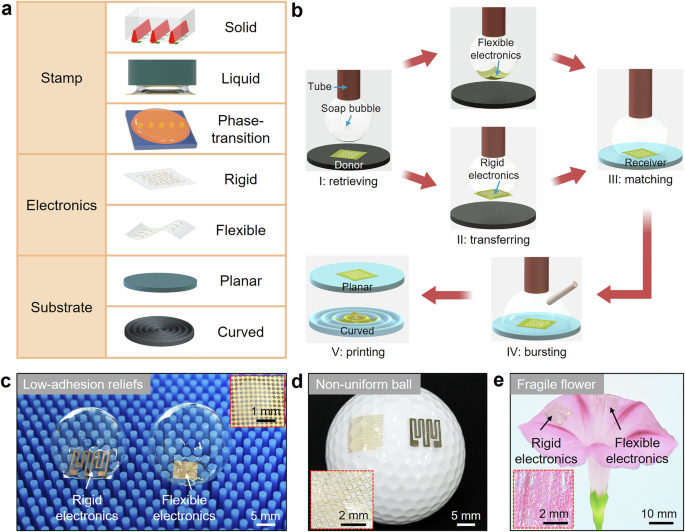
Figure 1b and Movie S1 (Supplementary Information) schematically illustrate the novel concept of the soap bubble transfer printing, featuring a common soap bubble as the stamp. The rigid and flexible electronics are prefabricated on the planar substrate by inkjet printing and mature micro/nanofabrication, respectively. As illustrated in Fig. 1b, we move the blowing tube to initiate contact between the soap bubble and the electronics, and then vertically lift the tube to retrieve the electronics from the donor substrate (Step I). After being separated from the substrate, the soap bubble stamp forms a convex liquid bridge to lift the rigid electronics, while the flexible electronics conformably deforms with the soap bubble (Step II). Subsequently, we inflate the soap bubble to ensure that the contact line between the soap bubble and the receiver substrate progressively propagates in a rheological manner, allowing the electronics to conform to the receiver substrate until the contact line exceeds the electronics (Step III), which effectively helps mitigate the bursting-induced damage. Finally, the soap bubble bursts on demand through puncturing with a finite-size bar (Step IV), allowing for the respective printing of both rigid and flexible electronics onto planar and curved substrates (Step V).
In soap bubble transfer printing, several existing challenging operations, including difficult micro-structure relief design10, narrow-range velocity control15, damage-related preload12, complex external stimuli38,39, and carefully-controlled planking23/attaching20 processes, are no longer required to lower printing difficulty and complexity. During the transfer process, the soap bubble, exhibiting capillary stability superior to that of the liquid droplet stamp40, is capable of hosting rigid, flexible, and three-dimensional curved electronics over a large area, significantly expanding the compatibility of transfer printing. In the printing process, the easy-to-burst property of the soap bubble enables the adhesion-independent printing to tackle switchability conflict for solid stamps29, while the ultrathin (microscale thickness) feature of the soap bubble minimizes the residual contamination for liquid stamps17. In addition, the rheological feature of the soap bubble guarantees the conformal, wrinkle-free, and damage-free printing as shown in Fig. S1c (Supplementary Information). Exemplarily, both rigid and flexible electronics are successfully integrated onto low-adhesion reliefs (Fig. 1c), non-uniform ball (Fig. 1d), and delicate structures such as a fragile flower (Fig. 1e). Furthermore, essentially different from the transfer printing of discrete pixels24, soap bubble transfer printing supports electronics prefabricated on membranes, and a transfer yield of 100% can be readily achieved, while the pattern resolution in electronics is, in principle, unlimited, benefiting from the decoupling between fabrication and transfer printing.
Transfer printing mechanism and volume modulation strategy
Through the forming and bursting of a soap bubble, prefabricated electronics can be easily retrieved from the donor substrate and printed onto the receiver substrate in an adhesion-independent manner. In Fig. 2 and Movies S2–S4 (Supplementary Information), both tilting during transferring and tombstoning during printing occur for electronics, which have not been reported in existing research. Moreover, the maximum allowable weight, the maximum damage, alignment accuracy, and morphology control for electronics play crucial roles in determining the versatility and compatibility of the soap bubble transfer printing. Here, mechanical models presented in Sections S2–S6 (Supplementary Information) are proposed to tackle the above problems, and a volume modulation strategy is introduced to guide the soap bubble transfer printing.


a A rigid electronics is positioned either tilted for a low-volume soap bubble (left) or horizontally for a high-volume soap bubble (right). b The relation between the tilt angle α of the electronics and the soap bubble volume V corresponding to different initial masses m0. Solid lines and dots respectively represent the theoretical solutions and experimental results. c A rigid electronics is either flipped for a low-volume soap bubble (top), leading to tombstoning and failure of printing, or successfully printed for a high-volume soap bubble (bottom) in an experiment. d Single contact line (top left) and multiple contact lines (bottom left) of electronics, and the relation between the torque M and the soap bubble volume V corresponding to different electronics weights G (right) and the moving distance of the contact line b = 0.1 mm. e A soap bubble deforms when carrying a heavy electronics. f The carrying capacities of both the soap bubble and liquid droplet17 stamps as a function of the volume. Solid lines and dots, respectively, denote the theoretical solutions and experimental results of the soap bubble stamp for L = 10 mm, while the dashed line represents the theoretical solutions of the droplet stamp. g The resistance changes for rigid and flexible electronics transferred through solid and soap bubble stamps11.
During the transfer process, as depicted in Figs. 2a and S2a (Supplementary Information) and Movie S2 (Supplementary Information), both rigid and flexible electronics exhibit tilting when lifted by the soap bubble stamp. This tilting can be adjusted through tuning the soap bubble volume, allowing for the programmable printing onto the inclined surface. The mechanical model in Fig. S2b (Supplementary Information) shows that the initial mass of the soap solution m0 consists of the mass of the soap bubble ms and the one of the residual liquid materials mr, while free mass transfer exists between the soap bubble and the residual liquid materials to prevent the capillary instability and the premature bursting of the soap bubble. The governing torque equilibrium and the spherical surface assumption in Section S2 (Supplementary Information) yield the tilt angle of the transferred electronics as α ≈ C2 (m0−ρhC1V2/3), in which C1 and C2 are to-be-determined coefficients, V is the soap bubble volume, and ρ and ℎ represent the density and thickness of the soap bubble, respectively, as illustrated in Fig. 2b. This indicates that the residual liquid materials are the primary cause of the tilting phenomenon, and the tilt angle α can be effectively controlled by adjusting the initial mass m0 and the soap bubble volume V in experiments. Consequently, a volume modulation strategy through programmable inflation to consume residual liquid materials is proposed to enable printing onto both planar (α = 0) and inclined (α = π/4) substrates, as shown in Fig. S2d (Supplementary Information).
During the printing process, when meeting the receiver substrate as shown in Figs. 2c and S3a (Supplementary Information) and Movie S2 (Supplementary Information), both rigid and flexible electronics might stand up, similar to the tombstoning phenomenon observed in printed circuit board soldering41. The tombstoning during printing is a sequential result of the tilting during transferring. Our experiments in Figs. 2d and S3b (Supplementary Information) reveal that a soap bubble with a low volume V tends to tilt (α > 0) and have a single contact line during printing, which leads to tombstoning. In contrast, a soap bubble with a high volume V tends to have horizontally-placed electronics (α = 0) and multiple contact lines, resulting in successful printing. The mechanical model in Section S3 (Supplementary Information) defines the torque dominating the tombstoning behavior as M = 2γL2(sinθR + sinθP)−ΔPL3/2−GLcosα/2, in which γ represents the surface tension of the soap bubble, L and G represent the length and weight of the electronics, respectively. The Laplace pressure ΔP, contact angles θR and θP, and tilt angle α are all functions of the soap bubble volume V, as illustrated in Fig. S3c (Supplementary Information). The theoretical solutions in Fig. 2d reveal that both the tilt angle α and the torque M decrease with the increase of the soap bubble volume V, eventually leading to α = 0 and successful printing. Therefore, our volume modulation strategy through programmable inflation is capable of preventing undesired tombstoning and guaranteeing successful printing.
The utility range of soap bubble transfer printing is determined by the carrying capability of the soap bubble stamp. The mechanical model in Section S4 (Supplementary Information) defines the maximum allowable weight of the transferred electronics as Gmax = 2πγLcosθe−ΔPπL2/4, in which both the contact angle θe and the Laplace pressure ΔP are functions of the soap bubble volume V and the blowing tube diameter d, as illustrated in Figs. 2e and S4a (Supplementary Information). This indicates that by programmatically adjusting the soap bubble volume V and the blowing tube diameter d, the carrying capability of the soap bubble can be significantly enhanced, as verified in Fig. 2f. Ideally, the soap bubble can be as large as meterscale42, and we have L = d = 1000 mm in principle, leading to the allowable weight as high as Gmax = 193.4 mN, which is two orders of magnitude higher than that of liquid droplet stamp17.
Throughout the entire transfer printing process, the maximum strain in transferred electronics is critical for evaluating potential damage. The mechanical model in Section S5 (Supplementary Information) reveals that, for the insignificant bending of rigid electronics and the remarkable conformal deformation of flexible electronics, the maximum strains are respectively εmaxrigid = 0.003% and εmaxflexible = 0.011%, both are significantly lower than the fracture strain of electronics43. Furthermore, our experiments in Fig. 2g demonstrate that for both rigid and flexible electronics, the resistance change experienced with the soap bubble stamp is much lower than that with a solid stamp11. This indicates that the soap bubble transfer printing technique is physically gentle and damage-free.
Alignment accuracy and morphology control are crucial for guaranteeing circuit performance and preventing wrinkles in soap bubble transfer printing. The low stiffness and fluidic nature of the soap bubble yield undesired motion of the transferred electronics, leading to poor alignment accuracy and limiting its applicability in scenarios requiring strict layer registration, such as multilayer transfer printing33,34. Figure S5, Movie S3 and Section S6 (Supplementary Information) demonstrate that adjusting the nozzle shape, soap solution concentration, and soap bubble volume can significantly enhance stability for transferred electronics, yielding reproducible alignment offsets within hundreds of micrometers for multilayer printing even through manual operation, as shown in Figs. S5d and S6 (Supplementary Information). Moreover, the intrinsic mismatch between the two-dimensional electronics and the three-dimensional soap bubble yields undesirable wrinkles. Figure S7, Movie S4 and Section S6 (Supplementary Information) demonstrate that, by modulating the soap bubble volume, folded electronics can be printed on the substrate in a wrinkle-free manner. Profiling results in Fig. S7b (Supplementary Information) confirm the low surface roughness (~2 µm) of the printed electronics, indicating a high-quality transfer printing.
Electronics and substrate compatibilities of soap bubble transfer printing
Figure 3a–d demonstrates the compatibility of soap bubble transfer printing for electronics in terms of stiffness, dimensionality, pattern, and size. Without the preload requirement12 for solid stamps and the capillary instability problem for liquid stamps17,18,19, the soap bubble stamp enables the versatile transfer printing. Here, yellow Polyimide (PI) membranes (elastic modulus: 3.5 GPa, thickness: 50 μm) and pink Polydimethylsiloxane (PDMS) membranes (elastic modulus: 1.8 MPa, thickness: 30 μm) are fabricated to simply represent rigid and flexible electronics, respectively. Figures 3a, b and S7c, d (Supplementary Information) reveal that the soap bubble stamp enables the successful lifting of both rigid and flexible electronics, regardless of aspect ratio, pattern, or size. In addition, Fig. 3c, d and Movie S5 (Supplementary Information) demonstrate that three-dimensional curved electronics, including a trapezoid and a buckled island-bridge in Fig. 3c and a porous sponge in Fig. 3d, can be retrieved with insignificant deformation and low stress using the soap bubble stamp. This is essential for sensitive electronics with no resistance to deformation but low tolerance to stress18,27. Therefore, the soap bubble transfer printing is versatile for rigid, flexible, and three-dimensional curved electronics.


a The soap bubble stamp hosts rigid (yellow, PI, 50 μm) and flexible (pink, PDMS, 30 μm) electronics with an aspect ratio of 20:1, in both partial and conformal contact manners, respectively. b Successful transferring of both rigid and flexible electronics with the hexagram pattern using the soap bubble stamp. c Three-dimensional curved electronics, including trapezoidal (left) and buckled island-bridge (right) structures, are retrieved from the donor substrate in a damage-free manner. d Lifting of a porous sponge using the soap bubble stamp. e Flexible electronics with patterns can be conformably printed onto concave (top left), convex (bottom left), and sharp-edged (right) surfaces. f Printing of both rigid (right) and flexible (left) electronics onto a porous sponge, which has no resistance to deformation. g Printing of both rigid and flexible electronics onto low-adhesion surfaces, including a circuit board surface with low contact area (left, diameter: 300 μm, spacing: 1 mm) and a polytetrafluoroethylene plate surface (middle) with low surface energy (right, contact angle: 110.7°).
Figure 3e–g demonstrates the compatibility of soap bubble transfer printing for substrates in terms of surface and adhesion. The remarkable deformability and the rheological feature of the soap bubble42,44 enable conformal printing onto various non-planar substrates with gradually varying curvature, not only concave and convex shapes, but also sharp knife with a curvature radius of 160 µm as shown in Fig. 3e. The soap bubble stamp achieves damage-free printing onto porous sponge without preload and remarkable deformation, as depicted in Fig. 3f. This capability is crucial for sensitive substrates6,7, such as biological tissues. Moreover, the soap bubble enables adhesion-independent printing onto substrates with challenging adhesion. The examples of low-adhesion surfaces include a needle array with a low contact area (needle diameter: 300 μm, spacing: 1 mm) on a circuit board and a polytetrafluoroethylene (PTFE) plate with extremely low surface energy (contact angle of 110.7o)45 in Fig. 3, as well as a low-adhesion plant surface in Fig. S7e (Supplementary Information). For high-adhesion substrates in Fig. S7f (Supplementary Information), such as a PDMS block and a sticky lint roller, successful printing of electronics can be achieved using the soap bubble stamp. However, it remains challenging to achieve conformal and uniform printing onto highly irregular surfaces with locally sharp curvatures, especially for large-area electronics. This can be possibly mitigated by adopting gentle local pressure, lowering the transfer speed, and weakening the interfacial friction to enhance the rheological performance of soap bubble transfer printing.
Special transfer printing behaviors enabled by the soap bubble stamp
Three-dimensional curved electronics46,47 enable superior performance compared to their planar counterparts, delivering low aberration for imaging systems48,49 and wide bandwidth for communication units50,51. However, the creation of three-dimensional curved electronics is significantly challenging. Both multi-fingered printing52 and wrap-like technique32 entail fabrication complexity and intricate manipulation strategy. In this manuscript, the soap bubble transfer printing technique is employed to seamlessly integrate flexible electronics onto three-dimensional objects with complete coverage. As shown in Fig. 4a and Movie S6 (Supplementary Information), a two-dimensional petal-shaped circuit with an LED array (3 × 5, connected by a silver circuit on the PDMS membrane) is printed onto a spherical surface; the LED array successfully illuminates after printing, and the related current–voltage (I–V) relation agrees well with that before printing, indicating the damage-free printing. Our experiments also reveal that the soap bubble facilitates the conformal contact between the electronics and the target substrate in a rheological manner. This enables the complete-coverage integration onto various three-dimensional substrates, including not only convex spherical surfaces, but also flat cube, cylinder and cone frustum, as shown in Fig. S8a (Supplementary Information), in which PDMS membranes (thickness: 30 μm) rather than the hard aforementioned silver circuit (thickness: 120 μm) are used to enhance wrapping performance on substrates with sharp curvature transitions.


a A petal-shaped LED array wrapped around a glass sphere (left), along with I–V curves (right) of the LED array before and after transfer printing. The inset displays the 2D layout and circuit schematic diagram of the petal-shaped LED array, and the illuminated LED array after printing. b Schematic illustration (left) and real-time resistance change during the loading and unloading of a 200 g weight (right) for a flexible pressure sensor. The inset shows the experimental image during loading, as well as the response and recovery time. c Schematic illustration (left) and experimental images (right) of selective transfer printing. Yellow (PI) and black (PET) pellets, respectively, represent target and non-target objects. The selective transfer printing process includes: the syringe array with D-shaped patterns being pulled up and dipped into the soap solution (Step i); these syringes are aligned with target objects and pushed down to generate a related soap bubble array (Step ii); the syringe array is lifted to pick up target objects from the donor substrate (Step iii); the soap bubble array is brought into contact with the receiver substrate (Step iv); the soap bubble array bursts to complete transfer printing in a damage-free manner(Step v), with a top view after printing. d Sequentially deflating and inflating the soap bubble to realize the printing onto an interior cavity of a hollow sphere: deflating the soap bubble to contract the hosted electronics to pass through the small incision (Step i); inflating the soap bubble to expand the electronics to conformably match the curved interior cavity (Step ii); bursting the soap bubble to complete the printing process (Step iii), with the top view after printing.
Multilayer transfer printing realizes the multi-level, multi-material, multi-functional, and highly-integrated hybrid electronics, significantly enhancing the complexity and performance of electronics33,34. However, the random interfacial delamination makes it challenging for solid stamps23, while residual materials trapped between layers reduce the alignment accuracy for both liquid and phase-transition stamps. The transparent and ultrathin features of soap bubbles guarantee high alignment accuracy and minimal residual materials, demonstrating unique advantages in multilayer transfer printing. As shown in Fig. S8b and Movie S7 (Supplementary Information), rigid and flexible electronics with varying patterns and thicknesses are assembled on a polymer plate in different sequences using the soap bubble transfer printing technique. Moreover, Fig. 4b demonstrates the sequential assembly of an SWNT-coated PDMS layer (thickness: 50 μm) and an Ag/PET layer (pattern: interdigital electrodes; thickness: 25.3 μm) onto a PDMS substrate (thickness: 30 μm), leading to a multilayer pressure sensor as shown in Fig. S8c. To validate the performance of the pressure sensor, a weight of 200 g is placed on and removed from the pressure sensor. The related change in resistance effectively captures this behavior, with a response time of ~400 ms.
Selective transfer printing in a programmable manner is capable of achieving the desired layout with irregular patterns, ensuring circuit complexity and diversity13,14. Figure 4c and Movie S8 (Supplementary Information) demonstrate the selective transfer printing procedure, achieved by controlling both the formation and bursting of a soap bubble array in an independent and selective manner. The transfer printing system, featuring a 3 × 3 syringe array (spacing: 40 mm), is utilized to transfer the target objects (yellow PI pellets, 50 µm thick and 15 mm in diameter), while the counterparts (black PET pellets, 50 µm thick and 15 mm in diameter) remain stationary. At the initial stage (Step i), several syringes (D-shaped pattern) corresponding to the target objects are selected, pulled up, and dipped into the soap solution. These syringes are then pushed down to generate a soap bubble array in the desired pattern (Step ii) and establish contact between the target objects and these soap bubbles. Sequentially, the transfer printing system is lifted upward to pick up the target objects from the donor substrate (Step iii) and moved downward again to establish contact between the target objects and the receiver substrate (Step iv), while the soap bubble is further inflated to shield target objects from any potential impact caused by the bursting of soap bubble. Finally, a finite-size bar is employed to burst all soap bubbles, releasing the target objects onto the receiver substrate (Step v). The top view in Fig. 4c shows transferred pellets in a D-shape pattern, demonstrating a successful selective transfer printing process. It is worth noting that the bursting-induced impact of a soap bubble can be effectively eliminated through inflating a soap bubble, as discussed in Section S6. However, the expansion of the soap bubble might lead to a reduction in resolution for transferred pixel arrays. This can be solved by pre-patterning a pixel array on a membrane, and the pixel array/membrane system is transfer printed through our soap bubble stamp.
Interior transfer printing35,36,37 enables the delivery of electronics into the cavities of 3D structures, particularly biological soft tissues, including the heart and brain, through small incisions. This achievement, challenging to achieve through traditional stamps, holds promise for minimally invasive surgeries and therapies53,54. Figure 4d and Movie S9 (Supplementary Information) demonstrate that by sequentially deflating, inflating and bursting the soap bubble stamp, the flexible electronics (20 mm × 20 mm × 850 nm) can be inserted into, intimately contacted with, and printed onto a hollow spherical cavity with a diameter of 40 mm through a small incision with a diameter of 15 mm in a tunable manner. This outperforms both balloon catheters35,37 and the syringes-injected technique36. In addition, a variant of the soap bubble transfer printing technique is introduced for deep cavities. Figure S9a, b (Supplementary Information), respectively, provide schematic and experimental illustrations of transfer printing in deep cavities, and the detailed information can be found in the Movie S10 (Supplementary Information). Figure S9c (Supplementary Information) demonstrates a D-shaped LED array printed within a hollow Y-shaped tube; the LED array can be successfully illuminated, and the change in the I–V relation is negligible before and after transfer printing, indicating successful and damage-free interior printing.
Figure 5 demonstrates the integration of flexible electronics onto different organ models using soap bubble transfer printing, potentially facilitating both invasive and noninvasive health diagnostics and therapies. For wearable and implantable applications, biodegradable and low-toxicity alkyl polyglycosides55, rather than conventional surfactants, are used to generate the soap bubble stamp to mitigate potential health hazards. Figure 5 shows that flexible electronics with a thickness of 850 nm can be successfully integrated onto the finger, tooth, and outer ear for wearable electronics, and assembled onto the eye, brain, heart, and blood vessel for implantable electronics. Moreover, the soap bubble transfer printing guarantees the wrinkle-free integration of ultrathin electronics, providing a maximum working area and superior conformability to prevent undesired motion artifacts and obtain high-quality signals. This facilitates comprehensive, multi-site, and long-term signal acquisition for human health monitoring. It is worth noting that flexible electronics are printed onto organ models in this study. Therefore, further pharmacological and toxicological studies are required to thoroughly validate the safety and efficacy for potential clinical applications. More biocompatible surfactants56,57 will be considered in future studies.


Soap bubble transfer printing enables the multi-functional, ultrathin integration of flexible electronics onto various organ models, including the brain, eye, ear, tooth, blood vessel, heart, and finger, promising health monitoring in both invasive and noninvasive manners.
link