
Fabrication of ultra-flexible graphene-Au nanomembranes
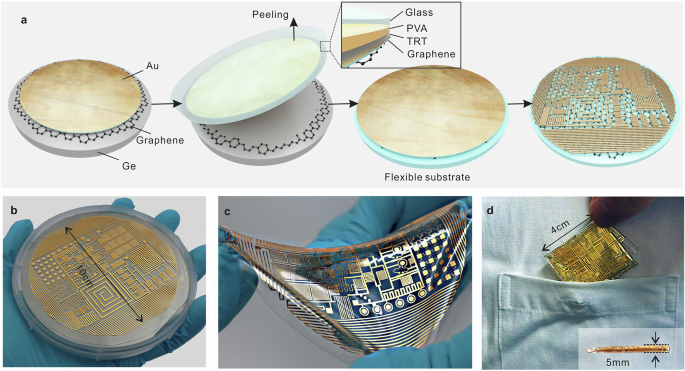
The fabrication of the graphene-Au nanomembrane is illustrated in Fig. 1a. An 80-nm-thick Au layer is deposited on CVD-grown graphene on a 100 mm Ge substrate by electron-beam evaporation. The Raman spectra of graphene in Supplementary Fig. 1 confirm the high crystalline quality of graphene26,27. A semi-rigid-transfer technique is employed to form the crack-free graphene-Au nanomembrane. The process involves peeling the thermal release tape (TRT)-covered graphene-Au nanomembrane with a stiff glass holder and polyvinyl alcohol (PVA) adhesive layer. It also ensures that the Au layer is securely attached to the TRT without delamination. Meanwhile, the Au nanomembrane acts as an adhesive layer, allowing the graphene to be easily delaminated from the Ge substrate21. The uniform peeling force exerted by the stiff glass holder prevents structural damage to either the graphene or the gold layer. Afterwards, the glass/PVA/TRT/Au/graphene stack is printed on the flexible substrate. After releasing the glass/PVA/TRT stack, the Au/graphene nanomembrane remaining on the flexible substrate is patterned by photolithography and wet etching to form the top electrode. The optical images of the 100 mm graphene-Au nanomembrane on Ge substrate, Ge substrate after the transfer process, and transferred Au-graphene nanomembrane on the flexible polyimide (PI) substrate are depicted in Supplementary Fig. 2.

a Fabrication process of the graphene-Au circuit. b Photograph of the 100 mm flexible graphene-Au circuit consisting of RF antennas, square spiral inductors, resistors, and interconnects. c Photograph of the biaxially stretched graphene-Au circuit. d Photograph of the folded 100 mm circuit, which is tiny enough to fit inside a pocket, with the inset showing the side view of the folded graphene-Au circuit.
Figure 1b shows the photograph of the 100 mm flexible graphene-Au circuit comprising RF antennas, spiral inductors, resistors, and interconnects. Although the graphene-Au nanomembrane is as thin as 80 nm, it has exceptional electrical conductivity and supports operation at higher frequencies (to be discussed later). The graphene-Au nanomembrane offers superior flexibility compared to traditional metal circuits, including the capability to stretch and fold. Figure 1c depicts the photograph of a biaxially stretched graphene-Au circuit, showing remarkably free of structural damage or fissures, confirming the exceptional stretchability and resilience of the graphene-Au nanomembrane. To further illustrate the versatility of the material, Fig. 1d shows the circuit in a state of multiple folds. The circuit on the 100 mm wafer is effectively condensed into a diminutive form of 3 × 4 cm2 with a thickness of just 5 mm, that can be conveniently stored in a pocket. The ability to seamlessly transition from an unfolded to a folded state significantly enhances the practical utility of the circuits and renders them well-suited for portable RF electronic applications.
High stretchability of graphene-Au nanomembranes
Figure 2 presents a detailed comparison of the stretchability between Au and graphene-Au nanomembranes, highlighting the impact of incorporating a graphene interlayer. Au nanomembranes tend to propagate cracks linearly when subjected to stretching strains of up to 5%, resulting in the formation of parallel defects that hinder electronic conduction, as shown in Fig. 2a. In contrast, the integration of a graphene interlayer underneath the Au nanomembrane acts as a barrier against crack propagation, effectively preventing the lateral expansion of cracks, as shown in Fig. 2b. To accurately assess the stretchability, experiments are conducted on resistors fabricated with both Au and graphene-Au nanomembranes. The normalized currents at a voltage of 0.1 V are measured under different strains, as shown in Fig. 2c. The insets illustrate the extension of the graphene-Au resistor using a numerically controlled motorized positioning platform. Notably, at a strain of 5%, the resistors constructed from Au nanomembranes exhibit a pronounced decline in the normalized current, indicative of comprehensive crack penetration through the electrodes and significantly reduced conductivity. In contrast, the graphene-Au nanomembrane-based resistors show only slight fluctuations in the normalized current despite strains as high as 14%. This observation suggests a markedly constrained initiation and propagation of cracks in the graphene-Au nanomembranes and underscores the superior mechanical properties and ability to maintain electrical integrity under extensive deformation.

a, b Schematic of the fracture behavior (top panel) and corresponding SEM images (bottom panel) of the Au and graphene-Au nanomembranes, respectively. c Normalized currents versus strain of the graphene-Au (red line) and Au (blue line) nanomembranes with the insets showing photographs of the graphene-Au resistor being stretched by a numerical control motorized positioning platform. d, e SEM images showing the morphology of the Au and graphene-Au nanomembranes under varying degrees of strains, respectively. f Statistical results of the length of cracks versus strain of the graphene-Au (red line) and Au (blue line) nanomembranes. g Statistical results of the density of cracks versus strain of the graphene-Au (red line) and Au (blue line) nanomembranes. h Optical images of LEDs powered by 3 V connected to the graphene-Au electrodes under different strains. The LEDs kept luminous when the strain is extended to 12%. i Optical images of LEDs powered by 3 V connected to the Au electrodes under different strains for comparison, showing that the LEDs extinguished when the strain exceeds 5%. j Optical image of the “SIMIT” logo consisting of 48 LEDs under stretching.
Figure 2d and e illustrate the crack development in the Au and graphene-Au nanomembranes as they are stretched from 2% to 6%. At a strain of just 2%, the Au nanomembranes already exhibit multiple cracks, which tend to widen as the strain increases. In contrast, cracks in the graphene-Au nanomembranes display irregular patterns and deflections, thereby allowing for continued current flow. Supplementary Fig. 3 shows the SEM images on a larger scale. Figure 2f shows the total crack lengths of the Au and graphene-Au nanomembranes, as the strain increases from 0% to 8% (shown by blue and red lines, respectively). This clearly demonstrates that the Au nanomembranes have significantly greater crack lengths than the graphene-Au nanomembranes. Notably, the graphene-Au nanomembranes do not exhibit apparent cracks at strains below 4%. The analysis of the crack density, shown in Fig. 2g, is conducted by optical microscopy in conjunction with the classic OTSU thresholding algorithm (more details can be found in Supplementary Fig. 4 and “Methods”)28,29. It provides quantitative insights into the structural integrity of these materials under mechanical stress. A higher crack density is observed from the Au nanomembranes compared to graphene-Au nanomembranes under identical strain conditions. The excellent stretchability of the graphene-Au nanomembranes renders them suitable for use as flexible electrodes, as demonstrated in Fig. 2h, which shows LEDs connected by graphene-Au electrodes remain luminous even at a strain of 12%. The luminance of LEDs was influenced by the instable connection from silver glue when strain exceeded 6%. In contrast, LEDs connected by Au electrodes cannot be lit at a strain of 5%, as shown in Fig. 2i. The finding is in alignment with the stretching results in Fig. 2c. The “SIMIT” logo, featuring 48 LEDs interconnected by graphene-Au electrodes (Supplementary Fig. 5), remains brightly lit under a 2% strain, as illustrated in Fig. 2j. The intensity of the LED illumination directly correlates with the applied voltage. The high durability and efficiency of the graphene-Au nanomembranes in maintaining electrical connectivity under strain are demonstrated.
High fatigue resistance of graphene-Au nanomembranes
The emergence of crack initiation sites under continuous loading can produce material failure and shorten the lifespan of applications requiring flexibility30. This type of failure is notably more common in metallic materials, where irreversible delamination and stress concentration facilitate the creation of these sites10,31. Figure 3a illustrates the progression of cracks in the Au nanomembranes as the number of repeated loading cycles increases. In the Au nanomembranes, delamination is observed under a 3% load for 5 × 10³ cycles, leading to the emergence of crack nucleation sites (as shown in the middle panel of Fig. 3a) due to stress concentration. These sites are prone to further expansion during subsequent loading and unloading cycles, ultimately resulting in large, gaping cracks that interrupt electron flow (bottom panel of Fig. 3a). On the contrary, the graphene-Au nanomembranes in Fig. 3b display a distinctly different behavior. The absence of chemical bonds and the presence of van der Waals interactions between the graphene and Au layers allow the nanomembranes to slide and rotate relative to each other. This mechanism effectively accommodates the local tensile or compressive stresses without causing delamination. The inherent reversibility of this sliding action significantly mitigates the stress concentration and forestalls the formation of nucleation sites for cracks. Consequently, even though capillary cracks may form, they do not propagate through the nanomembranes, thereby averting catastrophic failures. The surface morphology of the Au and graphene-Au nanomembranes after 10,000 cyclic loads is shown in Supplementary Fig. 6.

a, b Schematic of the fatigue behavior of cracks on Au and graphene-Au nanomembranes and corresponding SEM images, respectively. During repeating stretch and recovery, the surface morphology of the Au nanomembranes is always coarser. c, d Normalized currents of Au and graphene-Au electrodes, respectively, during the fatigue test at a voltage of 0.1 V and 3% strain. e Comparison of the fatigue properties of the graphene-Au (red lines) and Au (blue lines) electrodes under different strains at a voltage of 0.1 V.
The fatigue properties of Au and graphene-Au nanomembranes are evaluated. As shown in Fig. 3c, the normalized current of the Au nanomembranes decreases to 0.4 after 6000 cycles under a 3% stretching strain, indicative of crack development. After about 10,000 cycles, there is a sharp decline in the normalized current to zero representing extensive crack formation that interrupts the flow of current. In contrast, the graphene-Au nanomembranes (Fig. 3d) have a significantly longer fatigue life exceeding 12,500 cycles, in addition to superior cyclic stability with minimal current losses. Different fatigue experiments with different strains were conducted which current of resistors was measured every 800 times of stretching. The comparative analysis of the fatigue life of Au and graphene-Au nanomembranes under different strains is presented in Fig. 3e. As the loading strain increases from 1% to 3%, the fatigue life of the Au nanomembranes diminishes abruptly from 27,000 cycles to 10,000 cycles. In contrast, the graphene-Au nanomembranes display remarkable resilience, showing virtually no reduction in the fatigue life even at a 5% loading strain and stability for 60,000 cycles without notable performance degradation. During the loading and unloading cycles, a minor fluctuation in the current is observed due to the random separation and reconnection of capillary cracks. Nonetheless, this fluctuation is minimal and does not adversely affect the overall functionality of flexible applications. The long fatigue life indicates that the graphene-Au electrodes are very durable and stable, making them excellent for flexible applications requiring long-term durability and stability.
Ultra-thin graphene-Au WiFi antenna
In addition to the stretchability and fatigue durability, the RF characteristics of metallic materials play a critical role in flexible wireless applications as they determine the efficiency of RF electronic devices as well as their ability to transmit signals over long distances. There is, however, a limitation imposed by the intrinsic property known as the skin depth, which refers to the thickness of the material where the electrical current responsible for RF radiation flows effectively15. For example, the skin depth of Au is 1.59 μm for 2.4 GHz Wi-Fi technology32. The thickness required for Au-based antennas is four times larger than the skin depth of Au, as 98% of the current flows through the outer layer16. Therefore, antennas should be thicker than 30 μm17. This limitation hinders ultra-thin and ultra-flexible wireless applications.
It has been shown that 2D materials can enhance the RF properties of ultrathin metal films by alleviating the skin effect15. An optical image of the graphene-Au antenna with a thickness of 80 nm is shown in Fig. 4a. The RF characteristics of this antenna featuring a square spiral configuration are analyzed by the high-frequency simulator software (HFSS), and the results are shown in Supplementary Fig. 7. The working frequency of the graphene-Au antenna is determined by a vector network analyzer (VNA) in the anechoic chamber. The fabrication processes and scattering parameter (S11) of graphene antenna are shown in Supplementary Fig. 8. Figure 4b illustrates the relationship between the working frequency shifts and fatigue life. At approximately 1350 cycles with a strain of 3%, the operating frequency of the 80-nm-thick Au antenna exhibits a considerable shift of 1.8 GHz. This substantial shift in the operating frequency renders the antenna highly susceptible to environmental changes, leading to potential failure in transmitting and receiving electromagnetic waves at that specific frequency33. The changes in inductance and capacitance caused by numerous unrecoverable cracks formed in repeating stretches brought the large shift in resonant frequency. Conversely, the antenna with the graphene-Au nanomembranes has robust stability, with frequency variations confined to a mere 0.3 GHz range. A comparison of the characteristics of the Au and the graphene-Au antennas is shown in Supplementary Fig. 9, demonstrating that the graphene-Au antenna exhibits superior frequency stability under strain and can restore its pristine S11 after the release of a 7% tensile strain.

a Optical image of the square spiral antenna made of graphene-Au nanomembranes under stretching. b Shifts of the resonant frequencies of the antennas made by graphene-Au (red line) and Au (blue line) nanomembranes in the fatigue tests with a strain of 3%. c–e Two-dimensional radiation patterns, S11, and VSWR spectra of graphene-Au (red lines) and Au (blue lines) square spiral antennas, respectively. f Comparison of the S11 values with thickness in different studies. g Wireless video communication platform consisting of the graphene-Au WiFi antenna, camera, and WiFi module. h Clear and precise video output of a mobile phone captured by the camera.
The radiation pattern of the antenna at 8.5 GHz is shown in Fig. 4c. Both the Au and graphene-Au antennas exhibit similar omnidirectional radiation patterns, suggesting that the distribution of RF power radiation is primarily influenced by the physical structure of the antennas. Figure 4d and e compare the S11 and voltage standing wave ratio (VSWR) of the Au nanomembranes and graphene-Au nanomembranes with the same thickness of 80 nm. As expected, the Au antennas show limited effectiveness in manipulating electromagnetic waves (S11 = −10 dB), because the thickness is less than the skin depth of 1.59 μm. Conversely, the graphene-Au antennas with a greater skin depth show improved impedance matching for more effective manipulation of electromagnetic waves, giving rise to a superior S11 value (S11 = −20 dB) compared to Au antennas. As shown in Fig. 4f, the S11 values of the graphene-Au antennas and antennas made of other conductive materials with various thicknesses are plotted, and further details are available in Supplementary Table 1. Among the various conductive material-based antennas, the graphene-Au antenna is the thinnest and meets the commercial standards of wearable RF antenna with an S11 value greater than 10 dB (|S11 | > 10 dB).
A wireless video communication platform (Fig. 4g) consisting of the graphene-Au WiFi antenna, camera, and WiFi module is assembled to evaluate the communication characteristics of the graphene-Au antennas. All the tests are performed in real-time using the binary phase shift key (BPSK) modulation. The graphene-Au antenna can transmit information between a mobile phone and a video transfer module operating at 2.4 GHz. The corresponding S11 spectrum required at this frequency and radiation pattern are shown in Supplementary Fig. 10. Initially, the camera captures the light signal, which is then relayed to the CMOS sensor and converted into electrical signals. The MCU oversees the entire operation to ensure seamless integration between the digital and analog components. The high-frequency processing segment generates a 38.4 MHz signal through a crystal oscillator, which is subsequently upconverted to 2.4 GHz to serve as the carrier for the encoded video data. Figure 4h and Supplementary Movie 1 show a clear and precise video output on a mobile phone captured by the camera successfully.
Portable graphene-Au metasurface cloaks
A lightweight, thin, and portable electromagnetic stealth cloak plays a crucial role in security and military applications34,35. Fig. 5a depicts the schematic diagram of the periodic split-ring array-based graphene-Au metasurface cloak designed to operate at 20 GHz36. The geometric parameters of the split-ring unit cell are shown in the inset. During radar detection, electromagnetic waves emitted by and reflected from targets are absorbed by the metasurface periodic structure. Consequently, the electromagnetic waves detected become too weak for the radar to confirm the target’s presence. The graphene-Au metasurface cloak offers benefits such as lightweight, portability, foldability and superior absorption capabilities, which markedly improve stealth performance in various scenarios. To mitigate potential disruptions from environmental electromagnetic waves, the setup for measuring radiation patterns is established in a microwave anechoic chamber, as illustrated in Fig. 5b. The inset image demonstrates a metal ball covered by the graphene-Au cloak and effective shielding from detecting electromagnetic waves. Two standard horn antennas operating at 20 GHz are used as a transmitter and detector, respectively. An RF signal generator generates the electromagnetic waves, while a spectrum analyzer measures the incident electromagnetic waves on the detector. Figure 5c displays the radiation patterns of the detector antennas under three different conditions: without metasurface cloaks (yellow line), with Au metasurface cloaks (blue line), and with graphene-Au metasurface cloaks (red line). The radiation patterns observed by the metasurface cloaks show a uniform reduction in detection from all directions, indicating the cloak’s effectiveness in diminishing the electromagnetic wave detectability comprehensively37. Moreover, the graphene-Au metasurface cloak demonstrates superior absorption compared to the cloak made solely of Au, due to the stronger anti-parallel currents produced by the incident electromagnetic waves in the graphene-Au structure. Supplementary Fig. 11 shows the various shapes of the metasurface units crafted from the graphene-Au nanomembranes, together with the absorption rates at different frequencies. Each shape showcases improved absorption to highlight the large potential of the graphene-Au metasurface cloak in a variety of portable electromagnetic stealth applications38.

a Schematic of the graphene-Au nanomembranes used in the metasurface cloak. b Evaluation arrangement with the inset showing a metal ball covered by the metasurface cloak. c 2D radiation patterns of the antennas under three different conditions: without metasurface cloaks (yellow line), with Au metasurface cloaks (blue line), and with graphene-Au metasurface cloaks (red line).
link


More Stories
Researchers Reveal Molecular Secrets of Flexible Electronics
Growth Outweighs Uncertainty for Flexible and Printed Electronics: OE-A Survey
SEMI FlexTech Announces 2026 FLEXI Award Winners