
Concepts and design principle
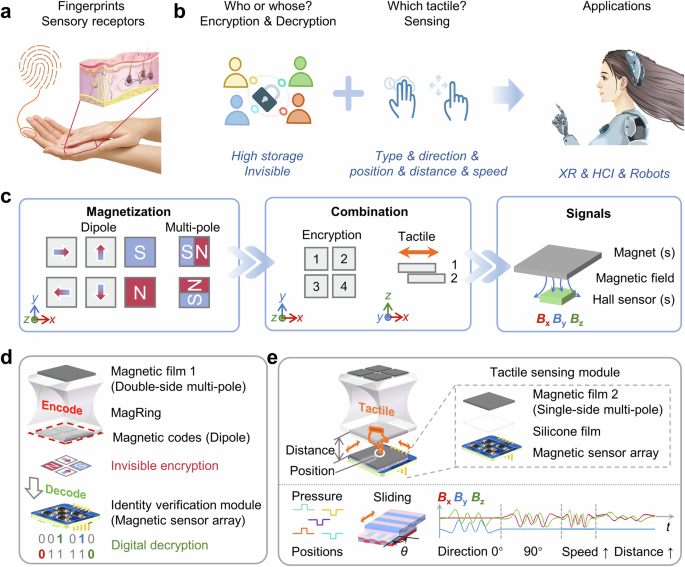
Our method utilizes magnetization structures and combinations to generate magnetic field signals detected by three-axis Hall sensors (Fig. 1c). Based on the number of magnetic pole pairs, we differentiate between dipole and multipolar magnetization. Dipole magnetization generates six distinct modes along the three axial directions, with the surface magnetic field being most pronounced along the magnetization axis. Using this property, we combine these six basic magnetic codes to create an encrypted array, which enhances the security of the information by remaining invisible. Moreover, adjusting the magnetic film combinations makes a programmable encryption array achievable. Each encryption unit’s magnetic field components are read by the Hall sensor array and converted into digital codes. Multipolar magnetization features staggered and periodically arranged magnetic poles, resulting in periodic magnetic field distribution. This characteristic is commonly utilized in magnetic encoders for position and speed detection. By strategically placing Hall sensors under opposing magnetic poles, we effectively decouple pressure at various locations. Additionally, stacking two multipolar magnetized films along the thickness direction forms a coupled magnetic field. The superimposed magnetic signal depends on the number of magnetic poles, distance, relative motion, and speed between the two films.
Building on these principles, we integrate both functionalities into a wearable magnetic ring (MagRing) and design corresponding signal modules for demonstration. The MagRing features a 2 × 2 dipole magnetic code array and a multipolar magnetic film. The identity verification module is a PCB with Hall sensor chips (MLX90393) that decrypts the magnetic code information into digital codes (Fig. 1d). Meanwhile, the tactile sensing module consists of a striped multipolar magnetic film, a silicone rubber layer and a PCB (Fig. 1e). It detects pressure at different positions and tracks the relative movement of the MagRing. The design of the magnetization structure allows us to integrate both functions into a single, wearable, and standalone MagRing, with modules that can be flexibly held or assembled.
Magnetization modes and signals
The magnetic field is a vector field defined by both direction and magnitude. The static magnetic field depends on the structure and magnetization profile of the magnetic material33,34,35. We propose generating magnetic field signals by controlling the magnetization direction and the number of magnetic pole pairs in flexible NdFeB films. The spatial magnetic field distributions differ for axial dipole (Fig. 2a), radial dipole (Fig. 2b), and axial multipolar (Fig. 2c) magnetization.

a Magnetic field of an axial dipole magnet. b Magnetic field of a radial dipole magnet. c Magnetic field of a multipole magnet. d Relationship between magnetic field and thickness at the center of the axial magnet. e Relationship between magnetic field and thickness at the center of the radial magnet. f Magnetic field distribution along a cutline of a multipole magnet. g Categories of magnetization modes. h Method for measuring magnetic field signals. i Magnetic field signal data.
The dipole magnet has one pair of magnetic poles. For axial magnetization, the poles are aligned along the thickness of the magnetic film, whereas for radial magnetization, they are perpendicular to it. The magnetic field at the center of the surface reaches its maximum magnitude along the magnetization direction (Supplementary Text, Formulas (1)–(6))36. COMSOL Multiphysics simulates the relationship between the magnetic field and thickness at the center of the axial (Fig. 2d) and radial magnetization (Fig. 2e), with the magnetic film dimensions set at 20 mm in length and width. The simulations yield the following conclusions: (1) At the center above the magnetic film, the magnetic field component along the magnetization direction is the strongest, while the components in the other two directions are zero. (2) The strongest magnetic field component positively correlates with the film thickness; thicker films generate stronger magnetic fields. (3) The surface magnetic field’s magnitude is the same for opposite magnetization directions along the same axis. (4) For z-axis magnetization, the strongest magnetic field component is aligned with the magnetization direction. Still, for radial magnetization, the strongest surface magnetic field component is opposite to the magnetization direction.
The axial multipole magnet contains more than one pair of magnetic poles, creating a staggered magnetic field alternating North and South poles along the x-axis or y-axis. We develop a simulation model of a 10-pole magnetic film and draw a cutline above the surface. The magnetic field components along this cutline show periodic curves in the direction of the pole arrangement (Fig. 2f). The Bx curve is axially symmetric, and the Bz curve is centrally symmetric. Theoretical models and formulas are provided in the supplementary material (Supplementary Text, Formulas (7)–(9))36.
We categorize the magnetization modes into four groups (Fig. 2g): z-axis axial magnetization (mode 1: B+z; mode 2: B-z), x-axis radial magnetization (mode 3: B+x; mode 4: B-x), y-axis radial magnetization (mode 5: B+y; mode 6: B-y), and axial multipole magnetization (mode 7: Bmp//x; mode 8: Bmp//y). The magnetic film measures 2 cm × 2 cm × 1 mm in the experiment. The Hall sensor detects the magnetic field components (Bx, By, Bz) for these eight magnetization modes (Fig. 2h) and presents the signals (Fig. 2i). Groups 1, 2, and 3 each contain a pair of opposite signals. Group 4 ensures one horizontal direction signal is zero (Bx or By = 0), with assembly accuracy affecting the other two signals. Dipole magnets produce the strongest field in a specific direction, making them suitable for encoding tactile information. The periodic and directional magnetic fields of multiple poles enable tactile recognition.
Magnetic encryption and decryption
The magnetic encryption and decryption method is illustrated in Fig. 3a. Three groups of dipole magnetic films serve as the basic codes, which are assembled into a programmable magnetic code array. The magnetic poles within the flexible magnetic film are invisible, enhancing information security. The storage density is defined as 6n × n, where the array size is n × n. Decryption is based on the magnitude and direction of the magnetic field, as outlined in Table 1. The components Bx, By, and Bz are converted into three-digit binary numbers, with the component exhibiting the highest absolute value designated as the judgment bit. Positive values yield a judgment bit of 1, while negative values yield 0. The other two digits are the complements of the judgment bit. Simulation results confirm that the magnetic field coupling between adjacent magnetic films does not affect the decryption rule (Supplementary Figs. 1–4). The magnetic film array is aligned with the Hall sensor array to decrypt the magnetic codes to digital ones.

a Magnetic encryption and decryption principle and process. b Simulation model of magnetic encoding combination. c Magnetic field component trend at cutline 1. d Magnetic field component trend at cutline 2. e Magnetic field measurements. f Correspondence between magnetic films and Hall sensors. g Magnetic field signal and encryption results.
A 2 × 2 array is an example of simulation and experiment verification. One of the simulation models is shown in Fig. 3b. Each magnetic film measures 9 × 9 × 1 mm, with a distance of 2 mm between films. The magnetic fields above the magnetic film array at the two auxiliary lines, cutline one and cutline two are shown in Fig. 3c, d. The array combination does not affect each basic magnetic code’s maximum absolute value and direction. In the experiments, the array magnetic films are placed in array-shaped grooves, and the distribution of Bz is measured (Fig. 3e). The array magnetic film is aligned with 2 × 2 Hall sensors. After the coordinate system transformation (Fig. 3f), the strongest values detected in order are −By, +Bz, +Bx, and −Bz (Fig. 3g). They are converted to codes: [101, 001, 100, 110]. The corresponding decimal code is 5146.
Magnetic tactile perception
The staggered magnetic pole configuration in the multipolar magnetic film facilitates tactile perception. The tactile sensing module has three layers: a single-sided multipole magnetic film, a silicone film, and a circuit board with Hall sensors. The dimensions and fit are shown in Fig. 4a. The magnetic film measures 20 × 20 × 1 mm, with a 2 mm pole pitch and ten magnetic poles. Hall sensors 1 and 2 are positioned beneath the South Pole, sensors 4 and 5 beneath the North Pole, and sensor 3 between the two magnetic poles. By optimizing the magnetic pole structure and aligning it with the Hall sensors, we minimize algorithm dependence and achieve pressure decoupling at five locations (Fig. 4b). Pressing areas 1, 2, 4, and 5 increases the absolute value of Bz, and pressing area 3 enhances the absolute values of By and Bz. The five three-axis Hall sensors produce 15 signal curves, with six curves (Bz1, Bz2, Bz4, Bz5, By3, and Bz3) effectively decoupling pressures at five locations. The value of Bx3 is close to zero, serving as an indicator of assembly accuracy. The three-axis test system evaluates the performance of the tactile sensing module (Supplementary Fig. 5, Supplementary Movie 1), showing a response time of 0.31 s, a relaxation time of 0.31 s (Fig. 4c), a minimum resolution of 0.2 N (Fig. 4d), and 1000 repeatability tests (Fig. 4e).

a Tactile sensing module composition and dimension. b Decoupling of pressing positions. c Response and recovery times. d Micro pressure detection. e Repeatability. f Superimposition of two magnetic films for decoupled sliding. g The signal of 90° sliding. h The signal of 0° sliding. i 90° sliding with different distances. j 0° sliding with different distances.
The sliding state is determined by detecting changes in the superimposed magnetic field of two magnetic films (Fig. 4f, Supplementary Movie 2). The double-sided magnetic film can be assembled with any object, allowing the tactile sensing module to detect its movement state. The contact between the double-sided magnetized film and the non-magnetized side of the single-sided magnetized film prevents excessive magnetic force from hindering smooth contact sliding. When the magnetic poles of the two films are oriented at 90°, this is referred to as perpendicular sliding; when they are aligned at 0°, it is termed parallel sliding. During perpendicular sliding, the periodic magnetic field of the double-sided magnetic film along the x-axis and z-axis combines with the initial magnetic field component of the single-sided magnetic film to produce a periodic signal, while the y-axis signal shows no significant fluctuations (Fig. 4g). In contrast, during parallel sliding, the periodic magnetic field of the double-sided magnetic film along the y-axis and z-axis combines with the initial magnetic field of the single-sided magnetic film, resulting in a periodic signal with no notable fluctuations in the x-axis signal (Fig. 4h). This magnetic field coupling method can also be extended to non-contact sliding detection, surpassing the sensory capabilities of human skin. The signals for perpendicular and parallel sliding at various distances are presented in Fig. 4i and Fig. 4j, respectively, showing that the absolute value of signal fluctuations increases as the distance decreases. In addition, the period decreases when the sliding speed increases from 5 mm/s to 25 mm/s (Supplementary Fig. 6).
Demonstrations
The flexible encrypted magnetic pole array and multipolar magnetic film are integrated into a ring for demonstration. This double-sided magnetic ring and its corresponding module are used for identity recognition and interactive perception. The user aligns the encryption surface with the identity verification module, and the array of Hall sensors detects the magnetic field signals (Fig. 5a). The computer interface unlocks once the identity is successfully matched (Supplementary Movie 3). The second encryption magnetic code and decryption is [011, 001, 100, 001] (Supplementary Fig. 7). The invisible array encryption system verifies unique identity information, ensuring secure interactions.

a Identity encryption and tactile information recognition. b Demonstration of force decoupling in controlling a virtual drone. c Demonstration of force and slide decoupling. d Pressure signals. e 0° sliding signals. f 90° sliding signals.
The tactile sensing module decouples the pressure at five distinct positions. This functionality is demonstrated through virtual drone interaction (Fig. 5b, Supplementary Movie 4). The corresponding magnetic field component changes are identified upon pressing, enabling control over the virtual drone’s movements. The drone can perform actions in two distinct modes, comprising eight maneuvers. In the first mode, pressing area 1 moves the drone forward, area 5 moves it backward, area 2 turns it left, and area 4 turns it right. Pressing area 3 toggles between the two modes. In the second mode, pressing area 1 makes the drone ascend, area 5 makes it descend, area 2 executes a fast left turn, and area 4 performs a fast right turn.
The tactile sensing module is capable of detecting the relative sliding of the multipolar magnetic film surface on the ring. Additionally, since the magnetic fields between the two magnetic films can couple without physical contact, the tactile sensing module is suitable for embedding within objects. This feature is demonstrated in a virtual reality pet game, where the module is placed beneath the fabric of a rabbit toy (Fig. 5c). When pressure signals (Fig. 5d), 0° sliding (Fig. 5e), and 90° sliding (Fig. 5f) are detected, the virtual pet responds accordingly. Pressure and sliding signals are decoupled. Pressing causes the pet to jump, 0° sliding increases its emotional value, and 90° sliding makes the pet sit down and rest (Supplementary Movie 5). This system shows great potential for applications in humanoid and care robots.
link



More Stories
Researchers Reveal Molecular Secrets of Flexible Electronics
Growth Outweighs Uncertainty for Flexible and Printed Electronics: OE-A Survey
SEMI FlexTech Announces 2026 FLEXI Award Winners